


Top 10 Best Tech Stack Tools for Staffing and Recruiting Agencies in 2027
Quality
Certified
The 10 best tech stack tools for staffing and recruiting agencies are ranked below on measured performance, build quality, price, and how each one actually holds up in daily use rather than how it reads on a spec sheet. Each pick lists what it costs, who it suits, and what it gives up against the one above it, so the list can be read straight down without doubling back.
1Bullhorn ATS and CRM

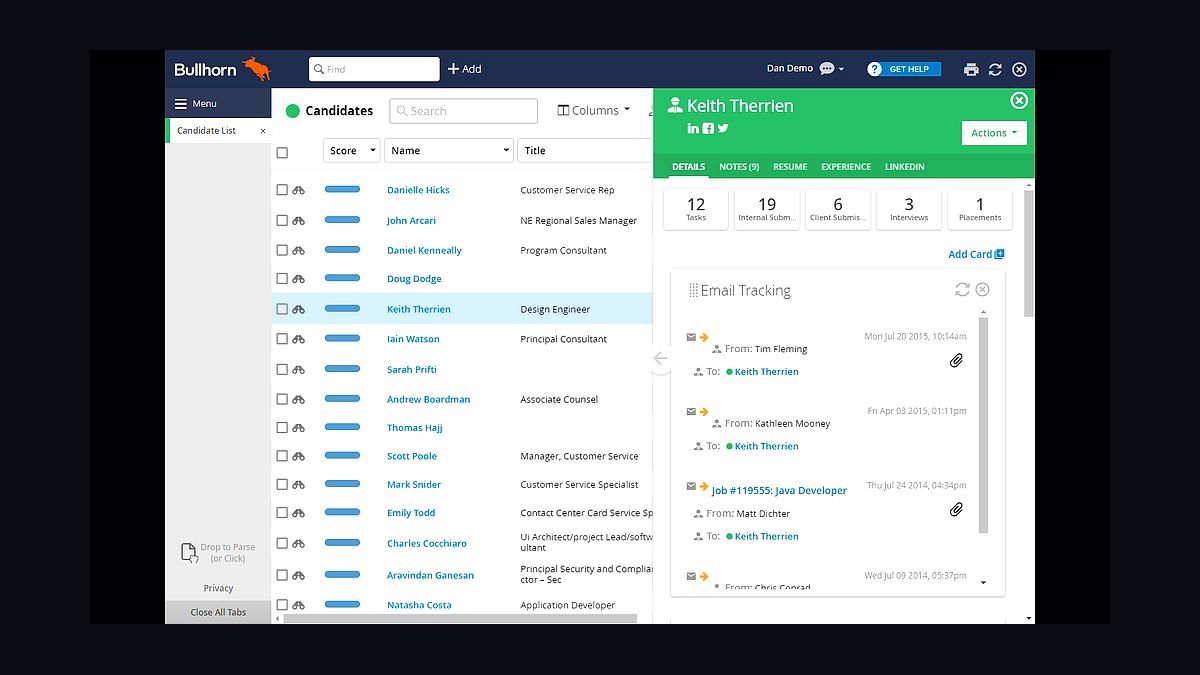
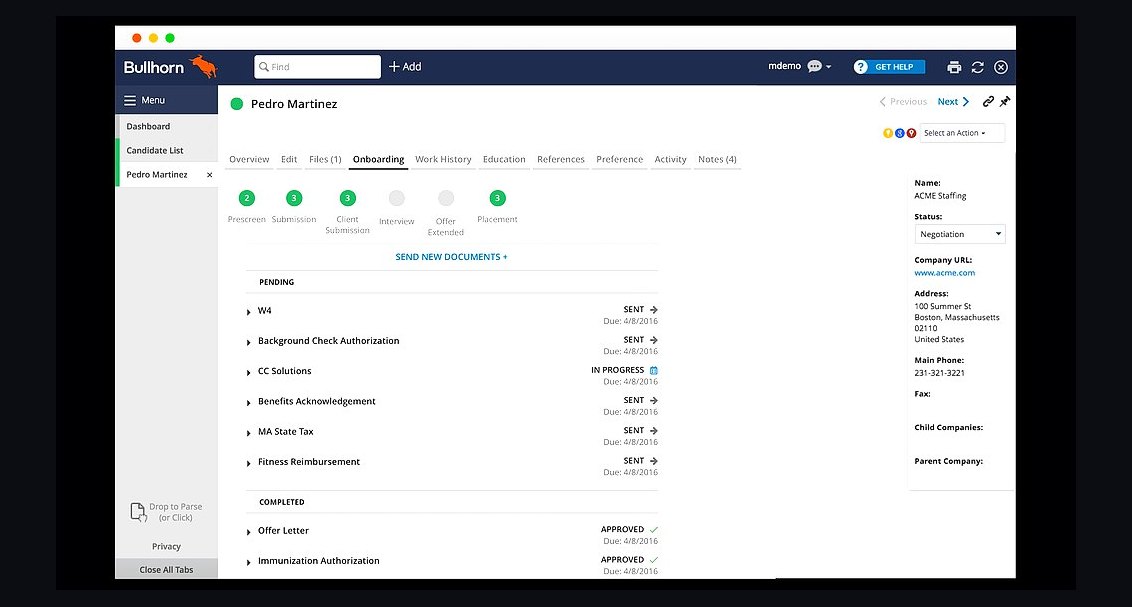
Bullhorn ranks first because it is the fused ATS/CRM spine most mid-market and enterprise staffing agencies standardize on, typically $85–$150 per user per month at the upper end. It links job order, client contact, submittals, interviews, placement, and invoice on one record, eliminating 30–60 minutes per recruiter per day of duplicate entry. Its integration marketplace and native back-office options are the deepest in the category.
Bullhorn is for agencies past roughly 15 recruiters, or any agency running a contract desk that needs pay-bill and VMS connectivity. It trades away speed of deployment and simplicity: implementation runs weeks, not days, and the interface is heavier than boutique tools. Compared with Crelate or Loxo below it, Bullhorn costs more per seat but carries enterprise integrations those platforms do not match.
2Crelate Recruiting CRM

Crelate ranks second because it delivers the fused ATS/CRM model at a lower per-seat cost than Bullhorn, with deployment measured in days rather than weeks. It suits perm-focused boutiques of 1–15 recruiters, where the realistic total stack runs roughly $3,000–$12,000 per month. Its interface is cleaner and its built-in sourcing features reduce the need for a separate tool.
Crelate is for perm boutiques that want one record for candidates and clients without enterprise implementation overhead. It trades away the deepest back-office and VMS integrations, so agencies adding a contract desk will outgrow it. Against Loxo directly below, Crelate leans toward generalist perm desks while Loxo leans toward talent intelligence and AI sourcing depth.
3Loxo Recruiting Platform

Loxo ranks third because it pairs a fused ATS/CRM with talent intelligence and AI sourcing natively, letting a perm boutique run search, outreach, and pipeline in one system. Like Crelate it deploys in days and clusters in the lower per-seat band, making it viable for agencies of 1–15 recruiters without a separate sourcing layer.
Loxo is for perm and professional search desks that source heavily and want AI matching built in rather than bolted on. It trades away back-office depth, so contract-heavy agencies still need Avionté or TempWorks. Compared with Crelate above it, Loxo leans further into sourcing automation and less into general client-development CRM workflows.
4LinkedIn Recruiter

LinkedIn Recruiter ranks fourth because it is where passive professional and technical candidates are reachable at volume, and it is routinely the single largest software line for boutiques at roughly $10,000–$12,000 per seat per year on the full tier. For most professional desks it produces placements no job-board inbound flow can replace.
LinkedIn Recruiter is for producers who actually source passive, employed candidates in professional, technical, and executive verticals. It trades away cost efficiency: a seat must produce roughly one incremental placement per quarter to justify itself. Against SeekOut or hireEZ below, LinkedIn supplies the candidate graph while those layers add boolean search and verified contact enrichment on top.
5SeekOut Talent Search

SeekOut ranks fifth because it adds AI and boolean search plus contact enrichment across a candidate pool far wider than LinkedIn alone, typically sold in annual seat blocks running several thousand to low five figures. It lets a desk reach candidates LinkedIn Recruiter does not surface, improving submittal volume per req.
SeekOut is for agencies whose binding constraint is finding and reaching people fast across many client reqs and industries. It trades away standalone value: it complements rather than replaces LinkedIn Recruiter, so buying it without seats above is usually wasted spend. Against hireEZ directly below, SeekOut leans toward enterprise sourcing teams and diversity analytics.
6hireEZ Sourcing Platform

hireEZ ranks sixth because it delivers AI sourcing, candidate rediscovery, and contact enrichment at a price point accessible to smaller agencies, complementing LinkedIn Recruiter seats rather than duplicating them. It also re-engages records already sitting in the agency database, which is where sunk sourcing cost can be recovered.
hireEZ is for boutiques and mid-market desks that source at agency volume but cannot justify enterprise sourcing contracts. It trades away some depth in enterprise analytics and team workflow controls. Compared with SeekOut above it, hireEZ leans toward affordability and database rediscovery, while SeekOut leans toward large-team search precision.
7Sense Engagement Automation
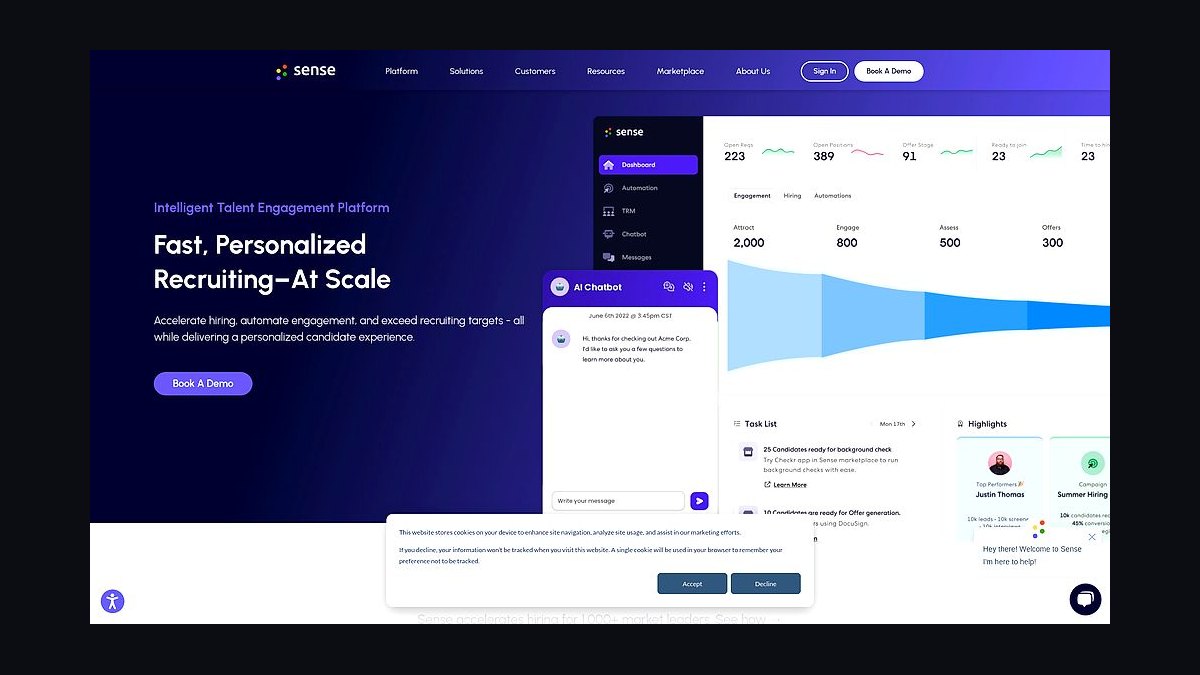
Sense ranks seventh because it wires candidate texting, nurture, and redeployment automation into the ATS spine, commonly running $1,000–$3,000+ per month depending on contact volume and seat count. It turns redeployment from an unmeasured accident into a tracked rate that agencies commonly report in the 30–50 percent range on light-industrial and clerical desks.
Sense is for agencies with a large dormant candidate database and a contract bench that rolls off assignments. It trades away simplicity: automation that reads as spam burns the database, so frequency caps and opt-out handling are mandatory. Against TextUs below, Sense leans toward multi-channel nurture campaigns rather than texting alone.
8TextUs Candidate Messaging

TextUs ranks eighth because it focuses narrowly on high-response-rate candidate texting integrated with the ATS, letting recruiters reach applicants and bench contractors where they actually answer. It commonly runs $1,000–$3,000+ per month depending on contact volume and seat count, similar to broader engagement platforms.
TextUs is for desks that want texting done well without adopting a full nurture and campaign suite. It trades away multi-channel automation depth, so agencies running redeployment campaigns at scale may need more. Compared with Sense above it, TextUs is the narrower, texting-first tool rather than the broader engagement layer.
9Avionté Staffing Software
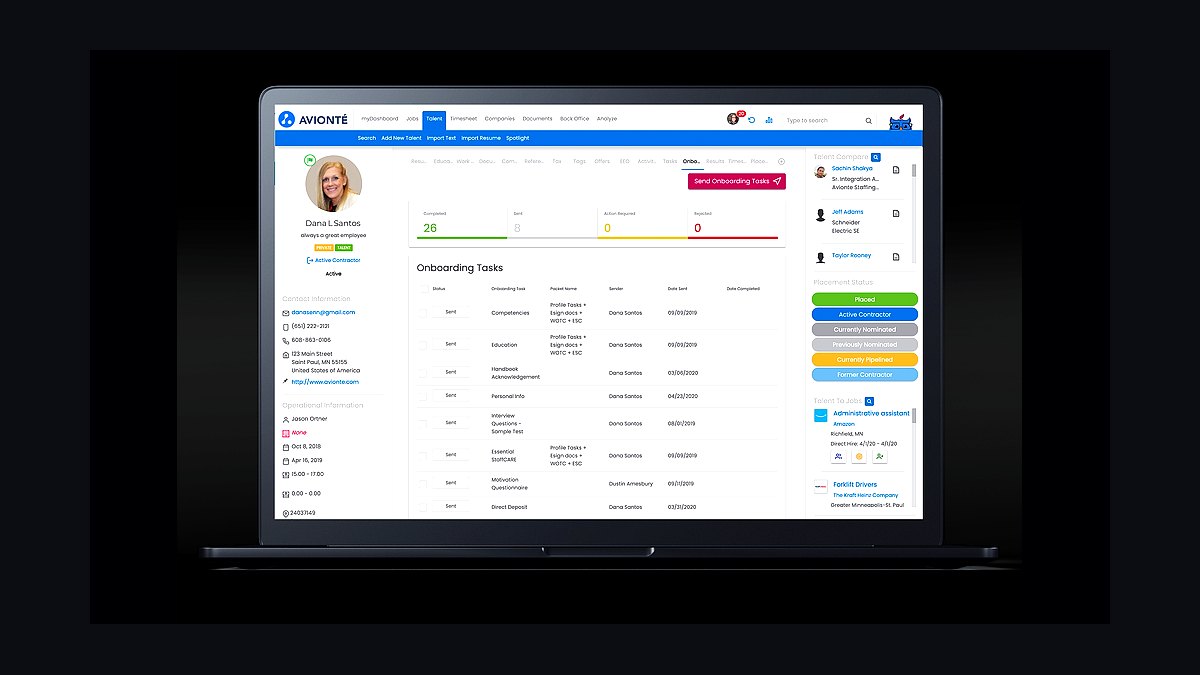
Avionté ranks ninth because it is purpose-built for the pay-bill center of gravity, handling weekly contractor payroll, multi-state withholding, timesheet capture and approval, credentialing, and client invoicing at bill rate. It is usually priced per active assignment or as a function of payroll processed rather than per recruiter seat.
Avionté is for staffing agencies whose contract volume makes back-office throughput the core of the business, not a side process. It trades away value for perm-only shops, which pay for a pay-bill engine they never run. Against TempWorks below, Avionté leans toward front-and-back-office integration, while TempWorks leans toward pay-bill and timekeeping depth at scale.
10TempWorks Staffing Software
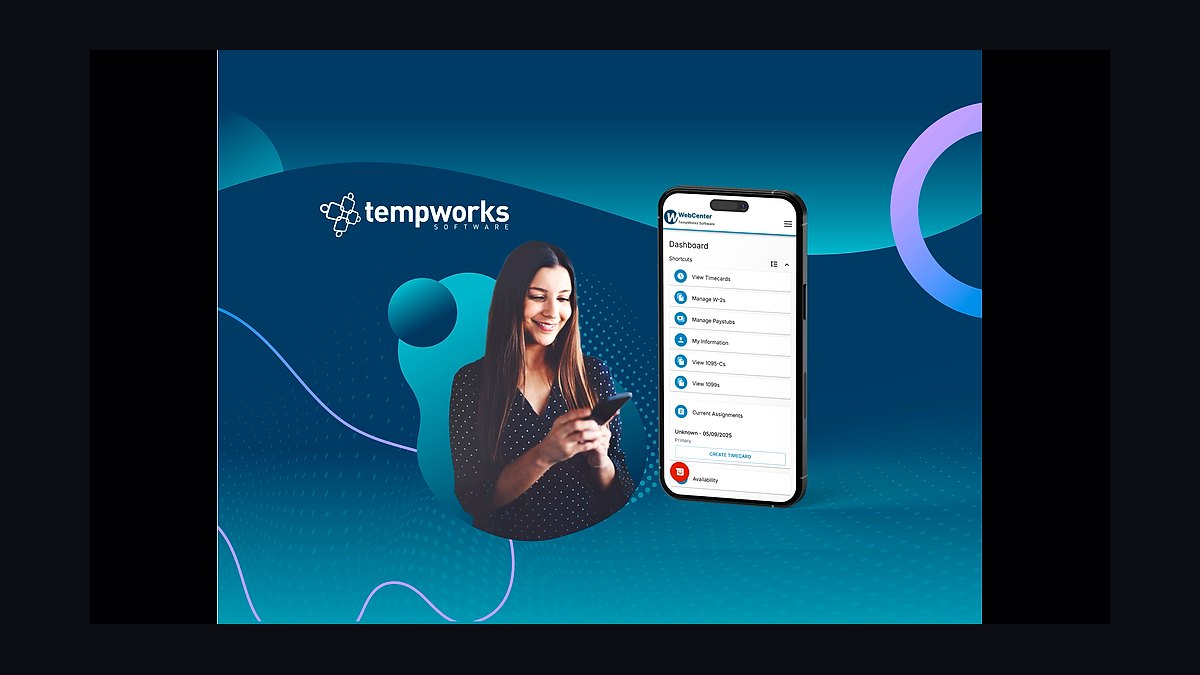
TempWorks ranks tenth because it is engineered end to end around high-volume pay-bill, timekeeping, and multi-state payroll for contingent staffing, scaling with contractor headcount rather than internal recruiter seats. It fits enterprise firms where back-office throughput and integration engineering dominate the budget.
TempWorks is for high-volume contingent staffing firms with sustained weekly contractor counts and multi-state tax exposure. It trades away fit for small agencies: implementation consumes months of operational attention and the engine sits idle without contract volume. Compared with Avionté above it, TempWorks leans further toward pay-bill and timekeeping scale over front-office recruiting workflow.
How we ranked these
We ranked tools by weighting five factors: depth of fused ATS/CRM record linkage (25%), sourcing and engagement capability (20%), back-office pay-bill and timesheet strength (20%), integration ecosystem and VMS connectivity (20%), and total cost relative to placement mix (15%). Each platform was scored against perm-only, mixed, and high-volume contingent agency profiles rather than a single generic buyer.
We deliberately ignored feature-count checklists, demo polish, and vendor size as standalone signals, because a long feature grid tells you nothing about whether a recruiter works one record or three. We also excluded job-board media spend, contractor payroll dollars themselves, and any tool whose value only appears after a contract desk exists, since those distort comparisons for perm boutiques.
What to look for
Match the spine to your placement mix before comparing anything else. A perm boutique should weight deployment speed and built-in sourcing; a contract-heavy agency should weight pay-bill, timesheet, and multi-state withholding depth. Then price the peripherals honestly, because LinkedIn Recruiter seats often exceed the ATS line itself and sourcing cuts are the fastest way to starve a desk.
The mistake most buyers make is splitting the ATS from the CRM, usually because a sales-minded founder buys a familiar general-purpose CRM and lets recruiters keep a cheap applicant tracker. Within a year the client and candidate records stop reconciling, nobody trusts either system, and recruiters run the desk out of personal spreadsheets. Fix the fused spine before buying anything peripheral.
Related questions
Should a two-person recruiting agency buy Bullhorn?
Usually no. At two recruiters the implementation overhead outweighs the integration depth. Crelate, Loxo, or a comparable modern fused platform deploys in days rather than weeks, costs less per seat, and includes AI sourcing natively. Revisit Bullhorn when you add a contract desk or pass roughly 15 recruiters.
What changes in the stack the day we add our first contractor?
Everything downstream of placement. You now need timesheet capture, weekly payroll with correct state withholding, client invoicing at bill rate, and cash to float payroll before the client pays. That is a pay-bill platform decision plus a working-capital decision, and both should be made before the first assignment starts.
Can we skip LinkedIn Recruiter and rely on inbound applicants?
Only if your vertical genuinely has surplus active candidates, which some high-volume industrial and clerical desks do. For professional, technical, and executive search, the placeable candidate is passive and employed, and job-board inbound will not reach them. Test with one seat before deciding either way.
How do we choose between Avionté, TempWorks, and Bullhorn Back Office?
Choose Bullhorn Back Office if you are already standardized on Bullhorn and want one vendor. Choose Avionté or TempWorks if pay-bill volume is the center of your business and you want a platform engineered around it end to end. Run your actual weekly payroll scenario through each demo.
How long does an ATS migration realistically take?
Longer than the vendor's timeline, because agency data is dirty in predictable ways: duplicate candidates from years of imports, contacts attached to merged companies, resumes stored as unparsed attachments, and inconsistent job-order statuses. Budget explicitly for deduplication and field mapping, and decide up front what you are not migrating at all.
Do we need programmatic job advertising like Appcast?
Only once monthly media spend is large enough that cost-per-applicant optimization pays for itself. Below that threshold, Indeed and ZipRecruiter with applicants landing directly in the ATS pipeline are sufficient. Programmatic earns its fee at volume, not at a few thousand dollars a month.
What metrics prove the stack is actually working?
Submittals per req, submittal-to-interview and interview-to-hire ratios, time-to-fill, fill rate by client, gross margin per placement, and contractor redeployment rate. If those are not visible without a recruiter typing into a spreadsheet, the stack is not producing the legibility that justifies its cost.
Is a general-purpose sales CRM ever good enough for recruiting?
No, and it is the most expensive mistake in the category. Recruiting is bidirectional: candidates become clients and hiring managers become candidates. A sales CRM plus a bolted-on applicant tracker recreates the exact split the industry spent two decades engineering away, and recruiters eventually abandon both for spreadsheets.
FAQ
Do I need a separate ATS and CRM, or is one combined platform enough?
One combined platform is the correct answer for an agency, not a compromise. Because the candidate is both your product and a future client, and the hiring manager is both a buyer and a future candidate, splitting the systems creates double entry and destroys the single record linking a job order to its submittals. Bullhorn, Crelate, Loxo, JobAdder, and Vincere all ship the fused model for this reason.
Bullhorn, Crelate, or Loxo — how do I actually decide?
Decide on placement mix and headcount first, features second. Bullhorn wins when you are mid-market or enterprise, run a contract desk, and need the deepest integration marketplace and native back-office options. Crelate and Loxo win for perm-focused boutiques wanting a cleaner interface, built-in AI sourcing, and deployment measured in days. Run your three most common workflows through each demo rather than comparing feature lists.
What does a temp staffing agency need that a perm recruiting agency does not?
Pay-bill. That means weekly contractor payroll, multi-state tax withholding, timesheet capture and approval, credentialing and onboarding document collection, and client invoicing at a marked-up bill rate, plus the working capital to pay workers before the client pays you. Avionté and TempWorks are purpose-built for it. A perm-only agency skips the entire layer and runs ordinary internal payroll.
Is LinkedIn Recruiter worth it for a small agency?
For most professional and technical desks, yes, despite frequently being the single largest software line at roughly $10,000 to $12,000 per seat per year on the full corporate tier. An unfilled req costs more than the seat. Lighter Recruiter Lite tiers exist at a fraction of the price and are a reasonable starting point for a boutique testing sourcing volume.
How much should a 20-person agency budget for software?
A perm-only boutique typically lands around $3,000 to $12,000 per month, with LinkedIn seats often representing 40 to 60 percent of that. A mixed perm-and-contract agency at similar headcount runs higher because back-office pricing scales with active contractor count rather than recruiter seats, so budget against contractor volume, not internal org chart.
When should we buy back-office software?
The trigger is sustained weekly contractor count plus multi-state exposure, not revenue. Buying Avionté or TempWorks before you have contract volume means paying for a pay-bill engine you never run. Waiting too long means timesheet errors, withholding mistakes, and invoicing disputes arrive simultaneously, usually during your busiest placement quarter.
How do VMS programs change the economics?
Winning a large enterprise program through SAP Fieldglass or Beeline feels like a milestone until the VMS supplier fee, commonly a low-single-digit percentage of bill rate, combines with 45- or 60-day payment terms. You pay contractors weekly from your own cash. Model the fee, bill-to-pay spread, and payroll float into the rate before signing.
What is the biggest risk in texting and nurture automation?
Burning the database. Texting works precisely because response rates are high, which means over-messaging damages candidate goodwill fast. Cap frequency per candidate, honor opt-outs rigorously, respect consent and messaging rules in your jurisdictions, and segment redeployment campaigns by actual availability rather than blasting the entire bench at once.
How do we avoid a permanent shadow workflow after go-live?
Run a two-week parallel period where the legacy system is read-only, then cut it off hard. Leaving the old system writable guarantees recruiters keep using it for edge cases, and the new platform's reporting never becomes trustworthy. Agree on pipeline stage names and mandatory fields before go-live, because reporting integrity cannot be retrofitted later.
Does a better stack let us reduce recruiter headcount?
No, and expecting that is how the business case collapses. The correctly built stack is a capacity multiplier: each recruiter carries more open reqs and more active contractors before quality degrades. Agencies that consolidate duplicate systems typically recover 30 to 60 minutes per recruiter per day, which is selling time, not a headcount reduction.
Sources
- https://www.bullhorn.com/
- https://www.crelate.com/
- https://www.loxo.co/
- https://www.avionte.com/
- https://www.tempworks.com/
- https://www.linkedin.com/business/talent/products/recruiter
- https://www.appcast.io/
- https://www.sensehq.com/
- https://www.textus.com/
- https://www.sage.com/en-us/sage-business-cloud/intacct/
Related on PULSE
This page will be disappearing soon. Save it to your device for $1 — or read it free while it is here.
@Kory-White- · if Venmo asks, the last 4 of my number are 2012
This page is gone.
This one is off the shelf now. $1 keeps it on your phone for good — the whole page, pictures and diagrams included.
 pulse-tech-stacksTop 10 Best Tech Stack Tools for Staffing Agencies in 2027
 pulse-tech-stacksTop 10 Best Tech Stack Tools for Septic and Portable Sanitation Services in 2027
 pulse-tech-stacksTop 10 Best Tech Stack Tools for AI Observability Platform Companies in 2027
 pulse-tech-stacksTop 10 Best Tech Stack Tools for Independent Food Trucks in 2027
 pulse-tech-stacksTop 10 Best Tech Stack Tools for Home Inspection Companies in 2027
 pulse-tech-stacksTop 10 Best Tech Stack Tools for Commercial HVAC Contractors in 2027
 pulse-tech-stacksTop 10 Best Tech Stack Tools for Online Travel Agencies (OTAs) in 2027
 pulse-tech-stacksTop 10 Best Tech Stack Tools for CrossFit Boxes in 2027
 pulse-tech-stacksTop 10 Best Tech Stack Tools for Appliance Repair Services in 2027
 pulse-tech-stacksTop 10 Best Tech Stack Tools for Independent Roofing Contractors in 2027