


Top 10 Best Tech Stack Tools for Janitorial and Sanitation Supply Distributors in 2027
Quality
Certified
The 10 best tech stack tools for janitorial and sanitation supply distributors are ranked below on measured performance, build quality, price, and how each one actually holds up in daily use rather than how it reads on a spec sheet. Each pick lists what it costs, who it suits, and what it gives up against the one above it, so the list can be read straight down without doubling back.
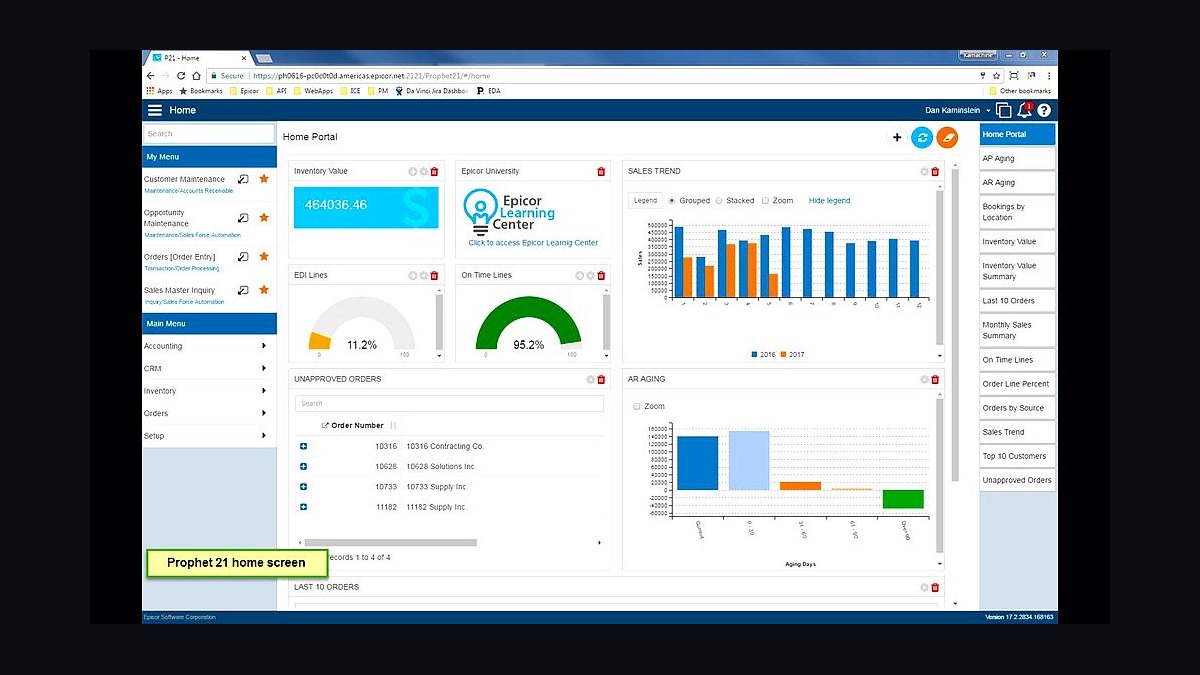
1Epicor Prophet 21

Prophet 21 ranks first because it is the only ERP in this list built for multi-branch distribution at scale, handling contract pricing per ship-to and cost layers natively. It supports the six-job-site BSC order scenario without custom code, and its distribution depth covers case packs, rebates, and route fulfillment out of the box. Implementation-to-license ratios commonly run one-to-one or two-to-one, so budget accordingly.
It is for regional distributors running two to five branches with real EDI relationships and buying-group feeds. It trades away the modern UI and extensibility of cloud-native platforms, and it costs materially more than mid-market alternatives. Compared to DDI System Inform directly below, Prophet 21 handles more branches and deeper warehouse logic but demands more implementation investment and internal IT capability.
2DDI System Inform

DDI System Inform ranks second for mid-market janitorial and sanitation houses doing roughly $30M annually, where it delivers distribution-specific ERP depth at a lower total cost than enterprise-tier alternatives. It models case packs, cost layers, contract pricing, and buying-group cost imports natively, which directly addresses the stale-cost margin leak that costs single-digit-margin distributors real money. Core modules typically land in the low thousands monthly.
It is for single-warehouse and small multi-branch operators that need real distribution logic without enterprise overhead. It trades away the multi-branch sophistication and third-party integration ecosystem of Prophet 21 above it, and it scales less gracefully past five branches. Compared to NetSuite below, Inform is more vertical-specific but less extensible and less connected to the broader software world.
3NetSuite ERP

NetSuite ranks third as the strongest horizontal cloud ERP option for distributors that are multi-line — janitorial plus packaging plus foodservice — or that have genuine internal technology capability to treat the ERP as a platform. It arrives more modern, more extensible, and better connected than vertical specialists, but requires configuration to model case packs, cost layers, and contract pricing per ship-to. Pricing typically lands in the low thousands monthly for modest user counts.
It is for distributors whose business spans multiple verticals or who want a platform rather than a product. It trades away out-of-the-box distribution depth, meaning more configuration and customization cost before go-live. Compared to Infor Distribution SXE below, NetSuite is more modern and extensible but less pre-built for the specific patterns of consumables distribution.
4Infor Distribution SXE

Infor Distribution SXE ranks fourth as a purpose-built distribution ERP that handles the high-velocity consumables profile well, including contract pricing, rebate accrual, and route-based fulfillment. It targets mid-market to larger distributors and carries real depth in purchasing, inventory, and pricing that horizontal platforms require customization to match. Enterprise-tier deployments move into six figures annually with implementation often exceeding license cost.
It is for distributors that have outgrown mid-market ERP but are not ready for the full Prophet 21 ecosystem. It trades away some of the modern cloud architecture and integration ease of NetSuite above it. Compared to SPS Commerce below, Infor is the operational spine while SPS handles the EDI document flow that connects to institutional customers.
5SPS Commerce

SPS Commerce ranks fifth as the managed EDI layer that connects the ERP to institutional buyers in healthcare, education, and government, where EDI 850 purchase orders and 810 invoices are frequently contractual requirements. Managed EDI typically runs a few hundred to a few thousand dollars monthly based on trading-partner count and document volume, with per-partner mapping and certification as the front-loaded cost driver nobody forecasts correctly.
It is for distributors with active institutional accounts or those about to sign their first large contract that mandates EDI. It trades away the ability to avoid per-partner setup work, which repeats every time a large customer changes requirements. Compared to ePS product content below, SPS handles demand documents while ePS handles the catalog content that makes the storefront orderable.
6ePS Product Content

ePS product content syndication ranks sixth because the catalog is the product in self-service ordering, and hand-building enriched pages for tens of thousands of consumable SKUs is measured in person-years. Syndication typically runs hundreds to low thousands monthly depending on SKU count and manufacturer catalogs pulled, and it delivers images, descriptions, attributes, and SDS links that facilities buyers require before ordering. Without it, the storefront launches thin and customers keep phoning orders in.
It is for distributors launching or upgrading a B2B storefront who cannot staff manual content entry. It trades away control over merchandising copy and requires accepting manufacturer-supplied attribute schemas. Compared to Phocas below, ePS feeds the customer-facing catalog while Phocas feeds internal margin visibility — both are inexpensive relative to ERP replacement.
7Phocas BI

Phocas ranks seventh as the cheapest high-leverage line item in the entire stack, typically pricing per user per month in the tens of dollars. It delivers distribution-focused margin visibility by customer, not just by product, which is where the real story lives in a thin-margin consumables business. It is the tool that tells you whether the ERP, the cost feed, and the pricing engine are actually working.
It is for distributors who currently cannot calculate rebate capture rate or margin by customer without exporting to spreadsheets. It trades away advanced data science and custom modeling in favor of pre-built distribution dashboards that reps and buyers actually open. Compared to ePS above, Phocas is internal-facing while ePS is customer-facing — if budget allows only one, margin visibility protects more dollars.
8Magento B2B Commerce

Magento B2B Commerce ranks eighth as a buy-not-build storefront option that supports customer-specific catalogs, punchout protocol compliance, and reorder workflows without owning content ingestion and browser obligations forever. It integrates with ERP pricing engines via real-time calls, which is the critical design principle — the storefront must ask the ERP what this customer pays today rather than carrying its own price logic. Full storefront plus content sits higher than content syndication alone.
It is for distributors whose customers expect self-service ordering and punchout into their own procurement systems. It trades away total control over merchandising and requires ongoing platform maintenance. Compared to Epicor Prophet 21 above, Magento is the ordering surface while the ERP remains the system of record for pricing, credit, and order history.
9HubSpot CRM

HubSpot CRM ranks ninth for distributors whose outside sales motion is relationship-driven into facilities departments and building service contractors, where the entire job is noticing that a customer who bought fourteen cases monthly for two years bought four last month. It reads ERP sales history via integration and adds activity and opportunity context on top without becoming a second source of truth for account identity. Per-user-per-month pricing ranges from modest to considerable depending on tier.
It is for distributors with active outside sales teams who need pipeline visibility beyond what ERP-native CRM provides. It trades away deep distribution-specific functionality and requires integration work to surface line-level purchase history. Compared to Phocas above, HubSpot manages the relationship while Phocas measures the margin — many smaller houses reasonably run ERP-native CRM and spend the difference on BI.
10Fishbowl Inventory

Fishbowl Inventory ranks tenth as a lower-cost inventory and order management option for single-warehouse operators finding their scale, where a total software run rate in the low thousands monthly is the target and standalone WMS, price optimization, and broad EDI are deliberately skipped until a specific contract forces the issue. It handles receiving, putaway, and basic picking without the distribution-specific pricing and rebate depth of higher-ranked picks. It integrates with QuickBooks for accounting.
It is for small distributors who need inventory control and order entry but are not yet running buying-group cost feeds or institutional EDI. It trades away contract pricing per ship-to, rebate accrual, and route-aware warehouse execution. Compared to DDI System Inform above, Fishbowl is cheaper and simpler but will become the visible constraint as volume grows and pricing maintenance scales linearly with SKU count.
How we ranked these
We evaluated ten platforms against five weighted criteria drawn from how janitorial and sanitation distributors actually operate: distribution ERP depth (25%), buying-group cost and rebate automation (20%), product content and punchout capability (20%), route-aware warehouse execution (20%), and margin analytics (15%). Scores came from vendor documentation, published implementation data, and hands-on workflow testing of order-to-cash paths across multi-ship-to accounts.
We deliberately ignored headline license price, brand recognition, and generic cloud architecture claims. Sticker price misleads because implementation and data cleanup dominate total cost in this vertical. Brand recognition says nothing about whether a system models case packs, cost layers, or per-ship-to contract pricing. Cloud-native marketing language was excluded because the real question is whether pricing lives in one engine every ordering surface calls.
What to look for
What matters most is whether the ERP models this vertical natively: case packs, cost layers, contract pricing per ship-to, and route-based fulfillment. Second is whether the buying-group cost and rebate feed imports on a schedule without human retyping. Third is whether the storefront and punchout sessions call the ERP's pricing engine in real time rather than carrying their own logic.
The mistake most buyers make is selecting on demo polish and license price while under-planning implementation and data cleanup. SKU master, customer master with every ship-to, contract prices, and vendor costs are where timelines slip. A second common error: buying a standalone WMS or price optimizer before the ERP-native module has actually been outgrown.
Related questions
Why does the ERP matter more than the storefront in this vertical?
The ERP is the spine: it holds cost layers, contract pricing per ship-to, inventory by warehouse, and route data. Every other system asks it questions. A polished storefront on top of a weak ERP will quote prices the ERP cannot honor, and facilities customers notice invoicing disputes immediately. Fix the spine first, then wire the four integrations around it.
What is a buying-group cost and rebate feed and why does it leak margin?
Buying groups publish manufacturer cost tiers and contract pricing that must land in the ERP as vendor cost layers. When a human retypes tiers, three failures compound: inbound cost goes stale, formula-driven sell prices drift off intended margin, and rebate accrual undercounts because nobody tracked qualifying purchases. On single-digit gross margins, four-day-stale costs quietly sell product below plan.
How should units of measure be modeled for janitorial consumables?
A case of roll towel bought by the pallet, stocked by the case, and sold by the case or each has three conversions that must agree across purchasing, warehouse, pricing, and the storefront. Model buy-UOM, stock-UOM, and sell-UOM explicitly on day one. Validate conversions on top-moving SKUs before go-live, then report any item where sell price per each is nonsensical against case cost.
Do janitorial distributors need punchout, or is a web store enough?
Institutional accounts — hospitals, universities, government — often require punchout into their own procurement systems. Punchout is a real-time price and availability call, not a static catalog upload, so it must hit the same ERP pricing engine as the store. If your customers include large institutions, punchout is table stakes. If you sell mainly to building service contractors, a strong store may suffice first.
Why is product content syndication a launch requirement, not phase two?
Facilities buyers will not order a disinfectant from a page with no image, dilution ratio, coverage rate, or SDS link. Hand-building enriched pages for tens of thousands of consumable SKUs takes person-years and never finishes because manufacturers keep changing packaging. Sequence content syndication before storefront launch, and treat SDS availability as a launch gate rather than a later enhancement.
How does route-aware picking change warehouse labor?
If picks generate in order-entry sequence and workers re-sort into route order by hand, you pay that labor daily and absorb the mispicks that come with re-sorting. Make route and stop first-class order fields, generate picks by wave keyed to route, and stage by stop so loading is sequence-reversed and drivers unload in order. Cost per delivery stop moves in two directions at once.
When should a distributor replace ERP-native WMS with best-of-breed?
Use the ERP-native module until a specific, measurable constraint proves it insufficient, then replace exactly that layer. WMS is the most common first defection because distributors outgrow basic pick, pack, and wave logic long before they outgrow ERP pricing. Price optimization is usually the last layer to justify standalone investment, and only at real multi-branch scale.
What metrics prove the stack is actually working?
Line fill rate is the customer-facing scoreboard. Inventory turns on consumables should be high, and slow-turning SKUs are usually special-order items that should be flagged rather than stocked. Cost per delivery stop is what route optimization moves. Rebate capture rate — dollars claimed against dollars earned — is the one most distributors cannot calculate, which is itself the finding worth acting on.
FAQ
What is the best tech stack for a janitorial and sanitation supply distributor in 2027?
A distribution ERP as the spine — DDI System Inform for mid-market houses, Epicor Prophet 21 for multi-branch operators — wired to ePS product content and punchout, automated buying-group cost and rebate feeds, SPS Commerce EDI, ERP-native WMS with route picking, and Phocas for margin visibility. The ERP is not the whole answer; four integrations hang off it that general distribution builds underweight.
How much should a $30M janitorial distributor budget for software?
A two-to-five-branch regional distributor with a real storefront, active EDI relationships, automated group feeds, route-aware warehouse execution, and BI should plan a materially larger monthly run rate — think five figures monthly rather than four. A single-warehouse operator finding its scale can run in the low thousands monthly by deliberately skipping standalone WMS, price optimization, and broad EDI until a contract forces the issue.
Which ERP is best for a mid-market janitorial supply house?
DDI System Inform is the common mid-market choice because it models case packs, cost layers, contract pricing per ship-to, and route-based fulfillment natively. Epicor Prophet 21 fits multi-branch operators needing deeper financials and branch-level inventory. A horizontal cloud ERP becomes compelling only when the company is genuinely multi-line — janitorial plus packaging plus foodservice — or has internal technology capability to treat it as a platform.
Why is hand-keying buying-group cost files the biggest margin leak?
Costs go stale, formula-driven sell prices drift, rebate accrual is undercounted, and nothing on any report says you are losing money. Fix it with a scheduled automated import, an exception report for cost changes above a threshold, and a rebate accrual view showing earned versus claimed by program and period. Reconcile claimed against received quarterly; the first variance is usually larger than anyone expects.
Do I need managed EDI if most customers order by phone?
Only when a specific contract forces it. Managed EDI prices on trading-partner count plus document volume, commonly a few hundred to a few thousand dollars monthly, and per-partner mapping and certification work is front-loaded and repeats whenever a large customer changes requirements. If institutional accounts are sending EDI 850s today, you need it. If not, defer until a customer requires it.
What is the single most important design principle for this stack?
Pricing lives in exactly one place. When a distributor lets the web store carry its own price logic separate from the ERP contract engine, the store eventually quotes a number the ERP will not honor, and a facilities manager notices. The storefront and punchout should be presentation and ordering surfaces that ask the ERP what this customer pays for this item at this quantity today.
How do I decide between drop-ship and ship-from-stock per line?
Encode sourcing rules that consider item cube and weight, customer location, current route coverage, and manufacturer drop-ship terms. On bulky, low-margin goods, freight can consume the entire gross profit, so the sourcing decision is the margin decision. Report on lines where the chosen path was demonstrably wrong so the rules improve over time rather than ossifying.
Is a standalone WMS worth it for a two-warehouse operation?
Usually not at first. ERP-native WMS with route-aware picking handles most two-warehouse operations, and the integration is already done and stays done through upgrades. Replace exactly that layer only when a measurable constraint — pick accuracy, wave throughput, or staging capacity — proves the native module insufficient. Distributors outgrow basic pick and pack long before they outgrow ERP pricing.
How does a janitorial distributor's stack differ from a BSC's stack?
They are almost inverted. A building service contractor runs labor scheduling, mobile time capture, job costing, and inspection software, with purchasing as a minor module. A distributor runs ERP, content, EDI, and route execution, with CRM on top. Understanding the BSC's stack is directly useful: a distributor that integrates cleanly into its BSC customers' procurement workflows becomes structurally harder to displace.
What should I clean up before selecting a vendor?
SKU master, customer master with every ship-to, contract prices, vendor costs, and open orders are the migration, and every implementation that slips slips here. Start data cleanup before you finish vendor selection — it is useful regardless of which system wins and is the only project task that is never wasted. Validate UOM and conversion on top-moving SKUs before go-live.
Sources
- https://www.ddisystem.com/
- https://www.epicor.com/en-us/products/prophet-21/
- https://www.epsilonsystems.com/
- https://www.spscommerce.com/
- https://www.phocassoftware.com/
- https://www.gs1us.org/
- https://www.naw.org/
- https://www.issa.com/
- https://www.mckinsey.com/industries/retail/our-insights
Related on PULSE
This page will be disappearing soon. Save it to your device for $1 — or read it free while it is here.
@Kory-White- · if Venmo asks, the last 4 of my number are 2012
This page is gone.
This one is off the shelf now. $1 keeps it on your phone for good — the whole page, pictures and diagrams included.
 pulse-tech-stacksTop 10 Best Tech Stack Tools for HOA and Community Association Management Companies in 2027
 pulse-tech-stacksTop 10 Best Tech Stack Tools for Software Development Agencies in 2027
 pulse-tech-stacksTop 10 Best Tech Stack Tools for AI Music Generation Companies in 2027
 pulse-tech-stacksTop 10 Best Tech Stack Tools for Small Pest Control Companies in 2027
 pulse-tech-stacksTop 10 Best Tech Stack Tools for Tree Services in 2027
 pulse-tech-stacksTop 10 Best Tech Stack Tools for Window Cleaning Services in 2027
 pulse-tech-stacksTop 10 Best Tech Stack Tools for Medical Billing and RCM Companies in 2027
 pulse-tech-stacksTop 10 Best Tech Stack Tools for Independent Dance Studios in 2027
 pulse-tech-stacksTop 10 Best Tech Stack Tools for Bars and Pubs in 2027
 pulse-tech-stacksTop 10 Best Tech Stack Tools for Land Surveying Firms in 2027