


Top 10 Best Tech Stack Tools for Family Entertainment Centers in 2027
Quality
Certified
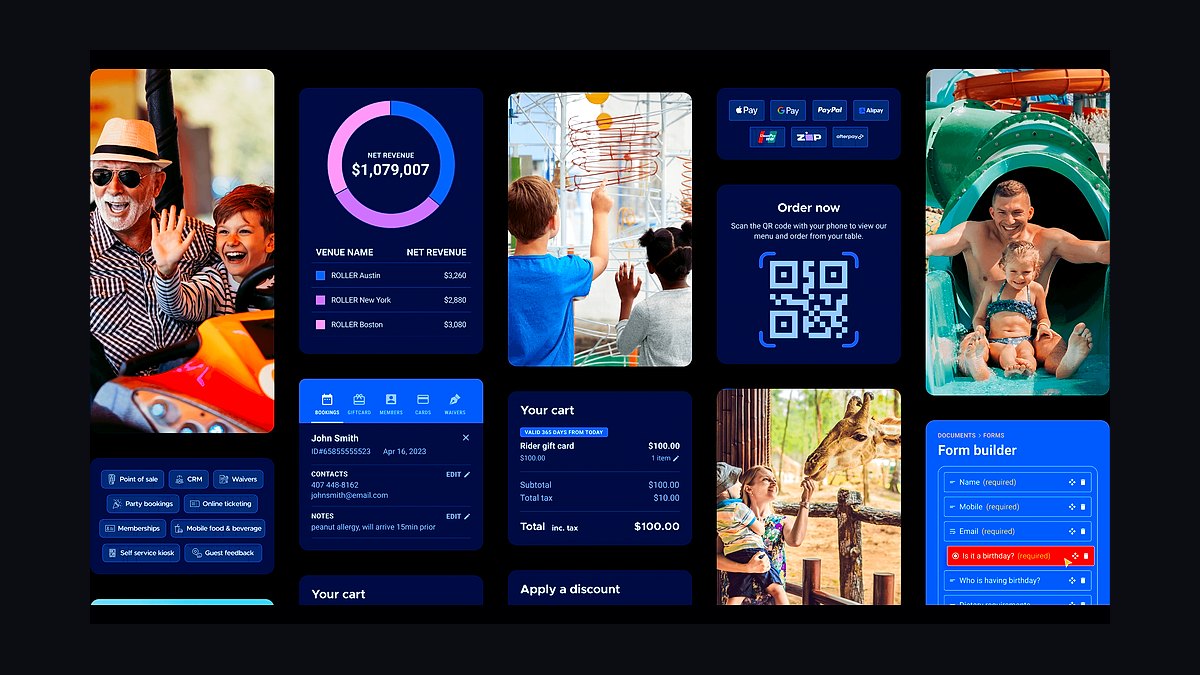
The 10 best tech stack tools for family entertainment centers are ranked below on measured performance, build quality, price, and how each one actually holds up in daily use rather than how it reads on a spec sheet. Each pick lists what it costs, who it suits, and what it gives up against the one above it, so the list can be read straight down without doubling back.
1ROLLER Attraction Management Platform

ROLLER ranks first because it anchors the entire stack with cloud-native POS, timed ticketing, capacity ledgers, digital waivers, and party booking in one guest record. Single-location pricing commonly lands around $1,000 to $2,500 monthly, scaling with modules and volume, plus a percentage on card-not-present online bookings. Its guest-facing booking flow is the fastest to launch among the anchor platforms.
It suits newer single-location and mid-size multi-attraction operators who want one credential flowing from online booking through the front desk. It trades away some of the deep legacy arcade and redemption integration that CenterEdge has built over decades, so Embed or Intercard still handles cashless play. Compared with CenterEdge directly below, ROLLER wins on launch speed and guest journey polish, not on established park depth.
2CenterEdge Advantage Software

CenterEdge ranks second as the deeper, longer-established North American anchor platform, with strong native arcade and redemption integration and mature multi-attraction capacity handling. It is favored by established parks running trampolines, go-karts, laser tag, and large arcades under one roof, and pricing sits in the same roughly $1,000 to $2,500 monthly band for a single location. Its reporting depth suits operators who already know their attraction mix.
It is built for established multi-attraction centers rather than first-year startups, and the trade-off is a steeper configuration effort and a less modern guest-facing booking experience than ROLLER above. Against Semnox Parafait below, CenterEdge is the stronger North American choice for arcade and redemption integration, while Semnox leads where RFID and self-service kiosks are central.
3Semnox Parafait

Semnox Parafait ranks third as the credible international alternative anchor, especially where RFID wristbands and self-service kiosks are central to the operation. It combines attraction management, cashless play, and access control on one RFID credential, which collapses the guest record problem that plagues operators running separate arcade and attraction systems. Pricing is quoted against module count and location volume rather than published.
It fits operators outside North America or centers that want kiosk-driven check-in and RFID-first design from day one. It trades away some of the North American payment and accounting integrations that ROLLER and CenterEdge ship natively, so QuickBooks feeds may need configuration work. Against Embed below, Semnox covers more of the attraction platform while Embed specializes in the arcade floor.
4Embed Cashless Arcade System

Embed ranks fourth as the dominant North American cashless arcade platform, and it is the line operators most consistently under-budget because it is part software and part capital equipment. Software runs a few hundred dollars monthly, but every game needs a reader at roughly $150 to $300 apiece, so a sixty-game floor is a real capex outlay measured in tens of thousands, plus reload kiosks and network.
It is for any center with a meaningful arcade floor that wants one credential shared with the attraction platform, writing play and redemption data back into the guest record. It trades away attraction capacity and party booking, which the anchor handles. Against Intercard below, Embed is the more common North American pairing with ROLLER and CenterEdge, while Intercard competes closely on the same floor.
5Intercard Cashless Technology

Intercard ranks fifth as the other dominant North American cashless arcade choice, competing directly with Embed on readers, reload kiosks, redemption counters, and mobile reload. Software pricing sits in the same few-hundred-dollars-per-month band, with reader hardware at roughly $150 to $300 per game, so game count drives the capital line more than the subscription does. It integrates with the major attraction platforms on a shared credential.
It suits operators who want a purpose-built cashless ecosystem rather than a bundled arcade module inside the anchor platform. It trades away attraction capacity, waivers, and party workflows, which stay with ROLLER or CenterEdge. Against Embed above, the decision usually comes down to integration fit with your specific anchor platform and reference calls with operators running the same pairing.
6Smartwaiver Digital Waivers

Smartwaiver ranks sixth as the standalone digital waiver layer, priced in the low tens to low hundreds per month and worth it when you need a kiosk flow or an archive independent of the attraction platform. At any real weekend volume, paper waivers create a door bottleneck, lost signatures, and legal exposure when a waiver cannot be produced after an incident. Digital signing pushes upstream to home or phone.
It is for operators whose anchor platform lacks native waivers, or who want a separate searchable archive for trampoline, ropes course, and kart incidents. It trades away automatic attachment to the booking, which platform-native waivers on ROLLER and CenterEdge handle better. Against WaiverForever below, Smartwaiver is the more established name with broader kiosk hardware support.
7WaiverForever

WaiverForever ranks seventh as the lower-cost standalone waiver alternative, typically priced below Smartwaiver and adequate for smaller centers that mainly need digital signatures with searchable storage. It handles kiosk signing, at-home signing linked from a booking confirmation, and an archive you can produce after an incident, which is the practical requirement for trampolines, ropes courses, and go-karts. Pricing scales with volume rather than location count.
It is for small single-location centers that cannot justify the higher tier or that already have waivers bundled and only need a backup archive. It trades away some of the deeper integration hooks and kiosk hardware ecosystem Smartwaiver offers. Against Smartwaiver above, choose WaiverForever on budget and Smartwaiver on integration depth and reference base.
8Toast Restaurant POS

Toast ranks eighth as the deliberate F&B layer for centers with a full kitchen and table service, where kitchen display and menu depth justify running it alongside the attraction platform. It handles food well but models no timed sessions, capacity ceilings, attached waivers, or party deposits, so it cannot anchor the stack. Accepting one reconciliation seam between Toast and the anchor is a defensible trade.
It is for multi-attraction centers with real food service, not snack bars, where the kitchen workflow matters more than a single ledger. It trades away unified guest records unless food charges push onto the party tab through integration. Against Square for Restaurants below, Toast is the deeper kitchen system while Square is the simpler, cheaper option for lighter menus.
97shifts Scheduling Software
7shifts ranks ninth as the labor scheduling layer, running in the tens of dollars per month per location and paying for itself the first time a manager forecasts labor cost against a projected party count instead of guessing. It handles shift swaps, availability, and labor cost tracking, which matters most on weekends when a dozen parties and a walk-up surge hit simultaneously. Pricing scales with staff count.
It is for operators who have outgrown spreadsheet scheduling but do not need the enterprise workforce tools of a chain. It trades away deep integration with attraction capacity unless the anchor platform exposes a forecast feed. Against When I Work below, 7shifts is the stronger restaurant and hospitality fit, which matters for centers with full food service.
10QuickBooks Online

QuickBooks Online ranks tenth as the accounting destination, roughly $35 to $235 monthly depending on tier, fed by a daily sales summary import rather than transaction-level sync. One integrated payment rail means POS sales, online bookings, party deposits, arcade reloads, and food orders settle to one statement and export as one daily summary, replacing the forty-five-minute three-report reconciliation. That trustworthiness in the numbers is the point.
It is for single-site operators who need clean books without multi-entity consolidation. It trades away the consolidated reporting chains require across LLCs. Against Sage Intacct, which sits above it for multi-entity chains at custom pricing, QuickBooks is the right call until consolidation across locations becomes the actual constraint.
How we ranked these
We ranked each tool on five weighted criteria: timed-session and capacity modeling (25%), cross-attraction guest-record integrity (20%), party and event booking depth (20%), cashless arcade integration and credential sharing (20%), and total cost including payment processing and reader hardware (15%). Scores came from vendor documentation, published module lists, operator-reported pricing ranges, and reference calls with single-site and multi-attraction centers.
We deliberately ignored UI polish, mobile app store ratings, and feature-count marketing sheets. A prettier dashboard does not move counter throughput or stop a 2:00 heat from overselling. We also excluded vendor-published ROI claims and any tool whose core value is generic retail or restaurant POS, since those cannot express timed capacity, waivers, or party deposits without side spreadsheets.
What to look for
What matters most is whether one guest record survives every hop: booking, waiver, wristband, arcade debit, redemption, food, and accounting. Ask vendors directly whether the arcade system writes play and redemption data back into the guest profile or only into its own report. Get that answer in writing before signing, and request a reference call with an operator running the same pairing.
The mistake most buyers make is budgeting software subscriptions carefully while ignoring payment processing and arcade hardware. Processing at 2.5 to 3.0 percent touches every dollar collected, and readers run roughly $150 to $300 per game, so a sixty-game floor is tens of thousands in capex. Buyers also cut over during peak season instead of shoulder season, then run manual receipts on a Saturday.
Related questions
Can a family entertainment center run on Square or Toast alone?
No. Both handle payments and food service well, but neither models timed sessions, cross-attraction capacity ceilings, attached waivers, or party deposits with room holds. You would rebuild those in spreadsheets, which is exactly the fragmentation the stack exists to remove. Use them for kitchen and menu depth alongside an attraction platform, not instead of one.
ROLLER or CenterEdge — how do I choose between them?
ROLLER is cloud-native with a polished guest-facing booking flow and is often faster to launch for newer single-location operators. CenterEdge is the deeper, longer-established North American platform with strong arcade and redemption integration, favored by established multi-attraction parks. Choose on guest journey fit and arcade integration depth, then verify with a reference call.
Do I need Embed or Intercard if my platform already has an arcade module?
Usually yes. The cashless ecosystem — readers on every game, reload kiosks, redemption counter, and mobile reloads — is specialized enough that purpose-built systems outperform bundled modules. The hard requirement is that both systems share one guest credential, so arcade spend lands on the same record as bookings, waivers, and food.
What is the single highest-leverage cost lever in the stack?
Payment processing. It applies to every dollar the building collects across walk-up POS, online bookings, party deposits, kiosk reloads, and food, so shaving a fraction of a percentage point typically outweighs every software subscription combined. Negotiate the rate at signing and renegotiate at renewal with your actual annual volume in hand.
How does this stack compare to a bowling center or climbing gym?
Nearly identical in shape. All three sell timed or credit-based access, require waivers, run parties, and benefit from memberships with recurring billing. Bowling adds lane management; climbing adds belay certification tracking. The anchor-plus-cashless-plus-waivers pattern holds across the whole category, so vendor comparisons transfer well.
When should we migrate to a new stack?
Shoulder season, never peak. Cutting over a POS in June or the week before spring break produces manual-receipt Saturdays. Migrate in a slow month, run the old system in parallel for a week, and keep a printed fallback price sheet plus an offline card terminal available for the first month after go-live.
Are digital waivers actually necessary at moderate volume?
Yes, especially for trampolines, ropes courses, and karts. A clipboard line at the door is simultaneously a throughput bottleneck, a lost-signature problem, and a legal exposure when an incident occurs and no waiver can be produced. Push signing upstream to booking confirmations so the door becomes a scan, not a form.
What should we ask before signing any integration promise?
Ask specifically whether the arcade card writes play and redemption data back into the guest record or only into its own reporting, and whether the F&B system pushes a party's food charges onto the party tab. Get answers in writing and, where possible, a reference call with an operator running the identical pairing.
FAQ
Do I really need a dedicated attraction-management platform instead of a retail POS?
Yes. A retail POS sells quantity times price and has no concept of a timed session, a capacity ceiling, an attached waiver, or a party deposit. Forcing an entertainment center onto retail software is the root cause of most operational pain, because you inevitably build side systems for capacity, waivers, and parties that never reconcile with the register.
What does a realistic monthly software budget look like for one location?
A small center with a modest arcade typically sees $1,800 to $4,000 per month recurring, plus arcade reader hardware as capex. A mid-size multi-attraction center with trampolines, karts, laser tag, a large arcade, and full food service commonly runs $4,000 to $9,000 per month, with readers scaling to game count.
How much does cashless arcade hardware actually cost?
Software is a few hundred dollars monthly, but every game needs a reader at roughly $150 to $300 apiece. A sixty-game floor is therefore tens of thousands in capital outlay, plus reload kiosks and the network to support them. Budget readers as a capex line in your pro forma, not as a software subscription.
Can one wristband really cover play, redemption, and food?
Yes, and that is the goal. The credential issued at the POS should be the same thing the game reader debits, the redemption counter reads, and increasingly the same thing carrying food credits and attraction entitlements. When the arcade system and attraction platform share it cleanly, the guest carries one item and you get one spend picture.
How do we stop overselling a go-kart heat or jump session?
A shared real-time capacity ledger. Online booking and the front desk must write into the same calendar, so a twelve-seat heat cannot be sold to seventeen people and a half-empty 11 AM session gets surfaced as discountable inventory. Refund lines shrink and the one-star full-session reviews largely disappear.
What does party booking software need to do beyond taking a deposit?
It must hold a room, take a deposit, fire reminder cadences, collect the balance, assign a host, and capture food pre-orders, then settle into the same daily ledger as walk-in business. If it cannot do all of that, it is a calendar, not a booking layer, and you will double-book rooms and forget food orders.
Is QuickBooks enough for accounting across multiple locations?
For a single site, QuickBooks Online at roughly $35 to $235 monthly is fine, fed by a daily sales summary import rather than transaction-level sync. Multi-entity chains usually move to Sage Intacct at custom pricing once consolidation across LLCs and royalty reporting become the binding constraint.
How do memberships and season passes fit into the stack?
They only work if the platform recognizes members at the POS, enforces member-only capacity, handles failed recurring payments, and reports churn. Memberships are the right medicine for seasonality, but a program run on manual renewals leaks silently and quietly destroys the margin it was supposed to protect.
What breaks most often after go-live?
Integration seams. Vendor updates change payloads quietly, so arcade spend stops landing on the guest record or party food charges stop settling onto the party tab without anyone noticing. Schedule a quarterly review of every seam, and check it on a Tuesday rather than discovering it during a Saturday rush.
Does software fix a struggling center?
No. A center with a tired arcade floor and no party rooms does not become profitable because it bought ROLLER. The stack removes friction and produces visibility into per-attraction yield, party conversion, and arcade revenue per game. The operator still has to act on what it shows.
Sources
- https://www.roller.software/
- https://www.centeredgeonline.com/
- https://www.embedcard.com/
- https://www.intercardinc.com/
- https://www.semnox.com/
- https://www.sacoa.com/
- https://www.smartwaiver.com/
- https://www.7shifts.com/
- https://quickbooks.intuit.com/
- https://www.sageintacct.com/
Related on PULSE
This page will be disappearing soon. Save it to your device for $1 — or read it free while it is here.
@Kory-White- · if Venmo asks, the last 4 of my number are 2012
This page is gone.
This one is off the shelf now. $1 keeps it on your phone for good — the whole page, pictures and diagrams included.
 pulse-tech-stacksTop 10 Best Tech Stack Tools for RV Dealerships in 2027
 pulse-tech-stacksTop 10 Best Tech Stack Tools for Independent Bakeries in 2027
 pulse-tech-stacksTop 10 Best Tech Stack Tools for Independent Wholesale Distribution Businesses in 2027
 pulse-tech-stacksTop 10 Best Tech Stack Tools for HVAC Equipment Distributors in 2027
 pulse-tech-stacksTop 10 Best Tech Stack Tools for API Security Vendors in 2027
 pulse-tech-stacksTop 10 Best Tech Stack Tools for Data Loss Prevention (DLP) Software Vendors in 2027
 pulse-tech-stacksTop 10 Best Tech Stack Tools for Movie Theaters in 2027
 pulse-tech-stacksTop 10 Best Tech Stack Tools for Medical Billing and RCM Companies in 2027
 pulse-tech-stacksTop 10 Best Tech Stack Tools for Hair Salons in 2027
 pulse-tech-stacksTop 10 Best Tech Stack Tools for AI Music Generation Companies in 2027