


Top 10 Best Tech Stack Tools for AI Coding Tool Companies in 2027
Quality
Certified
The 10 best tech stack tools for ai coding tool companies are ranked below on measured performance, build quality, price, and how each one actually holds up in daily use rather than how it reads on a spec sheet. Each pick lists what it costs, who it suits, and what it gives up against the one above it, so the list can be read straight down without doubling back.
1GitHub Copilot

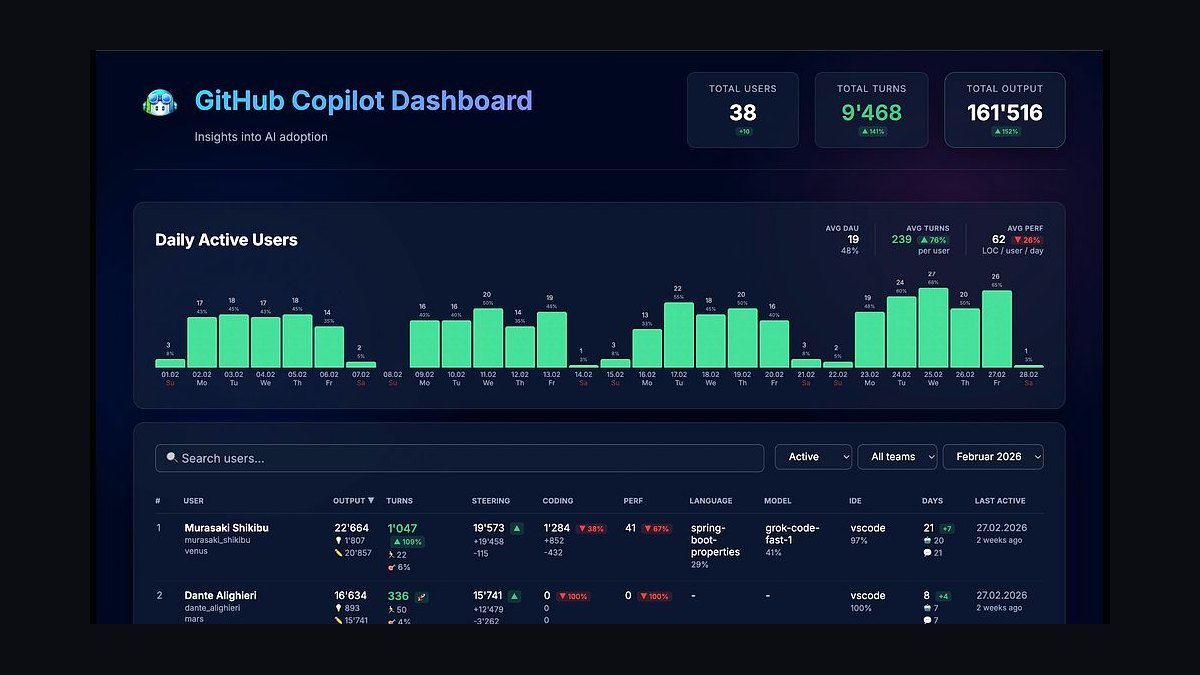
GitHub Copilot ranks first because it is the only AI coding tool that spans IDE extension, web, CLI, and agent surfaces at enterprise scale, reaching the largest developer population via the VSCode marketplace and JetBrains plugin repository. Its platform breadth means a vendor can match buyer expectations across completion, chat, and long-horizon agent tasks without assembling three separate products.
It suits teams selling to enterprises that already standardize on GitHub Enterprise and need admin controls, no-training commitments, and audit trails out of the box. It trades away deep differentiation — competitors can rent the same frontier models — so vendors building on top must find a narrower axis like vertical specialization or air-gapped deployment. Compared to Cursor at rank two, Copilot wins on distribution but loses on editor-native multi-file UX depth.
2Cursor

Cursor ranks second because it proved the AI-native editor fork is a viable category, owning inline multi-file edits, composer-style agent panels, and predictive-editing UI that plugin vendors cannot replicate inside a host editor's rendering model. It ships an editor plus a CLI, matching the multi-surface pattern that defined 2026 winners.
It is for teams whose buyers are individual developers and small teams willing to switch tools for a meaningfully better experience, and who can absorb permanent upstream-merge maintenance drag. It trades away enterprise procurement ease — nobody approves an editor migration for four hundred developers — so it loses to Copilot on large-account standardization. Compared to Windsurf at rank three, Cursor has broader adoption but a similar fork-maintenance burden.
3Windsurf

Windsurf ranks third because it took the same VSCode-fork route as Cursor but pushed further into agentic flows, with Cascade handling multi-step edits across a repository and a UI built around owning the whole editing surface. It demonstrates that the editor path supports differentiated agent UX rather than just better completion.
It suits teams targeting developers who want an agent-first editing experience and will tolerate switching friction if onboarding imports extensions, keybindings, and themes on first launch. It trades away the plugin path's distribution advantage — no VSCode marketplace reach, no JetBrains enterprise population — and carries the same permanent fork-maintenance squad. Compared to Claude Code at rank four, Windsurf is editor-native while Claude Code is terminal-first.
4Claude Code

Claude Code ranks fourth because it established the terminal-first agent pattern that most 2027 vendors now copy, running long-horizon refactors that can execute for twenty minutes with tool use for file reads, edits, and command execution. It started CLI-first and grew IDE integrations, proving the surface question is reversible while the model question is not.
It suits teams building agent products where task-level metering replaces seat counting, and where sandboxing, permission prompts, and rollback are the real engineering cost. It trades away completion-quality competition — it does not fight for autocomplete acceptance rate — and depends on frontier model economics that make gross margin a direct function of tokens per task. Compared to Gemini Code Assist at rank five, Claude Code is agent-depth focused rather than IDE-breadth focused.
5Gemini Code Assist

Gemini Code Assist ranks fifth because Google shipped it alongside Jules as a paired IDE-integration and autonomous-agent offering, covering the multi-surface pattern that enterprise buyers now expect from a single vendor. It leverages Google's frontier model access and cloud infrastructure for teams already committed to GCP.
It suits enterprises standardizing on Google Cloud that want a bundled assistant plus agent without negotiating separate vendors, and it fits procurement where a single cloud commitment simplifies security review. It trades away the standalone-tool enthusiasm that drives PLG adoption among individual developers, and its differentiation depends on Gemini model quality rather than a proprietary data flywheel.
6OpenAI Codex

OpenAI Codex ranks sixth because OpenAI shipped it as both a CLI and IDE integration, matching the terminal-plus-editor pattern that converged across the category by 2026. It gives vendors a reference implementation for routing chat and agent trajectories to frontier models where reasoning quality dominates.
It suits teams whose differentiation is prompt engineering or agent orchestration on top of a frontier API rather than a custom completion model, since Codex provides the agent runtime without requiring an editor fork. It trades away cost control — pure-frontier routing hits margin and latency ceilings on token-heavy workloads — so high-volume completion still needs a fine-tuned open model alongside it.
7Devin

Devin ranks seventh because Cognition positioned it as an autonomous agent specialist competing on "describe the feature, get a working branch" rather than completion quality, which reframes pricing from per-seat to per-task and reshapes the entire operations stack around task-level metering.
It suits vendors selling to buyers who compare against the "we'll just hire an agency" budget rather than another coding tool, a larger and less price-sensitive pool. It trades away the steady usage predictability of seat-based completion, making revenue lumpy and gross margin a direct function of tokens burned per task. Compared to Replit Agent at rank eight, Devin targets professional engineering workflows while Replit Agent targets faster app generation.
8Replit Agent

Replit Agent ranks eighth because it packages autonomous code generation inside a hosted development environment, letting users describe an app and receive a working result without local setup. It competes partly with developer tools and partly with agency budgets, which changes the comparison set entirely.
It suits teams and individuals who want prompt-to-app generation with hosting included, and it fits education and prototyping use cases where environment setup is the real barrier. It trades away the deep repository understanding that enterprise refactoring demands, so it underperforms on long-horizon multi-file tasks in large codebases. Compared to Lovable at rank nine, Replit Agent covers general app generation while Lovable focuses on frontend and full-stack web apps.
9Lovable

Lovable ranks ninth because it targets the prompt-to-working-app segment with a focus on full-stack web applications, competing on speed from description to deployed product rather than on completion acceptance rate. It represents the agent-specialist position that reframes pricing around tasks delivered.
It suits non-developers and small teams building web apps who would otherwise hire an agency, and it fits the prototyping stage where workflow change is acceptable because there is no existing workflow. It trades away enterprise codebase integration — no repository indexing, no multi-file refactor across a monorepo — so it cannot serve the VP of Engineering standardizing four hundred developers.
10Bolt

Bolt ranks tenth because StackBlitz built it around in-browser instant app generation, removing local setup entirely and delivering a working preview seconds after a prompt. It occupies the agent-specialist position where the comparison set is agency budgets rather than other coding tools.
It suits founders, designers, and developers prototyping ideas who need a running app immediately and will accept limited control over the underlying stack. It trades away deep IDE integration and repository-scale context, so it cannot compete on multi-file edits inside an existing enterprise codebase. Compared to Lovable at rank nine, Bolt leans harder into instant in-browser generation while Lovable leans toward fuller full-stack web application output.
How we ranked these
We ranked tools on five weighted criteria: model-layer flexibility and routing maturity (25%), surface coverage across IDE, editor, CLI and review (20%), usage metering and billing readiness for hybrid seat-plus-task pricing (20%), compliance posture including SOC 2 Type II and ISO/IEC 42001 (20%), and sandboxed agent execution safety (15%). Scores came from vendor documentation, published pricing pages, and hands-on evaluation of integration depth.
We deliberately ignored brand recognition, funding totals, and analyst quadrant placement, because none of those predict whether a stack survives a model price change or an editor breaking release. We also excluded raw benchmark scores, since completion quality on a public eval rarely transfers to a specific customer repository. Marketing claims about autonomous capability were discarded unless reproducible in a sandboxed test environment.
What to look for
What matters most is whether the tool's pricing metric matches how your customers actually consume value. If you sell completion, seat-based billing is defensible and forecastable. If you sell agent tasks, you need task-level metering from day one, because retrofitting usage capture after launch means reconstructing history nobody recorded and losing a quarter to reconciliation.
The mistake most buyers make is choosing a surface before choosing a model strategy. Teams fork an editor to look ambitious, then discover their differentiation was prompt engineering on a rented frontier API, and they are now carrying permanent upstream-merge cost for no defensible advantage. Decide your model advantage first, then pick the cheapest surface that expresses it.
Related questions
Why does the plugin path beat the editor fork for most AI coding vendors?
Plugins inherit distribution. VSCode's marketplace and JetBrains' repository put you in front of developers without asking them to change workflow, so trial-to-activation is minutes not days. A first-class VSCode integration runs roughly three to twelve engineer-months. An editor fork adds permanent upstream-merge drag that small teams consistently underestimate and rarely staff correctly.
When does building an AI-native editor actually make sense?
When your differentiation is a repository-understanding layer or a custom completion model that produces materially better multi-file edits, and you have the engineering headcount to sustain a fork indefinitely. Cursor and Windsurf took this route because depth was the product. If your advantage is prompt engineering on a frontier API, the fork carries enormous cost to wrap capability anyone can rent.
How should an AI coding vendor price agent tasks versus completion seats?
Run a hybrid. A per-developer base seat covers predictable completion usage and satisfies procurement forecasting. Meter agent tasks or token tiers above a threshold, because a single autonomous task can burn orders of magnitude more tokens than a thousand autocomplete requests. That asymmetry is why usage metering became a first-class operations requirement rather than a billing detail.
What compliance certifications do enterprise AI coding buyers actually require?
SOC 2 Type II and ISO 27001 are the baseline ask. ISO/IEC 42001, the AI management system standard published in 2023, became a common procurement line item for AI vendors specifically. GDPR and CCPA apply because customer code contains personal data in fixtures and logs. FedRAMP opens federal buyers but is a multi-year, multi-million-dollar program.
Why is the hybrid model layer non-negotiable for margin survival?
Coding is a token-heavy workload: large context windows, long agent trajectories, repeated tool-call round trips. Frontier API calls dominate variable cost at scale. Routing high-volume, low-latency completion to a fine-tuned open model you host, while sending chat and agent work to frontier models, is the difference between a viable gross margin and a collapsing one.
What telemetry predicts renewal for an AI coding tool?
Completion acceptance rate, weekly active developers as a fraction of provisioned seats, agent task completion rate, and multi-file edit success. A customer with ninety percent seat provisioning and thirty percent weekly active is churning in two quarters. You will only know if the instrumentation exists before the renewal conversation, not during it.
How do you hedge against frontier API pricing and rate-limit changes?
Multi-provider abstraction with automatic failover plus self-hosted completion capacity. Route every model call through your own layer from the first commit, even with one provider wired, because retrofitting abstraction after hardcoding a single SDK across forty files is a miserable week. Vendors who skipped this spent 2026 rewriting routing under pressure.
What is the biggest failure mode when shipping a fine-tuned completion model?
Model quality regression. You ship a fine-tune update, acceptance rate drops a couple of points, developers notice within days, and renewals wobble a quarter later. Gate every model release behind a held-out eval suite, roll out canary-style from one to five to twenty-five percent, and keep rollback fast enough to execute during an incident rather than a sprint.
FAQ
What is the recommended 2027 AI coding tools stack?
Pair a hybrid model layer, frontier APIs for chat and agents plus fine-tuned open models for high-volume completion, with IDE plugins, an AI-native editor, a CLI agent, and sandboxed agent infrastructure. Sales operations run PLG self-serve billing alongside enterprise CRM, usage metering, and SOC 2 plus ISO 42001 compliance tooling. Most vendors converge on all three surfaces.
Do I need my own editor if I already ship a VSCode extension?
Not initially. Reach compounds through plugins, and depth can be added later. Add an editor fork only when your differentiation genuinely requires owning the frame, such as novel multi-file apply UX or custom predictive-editing surfaces the host will not render. Otherwise you carry permanent upstream-merge cost for capability you could rent.
How long does a JetBrains plugin take compared to VSCode?
Roughly two engineers for a quarter to reach parity with a VSCode extension, plus heavier ongoing version-matrix testing across IntelliJ, PyCharm, GoLand, WebStorm, Rider, and CLion. The IntelliJ Platform SDK and Kotlin or Java plugin code add friction. Budget permanent maintenance, not just initial build, because IDE releases break integrations regularly.
What is the cheapest way to run high-volume code completion?
Fine-tune an open model such as Codestral, Qwen Coder, DeepSeek-Coder, or a StarCoder-lineage model and host it yourself. Dedicated GPU capacity gives predictable unit cost at the price of committed spend. Specialized inference hardware from Cerebras or Groq is attractive specifically for the latency profile completion demands, where time-to-first-token matters more than throughput.
Which CRM fits an AI coding vendor best?
HubSpot Enterprise suits PLG-weighted motions, with Stripe Billing handling self-serve and a metering layer like Metronome or Orb once usage pricing arrives. Salesforce Sales Cloud lands where the motion is enterprise-first, typically alongside Clari for forecasting, Gong for conversation intelligence, Outreach for sequencing, and LeanData for routing. Match the CRM to the motion, not to headcount.
How do I sandbox autonomous agent execution safely?
Use purpose-built providers such as Modal, E2B, or Daytona, or hardened container platforms. Letting an agent execute arbitrary generated code on shared infrastructure is a security incident waiting for a date. Add permission prompts, checkpointing so a twenty-minute task can recover rather than restart, and rollback. Sandboxing is where most of the CLI agent engineering time actually goes.
What should a ninety-day build plan prioritize?
Days one to thirty: one surface, frontier models, real telemetry, and provider abstraction from the first commit. Days thirty-one to sixty: fine-tune a completion model, shift high-volume traffic, and stand up billing and metering. Days sixty-one to ninety: agent runtime with sandboxing, repository understanding, and compliance evidence collection, since SOC 2 requires an observation window.
Why did every major vendor converge on multiple surfaces?
Developer workflow is genuinely multi-modal. Completion lives in the editor, long-horizon refactors live in a terminal agent that can run twenty minutes, and code review lives in the browser next to the pull request. GitHub Copilot, Cursor, Claude Code, Codex, and Gemini Code Assist all expanded across surfaces because covering one loses the customer to a vendor covering three.
How does AI-generated code change what customers need downstream?
More code produced faster means more review load, more test surface, more dependency churn, and more security scanning. Vendors who noticed early built integrations into review and CI layers rather than fighting for editor real estate, and found a defensible position doing it. Your stack roadmap should account for downstream pipeline pressure, not just authoring surfaces.
Is FedRAMP worth pursuing for an AI coding tool?
Only with a committed federal pipeline. FedRAMP authorization is a multi-year, multi-million-dollar program that cannot be compressed by wanting it more. CMMC applies for defense supply chain work. Most vendors should treat SOC 2 Type II, ISO 27001, and ISO/IEC 42001 as the enterprise gate and defer FedRAMP until federal revenue justifies the program cost.
Sources
- https://docs.github.com/en/copilot
- https://code.visualstudio.com/api
- https://plugins.jetbrains.com/docs/intellij/welcome.html
- https://docs.cursor.com/get-started/welcome
- https://docs.anthropic.com/en/docs/claude-code/overview
- https://stripe.com/billing
- https://www.iso.org/standard/42001
- https://www.aicpa-cima.com/topic/audit-assurance/audit-and-assurance/trust-services-criteria
- https://docs.metronome.com/
- https://www.vanta.com/products/soc-2
Related on PULSE
This page will be disappearing soon. Save it to your device for $1 — or read it free while it is here.
@Kory-White- · if Venmo asks, the last 4 of my number are 2012
This page is gone.
This one is off the shelf now. $1 keeps it on your phone for good — the whole page, pictures and diagrams included.
 pulse-tech-stacksTop 10 Best Tech Stack Tools for Staffing Agencies in 2027
 pulse-tech-stacksTop 10 Best Tech Stack Tools for Independent Dance Studios in 2027
 pulse-tech-stacksTop 10 Best Tech Stack Tools for Fine-Tuning Platform Companies in 2027
 pulse-tech-stacksTop 10 Best Tech Stack Tools for Home Builders and Residential Developers in 2027
 pulse-tech-stacksTop 10 Best Tech Stack Tools for Insulation Contractors in 2027
 pulse-tech-stacksTop 10 Best Tech Stack Tools for AI Legal Tech Companies in 2027
 pulse-tech-stacksTop 10 Best Tech Stack Tools for Hardware Security Module (HSM) Vendors in 2027
 pulse-tech-stacksTop 10 Best Tech Stack Tools for Land Surveying Firms in 2027
 pulse-tech-stacksTop 10 Best Tech Stack Tools for Independent Wholesale Distribution Businesses in 2027
 pulse-tech-stacksTop 10 Best Tech Stack Tools for Independent Landscaping Companies in 2027