


Top 10 Best Tech Stack Tools for Dance Studios in 2027
Quality
Certified
The 10 best tech stack tools for dance studios are ranked below on measured performance, build quality, price, and how each one actually holds up in daily use rather than how it reads on a spec sheet. Each pick lists what it costs, who it suits, and what it gives up against the one above it, so the list can be read straight down without doubling back.
1Jackrabbit Dance

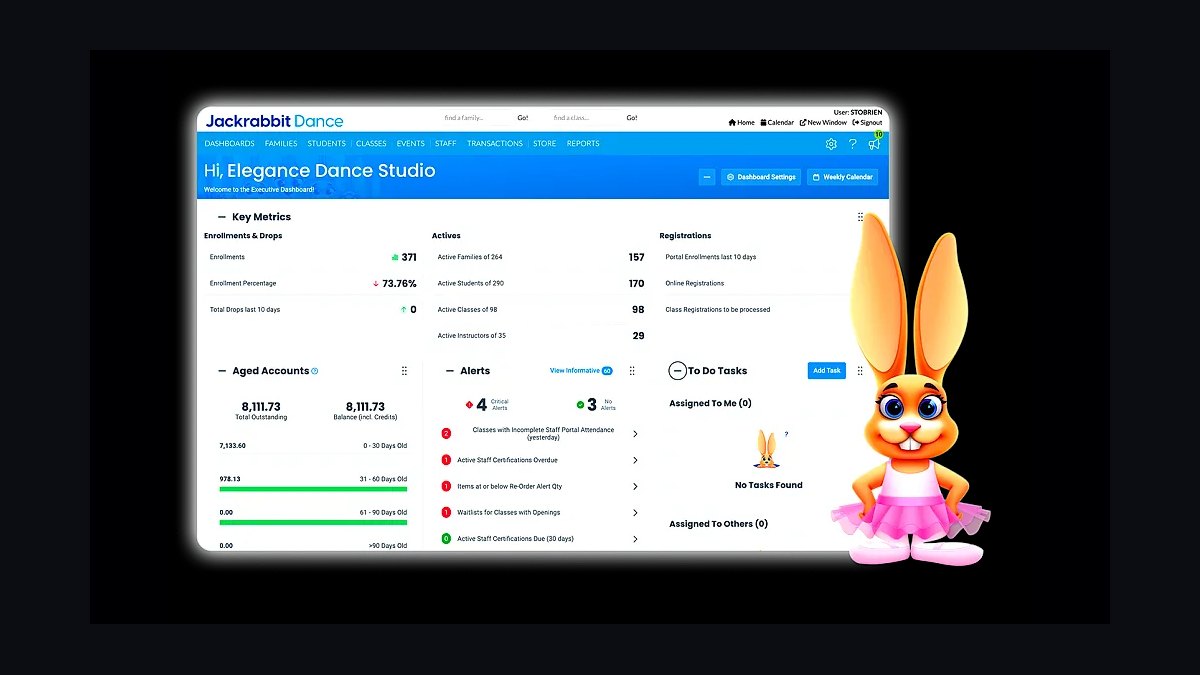
Jackrabbit Dance ranks first because it is the only platform in 2027 with the reporting depth, parent app, and costume sizing logic to run a studio above 120 students. Pricing starts near $49/month under 100 students, Jackrabbit Plus with the branded parent app sits near $93/month, and Enterprise with the Business Intelligence Dashboard runs near $245/month. Robo-Sizer-style measurement-to-vendor-SKU conversion is built in, cutting the costume cycle from 30-50 manual hours to roughly 8-12.
It is built for growing and multi-location studios that need program-level profitability and a parent-facing portal, not solo operators watching every dollar. It trades away cheap flat pricing: below 120 students, DanceStudio-Pro undercuts it at $45/month for unlimited enrollment. Above that line, Jackrabbit's tuition tier ladders, waitlists, and recital event module justify the premium over both DanceStudio-Pro and Mindbody.
2DanceStudio-Pro

DanceStudio-Pro ranks second because it delivers the cheapest defensible studio spine at roughly $45/month for unlimited students, with Premier near $75/month adding two-way messaging, granular permissions, and Zapier access. It handles hours-per-week tuition tiers, enrollment caps, waitlists, and costume sizing that Square Appointments and Acuity cannot model past 40 students. For a solo studio at 60-150 students, it is the flat-pricing winner.
It is for owners under 120 enrolled students who want predictable cost and do not need a custom-branded parent app. It trades away the reporting depth and Business Intelligence Dashboard that Jackrabbit Enterprise provides above 500 students. Against Jackrabbit Dance directly above, it wins on price and loses on parent app polish and multi-location analytics, so the enrollment line at 120 is the real decision point.
3QuickBooks Online Plus

QuickBooks Online Plus ranks third because class tracking is what turns a blended revenue number into a program-level P&L by ballet, hip-hop, recital, and costumes. It runs near $99/month, versus Essentials at $65/month which lacks class tracking and budgets. For a 200-student studio billing $22,000/month, this is the difference between knowing which program subsidizes which and guessing.
It is for studios that have outgrown a single revenue bucket and want books that answer profitability questions, not just tax questions. It trades away simplicity: Essentials is cheaper and fine for a solo studio under 100 students. Against Gusto below it, QuickBooks handles the ledger while Gusto handles payroll filing, and skipping either creates the 6-10 hours of monthly reconciliation the stack is designed to eliminate.
4Gusto Payroll

Gusto ranks fourth because it files state taxes that Jackrabbit and DanceStudio-Pro teacher-pay modules do not, and late-filing penalties average $580-$1,400 per missed state per year. Gusto Simple runs about $49/month base plus $6 per employee; Plus about $80/month base plus $12 per employee. A studio with 12 instructors lands near $121/month on Simple, handling 1099 contractors and W-2 front-desk staff in one run.
It is for any studio paying instructors across one or more states, which is most studios past 150 students. It trades away the illusion of saving $49/month by running payroll inside the studio platform, a saving that evaporates on the first penalty notice. Against QuickBooks Online Plus above it, Gusto pushes the journal entry into the ledger rather than replacing it, so the two are complements, not substitutes.
5Mailchimp Standard

Mailchimp Standard ranks fifth because multi-step automations — welcome series, recital countdown, dropped-class win-back — are what keep parent communication from becoming a front-desk phone queue. Standard runs about $20/month at 500 contacts and climbs toward $100/month near 5,000 contacts. It pushes the parent roster out of the studio platform and into scheduled, trackable sends.
It is for studios with enough families that manual email no longer works, typically past 100 students. It trades away the e-commerce depth that Klaviyo offers near $130/month at 10,000 contacts, which matters only if the studio runs real merchandise sidelines. Against Gusto above it, Mailchimp is the outward-facing parent channel while Gusto is the inward-facing payroll rail, and both sit downstream of the platform spine.
6Revolution Dancewear

Revolution Dancewear ranks sixth because its studio-exclusive vendor portal is free and its ecosystem spans Tenth House, Nimbly, and Dance Studio Owner education, giving operators one relationship across costumes and training. It is strongest for jazz and hip-hop repertoire, where sizing runs closer to contemporary fit than classical line. Parents cannot buy direct, which protects studio margin and keeps the catalog controlled.
It is for studios with a recital-heavy jazz and hip-hop program that want a single vendor relationship and pre-loaded size charts. It trades away the classical ballet fit that Weissman has refined over 60-plus years. Against Weissman below it, the practical answer for many operators is running both, split by genre, since neither portal writes costume charges back to the studio billing module.
7Weissman Costumes

Weissman ranks seventh because it is a 60-plus-year family business whose studio-exclusive catalog is preferred by traditional ballet and recital-heavy studios for classical fit and construction. Like Revolution, the portal is free and closed to parents, so the studio controls catalog, sizing, and margin. Pre-loaded vendor size charts reduce the measurement-to-SKU conversion work that spreadsheets cannot handle.
It is for studios whose repertoire leans ballet and classical recital work rather than jazz and hip-hop. It trades away the broader ecosystem — education brands and sister labels — that Revolution Dancewear bundles. Against Revolution above it, Weissman wins on classical fit and loses on breadth, which is why many operators run both portals and split the order by genre rather than picking one.
8OnTheStage Ticketing

OnTheStage ranks eighth because recital ticketing spikes to 800-3,000 transactions in a 72-hour window, and it charges roughly $1.75-$3.50 per ticket passed to the parent with no monthly fee. A 1,200-seat recital at $22/ticket generates $3,300-$4,200 in fees paid by attendees, not the studio. That removes the capital risk of a ticketing platform on a once-a-year event.
It is for studios that want a dedicated ticketing experience without a subscription, especially those whose platform's bundled event module feels thin. It trades away the zero-marginal-cost option: Jackrabbit Events is bundled into the platform subscription, so Jackrabbit users may prefer it. Against Weissman above it, OnTheStage handles the revenue event while Weissman handles the costume cycle, two separate seasonal peaks in the same year.
9Jackrabbit Events

Jackrabbit Events ranks ninth because it is bundled into the Jackrabbit Dance subscription, meaning zero incremental ticketing cost for studios already on the platform. For a 1,200-seat recital, that avoids the $3,300-$4,200 in per-ticket fees OnTheStage passes to parents. It keeps ticket buyers inside the same system that holds enrollment, tuition, and family accounts.
It is for Jackrabbit Dance subscribers who value one vendor and one roster over a specialized ticketing experience. It trades away the dedicated box-office features and parent-facing polish that OnTheStage has built specifically for live events. Against OnTheStage above it, Jackrabbit Events wins on cost for existing subscribers and loses on ticketing depth, so the choice depends entirely on which platform already runs the studio spine.
10Klaviyo

Klaviyo ranks tenth because studios with real e-commerce sidelines — merchandise, intensives, digital content — need segmentation and revenue attribution that Mailchimp Standard does not provide. It runs near $130/month at 10,000 contacts, roughly 30% above Mailchimp at comparable scale. Flows tied to purchase history and predicted lifetime value are the differentiator for studios selling beyond tuition.
It is for operators whose email list is a revenue channel, not just a parent communication tool, typically multi-location studios past 500 students. It trades away cost efficiency: Mailchimp Standard at $20-$100/month covers welcome series and recital countdown for most studios. Against Mailchimp above it, Klaviyo is the upgrade path only when merchandise and ticket sales justify the segmentation, not a default replacement.
How we ranked these
We ranked each tool on five weighted criteria: fit with recurring, tiered tuition billing (30%), parent-facing portal quality (20%), costume and recital workflow depth (20%), accounting and payroll integration (15%), and total cost of ownership at three enrollment tiers (15%). Scores came from published pricing pages, feature documentation, and hands-on configuration against a 200-student test roster.
We deliberately ignored brand recognition, app store ratings, and vendor sales demos. We also excluded generic booking and fitness platforms from the top ranks unless they served a genuine hybrid studio, because their pricing and feature gaps distort the comparison. Social media follower counts and conference sponsorships carried zero weight in scoring.
What to look for
Match the platform to your billing model first. If tuition is tiered by hours per week with proration and family caps, a vertical studio platform is mandatory; generic schedulers will break by 40 students. Then check whether the parent portal shows balances, costumes, and recital info without a phone call to the front desk.
The mistake most buyers make is choosing on monthly subscription price while ignoring processing rates and integration labor. Saving $40/month on the platform but paying 3.5% plus $0.30 in processing costs a 200-student studio thousands annually. Buyers also skip the QuickBooks connection, then spend 6-10 hours monthly reconciling.
Related questions
Do I need a dedicated studio platform at 80 students?
Yes. Anything over 40 students outgrows Square, Acuity, or a spreadsheet within a season. DanceStudio-Pro at roughly $45/month is the cheapest defensible answer below 120 students, and it handles tiered tuition, waitlists, and costume sizing that generic tools cannot.
Can I run payroll inside Jackrabbit or DanceStudio-Pro instead of Gusto?
No. Both platforms calculate instructor pay but neither files state taxes. The late-filing penalties you accumulate will exceed the $49/month you thought you saved, and multi-state operators get hit hardest.
Revolution Dancewear or Weissman for costumes?
Both are studio-exclusive and both are strong. Revolution carries a broader ecosystem including Tenth House and Nimbly. Weissman has 60-plus years and is preferred by traditional ballet and recital-heavy studios. Many operators run both, split by genre.
Is Mindbody ever right for a dance studio?
Only for a genuine hybrid running yoga, pilates, fitness, and dance under one roof. A pure dance studio pays two to three times Jackrabbit's price for weaker recital, costume, and tuition-tier logic.
What is realistic year-one software spend for a new 100-student studio?
Roughly $2,500-$3,000 in subscriptions for the year, plus about 2.9% of tuition in processing fees. Budgeting less usually means re-platforming in year three at roughly four times the cost.
How do I decide between Jackrabbit Dance and DanceStudio-Pro?
Use enrollment as the line. Below 120 students, DanceStudio-Pro's flat pricing at roughly $45-$75/month usually wins. Above it, Jackrabbit's reporting depth, Business Intelligence Dashboard, and custom-branded parent app justify the higher tier.
What is the biggest unsolved integration in the 2027 dance studio stack?
The costume-order-to-tuition-statement loop. Vendor portals do not write back to the studio billing module, so when a family owes $294 across three routines, the operator still drops that charge manually. It is the largest administrative time sink in the industry.
FAQ
How much does the full tech stack cost per month for a typical studio?
A solo studio at 60-150 students lands near $210/month in subscriptions plus processing. A growing studio at 150-500 students lands near $510/month. A multi-location operator at 500-2,500 students lands near $1,200-$1,400/month plus bookkeeping. Processing runs 2.6%-3.5% of tuition on top.
Why do dance studios need a vertical platform instead of generic booking software?
Because tuition is a recurring subscription tied to hours-per-week tiers, costumes are a sizing problem rather than a merchandise problem, and recital ticketing spikes to thousands of transactions in 72 hours. Generic tools model none of those three, which is why they break past 40 students.
What is the biggest unsolved integration in the 2027 dance studio stack?
The costume-order-to-tuition-statement loop. Vendor portals do not write back to the studio billing module, so when a family owes $294 across three routines, the operator still drops that charge manually. It is the largest administrative time sink in the industry.
How do I decide between Jackrabbit Dance and DanceStudio-Pro?
Use enrollment as the line. Below 120 students, DanceStudio-Pro's flat pricing at roughly $45-$75/month usually wins. Above it, Jackrabbit's reporting depth, Business Intelligence Dashboard, and custom-branded parent app justify the higher tier.
What happens if I skip QuickBooks and run the platform standalone?
You lose program-level profitability. The platform tracks enrollment and billing but does not produce a clean P&L by program, so you cannot tell whether ballet or hip-hop carries the studio. You also spend 6-10 hours a month reconciling manually.
How should I handle recital ticketing fees?
Most platforms pass the per-ticket fee to the parent. OnTheStage charges roughly $1.75-$3.50 per ticket with no monthly fee, and Jackrabbit Events is bundled. On a 1,200-seat recital at $22/ticket that is $3,300-$4,200 in fees, paid by attendees, but the operator chooses the platform.
What processing rate should a dance studio expect to pay?
Effective rates land between 2.6% + $0.10 and 3.5% + $0.30 depending on volume and whether you are on interchange-plus. A studio processing $45,000/month pays roughly $1,250-$1,575. Moving from 3.5% + $0.30 to 2.6% + $0.10 on $540,000 annual tuition saves about $5,500 a year.
Do I need a separate email platform if my studio software sends messages?
Yes, for anything beyond transactional notices. Mailchimp Standard at about $20/month handles welcome series, recital countdowns, and dropped-class win-back automations that studio platforms do not build. Studios with real e-commerce sidelines sometimes graduate to Klaviyo near $130/month at 10,000 contacts.
What is the risk of buying a fitness platform for a dance studio?
Mindbody at $99-$349/month costs two to three times Jackrabbit while delivering weaker recital, costume, and tuition-tier logic. Operators discover this in year two when the costume cycle hits and the system has no sizing model. Only genuine hybrids should consider fitness-first platforms.
How long does a full stack rollout take?
Plan 90 days. Days 0-30 stabilize the platform spine and test billing. Days 30-60 connect QuickBooks and Gusto and verify program-level P&L. Days 60-90 load costume vendor portals, build Mailchimp automations, and configure recital ticketing before the season's biggest revenue event.
Sources
- https://www.jackrabbitdance.com/pricing/
- https://www.jackrabbitclass.com/pricing/
- https://info.dancestudio-pro.com/pricing
- https://gusto.com/product/pricing
- https://quickbooks.intuit.com/pricing/
- https://mailchimp.com/pricing/
- https://www.klaviyo.com/pricing
- https://www.revolutiondance.com/
- https://www.weissmans.com/
- https://www.onthestage.com/pricing
Related on PULSE
This page will be disappearing soon. Save it to your device for $1 — or read it free while it is here.
@Kory-White- · if Venmo asks, the last 4 of my number are 2012
This page is gone.
This one is off the shelf now. $1 keeps it on your phone for good — the whole page, pictures and diagrams included.
 pulse-tech-stacksTop 10 Best Tech Stack Tools for Home Inspection Companies in 2027
 pulse-tech-stacksTop 10 Best Tech Stack Tools for Podiatry Practices in 2027
 pulse-tech-stacksTop 10 Best Tech Stack Tools for Independent Wholesale Distribution Businesses in 2027
 pulse-tech-stacksTop 10 Best Tech Stack Tools for Mobile Threat Defense (MTD) Vendors in 2027
 tkTop 10 Best Tech Stack Tools for Fencing and Deck Contractors in 2027
 pulse-tech-stacksTop 10 Best Tech Stack Tools for Employee Benefits Consulting Firms in 2027
 pulse-tech-stacksTop 10 Best Tech Stack Tools for Data Loss Prevention (DLP) Software Vendors in 2027
 pulse-tech-stacksTop 10 Best Tech Stack Tools for Window Cleaning Services in 2027
 pulse-tech-stacksTop 10 Best Tech Stack Tools for Independent Landscaping Companies in 2027
 pulse-tech-stacksTop 10 Best Tech Stack Tools for AI Translation API Companies in 2027