


The Sales Acceleration Formula by Mark Roberge — Cliff Notes & Chapter-by-Chapter Summary
Quality
Certified
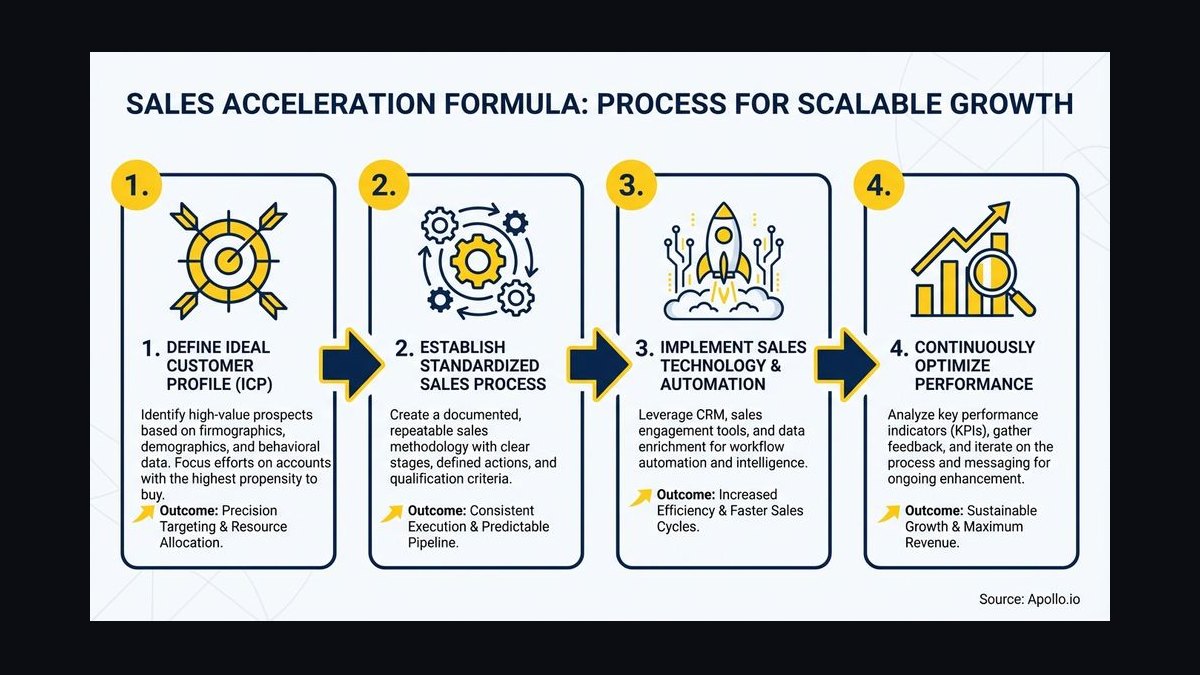
The Sales Acceleration Formula by Mark Roberge (Wiley, 2015) turns sales leadership into an engineering problem, expressed as Hiring + Training + Coaching + Demand Generation = Sales Acceleration. Roberge, HubSpot's first sales hire, documents how he scaled revenue toward $100M by scoring candidates on five predictors, standardizing ramp, coaching one skill at a time, and running a marketing SLA.
The outcome you should expect
The realistic payoff from installing Roberge's system is not a hockey stick in month two. It is a narrowing of variance. Before the formula, a typical B2B sales org has a small number of intuitive top performers carrying most of the number and a long tail of reps who never reach quota, and nobody can articulate why. After the formula, the distribution tightens: more reps land inside a predictable band, ramp times converge, and the org can forecast headcount-to-revenue with something closer to arithmetic than hope.
That shift matters more than raw growth because it changes what a leadership team can commit to. When the spread between your best and worst rep is 6x, hiring is a lottery ticket and every board conversation is a negotiation about faith. When the spread compresses toward 2x, a VP can say "give me four more reps and I will give you X in twelve months" with a defensible model behind it. Roberge's whole argument is that predictability, not heroics, is the asset investors and operators are actually buying.
Expect the following categories of change. Hiring decisions become slower to make but far less regretted, because a scorecard forces disagreement into the open before the offer instead of after the first bad quarter. Onboarding becomes a curriculum with a pass/fail gate rather than a shadowing exercise, so new reps stop learning the product by burning real opportunities. Manager time reallocates away from deal-by-deal firefighting toward skill development, which is the only intervention that compounds. And the marketing relationship stops being a standing argument about lead quality and becomes a two-sided contract with numbers on both sides.

There is also an organizational side effect worth naming. Once you instrument hiring, ramp, and coaching, you generate a data exhaust that did not exist before — interview scores paired with two-year performance, certification pass rates paired with time-to-first-deal, coaching focus areas paired with conversion movement. That exhaust is what lets you improve the system rather than just run it. Most sales orgs never build it, which is why they relitigate the same debates every year with anecdotes instead of evidence.
Where the outcome disappoints: teams that adopt the vocabulary without the measurement. Writing "coachability" on an interview scorecard and then hiring on gut feel anyway produces exactly the results you had before, plus paperwork. The formula only pays when the scores are recorded, the correlation is checked later, and the threshold is actually enforced against a candidate everybody liked in the room.
What drives that outcome
Four mechanisms do the work, and they are interdependent — running one in isolation produces a fraction of the effect.
Selection quality. Roberge's central claim from Chapter 1 is that sales success is predictable from a small set of traits, and that years of sales experience is not among them. His five predictors — coachability, curiosity, prior success, intelligence, work ethic — were derived by scoring candidates at hire time, hiring across the score distribution, then correlating those scores against ranked performance roughly two years later. Coachability and curiosity came out strongest. The methodological point is more durable than the specific five: your predictors should be *your* predictors, validated against *your* performance data, because the ideal profile depends on your product complexity, deal size, and buyer. Roberge built rep personas — hunter, farmer, technical seller, channel seller — each with a different ideal scorecard weighting, precisely because one profile does not fit every motion.
Ramp compression. Chapter 4's training formula sequences instruction deliberately: the customer first, the sales process second, the tools last. A rep who can narrate the buyer's day — their pain, their workflow, their KPIs, the vocabulary they use in their own meetings — will improvise a decent discovery call with no script. A rep who memorized the demo but cannot describe the buyer will read the script beautifully and lose. HubSpot enforced this with certification: reps could not take live opportunities until they passed role-plays and tests. That gate is the operational heart of the chapter, and it is the part most companies skip because it feels like withholding productive capacity. It is actually protecting pipeline from being consumed by someone who is not yet ready.
Coaching concentration. Chapter 5 is the one that changed how modern sales managers spend their week. The instruction is brutally simple: diagnose one skill gap per rep per quarter, put the large majority of your coaching minutes against that one gap, measure movement weekly, then pick the next one. Managers who coach ten things coach nothing — the rep receives a diffuse cloud of feedback and changes no behavior. Equally important, Roberge separates coaching from pipeline review. They are different meetings on different cadences, because a coaching conversation that drifts into "what's happening with Acme" always becomes a pipeline conversation and never returns.
Demand supply and the handoff. Chapters 6 and 7 supply the top of the funnel and then govern the seam. The inbound machine — content answering specific buyer questions, optimized for long-tail search, with conversion paths capturing the visitor, behavioral lead scoring, and a threshold handoff to sales — generated lead volume at a fraction of outbound cost-per-lead. The SLA then makes both sides accountable in numbers: marketing commits to a lead count at a quality bar, sales commits to a follow-up speed and a conversion rate on those leads, both measured weekly.
Benchmarks and realistic ranges
Roberge is specific where he has data and general where he does not, and it is worth respecting that line rather than inventing precision.
On hiring, the honest benchmark is process discipline rather than a universal pass rate. Multiple independent interviewers score the same predictors, scores are committed *before* the debrief so nobody anchors on the loudest voice in the room, and the debrief reconciles differences rather than deciding whether to hire. New interviewers get calibrated — their scores tracked against how their hires actually performed — before their vote carries equal weight. If you want a number to manage against, track the correlation between your interview scores and rank-ordered rep performance at the 18-to-24-month mark. That is the metric that tells you whether your scorecard is real or decorative.
On ramp, sequence and gating are the levers. A useful working range in mid-market SaaS is a structured onboarding measured in weeks, not days, with the first block devoted entirely to buyer immersion before product. The number that matters is time-to-first-closed-deal and its dispersion across a cohort. If cohort members are landing their first deal anywhere from month two to month nine, your training is not a curriculum — it is a hazing ritual with variable outcomes.
On coaching, the cadence Roberge describes at HubSpot is a weekly one-on-one of roughly half an hour focused on the chosen skill, a monthly review measuring progress on that skill, and a quarterly refresh selecting the next one. Pipeline inspection lives elsewhere. A practical audit: pull your last eight one-on-one agendas. If more than a third of the minutes went to deal status, you are not coaching, you are forecasting with extra steps.
On demand generation, the book's headline figures come from HubSpot's own machine at its peak — very high publishing cadence, lead volume in the thousands per month, and a cost-per-lead dramatically below the outbound equivalent. Treat those as an existence proof, not a target. The mechanism generalizes; the magnitudes were produced by a company that was simultaneously inventing and evangelizing the category, with a brand tailwind almost nobody else has.
On the SLA, the useful structure is four numbers, two per side. Marketing owns lead volume and lead quality (defined by a score threshold, not by vibes). Sales owns speed-to-first-touch and conversion rate on delivered leads. Both are reviewed weekly, and an executive tiebreaker resolves disputes rather than letting them fester into a quarter-long grudge. Speed-to-lead is the single number most worth instrumenting first, because the decay curve on inbound intent is steep and measurable, and because it is the fastest thing on the list to actually fix.
One broader benchmark worth carrying: adoption timelines. The hiring and coaching changes are slow to validate because they require a full sales cycle plus tenure before you can judge them. Demand-gen and SLA changes show signal much faster. Sequence accordingly — put the fast-feedback changes first so you build organizational credibility while the slow ones cook.
Risks, edge cases, and failure modes
Cargo-culting the five predictors. The most common failure is treating Roberge's list as universal truth rather than as the output of one company's regression. HubSpot in that era sold a mid-market product to marketers with a short cycle and a strong inbound engine. If you sell seven-figure infrastructure deals into procurement-heavy enterprises over eighteen months, prior success and domain intelligence may dominate, and pure coachability may matter less than political navigation. Run the same *method*; do not assume the same *answer*.
Scorecards as theater. A scorecard that never vetoes a candidate everyone liked is not a scorecard. The discipline only exists at the moment it costs you something. Similarly, if you never go back and correlate scores against performance, you have built a bureaucracy rather than a measurement system, and it will quietly drift toward rewarding interview polish.
Coaching monoculture. One skill per quarter is powerful and also risky if the diagnosis is wrong. Spending an entire quarter drilling objection handling on a rep whose real problem is that they never get to a second meeting wastes both the rep's quarter and the manager's. Diagnosis quality is the hidden dependency, and it usually requires call recordings or shadowing rather than pipeline data, because pipeline data tells you *where* deals die, not *why*.
The inbound assumption has eroded. This is the book's most-aged section. In 2015, publishing high-quality answers to buyer questions was a competitive advantage because relatively few B2B companies did it well. Today the tactic is universal, search results are saturated, gated-ebook conversion has fallen as buyers refuse forms, and AI-generated content has flooded the long tail while AI answer surfaces increasingly satisfy queries without a click. The mechanism — earn attention by answering real buyer questions, then capture and score intent — still holds. The specific 2015 tactics deliver a small fraction of their original yield. Anyone reading the demand-generation chapter today should extract the principle and rebuild the tactics.
The first-hire advice collides with product-led growth. Chapter 3 argues the first sales hire should be a pure individual contributor, coachable, aggressive on prospecting, and comfortable without a playbook — never a VP of Sales hired to build a team before there is a repeatable motion. That warning about premature VP hiring remains one of the most valuable pages in the book. But in a PLG company where users self-serve into the product, the first commercial hire is often closer to a customer success or growth role expanding existing accounts than to a net-new hunter. The underlying principle survives: hire the person who fits the motion you actually have, not the org chart you aspire to.
SLA weaponization. An SLA is supposed to end the sales-versus-marketing argument. Badly implemented, it industrializes it — marketing games the score threshold to hit its MQL number, sales disqualifies aggressively to protect its conversion rate, and both sides bring spreadsheets to a fight they used to have verbally. Guard against this by making at least one shared downstream metric (pipeline created, or closed-won from marketing-sourced leads) a joint number both sides own.
Over-experimentation. Chapter 8's A/B testing enthusiasm assumes enough volume to reach significance. A team running fifteen deals a quarter cannot A/B test discovery scripts — the sample will never separate signal from noise, and the org will convince itself of things that are not true. Below meaningful volume, the right move is qualitative: listen to calls, form a hypothesis, change one thing, and judge it on reasoning rather than a p-value you cannot earn.
Tooling as a substitute for system. Chapter 9's stack — CRM as system of record, marketing automation, sales engagement, conversation intelligence, forecasting, CPQ — amplifies a working process and accelerates a broken one. Buying conversation intelligence before you have decided what skill you are coaching produces a library of recordings nobody watches.
A practical rollout plan

Sequence matters more than ambition. Here is a rollout that respects feedback speed and organizational patience.
Weeks one through three — instrument before you change anything. Pull the data you already have: rep-by-rep attainment, time-to-first-deal by cohort, stage conversion rates, speed-to-first-touch on inbound leads, and the last two quarters of one-on-one agendas. Do not fix anything yet. You need a baseline, because every subsequent claim of improvement will be challenged, and "it feels better" loses that argument. Interview five reps about what they wish they had known in month one — that list is the first draft of your training curriculum.
Weeks two through six — fix speed-to-lead and write the SLA. This is the fastest visible win and it buys you political capital for the slower work. Define the score or fit threshold at which a lead goes to sales, commit marketing to a monthly volume at that bar, commit sales to a follow-up window, and publish both numbers weekly where everyone can see them. Add one shared downstream metric so neither side can win by making the other lose. Expect the first four weeks of the SLA to expose data problems rather than performance problems — routing gaps, attribution disagreements, leads sitting in a queue nobody owns.
Weeks four through ten — rebuild onboarding as a certification. Write the curriculum in Roberge's order: buyer first, process second, tools last. Buyer immersion means persona documents, recorded customer calls, and a required exercise where the new rep narrates a day in the buyer's life to a manager without notes. Process means the documented stage definitions and exit criteria, drilled through role-play. Tools last. Then build the gate: a role-play plus a written assessment that must be passed before the rep touches a live opportunity. Pilot it on the next two hires before declaring it policy.
Weeks six through twelve — install the hiring scorecard. Choose your predictors, borrowing Roberge's five as a starting hypothesis and adjusting for your motion. Write two or three behavioral probes per predictor plus a role-play that includes a deliberate coaching moment — give the candidate feedback mid-exercise and observe how fast they incorporate it, which is the only direct measurement of coachability available in an interview. Require independent scores submitted before the debrief. Log every score in a place you can query in two years. This is the step everyone skips and the step that makes the whole system self-improving.

Weeks eight onward — reset the coaching cadence. Split coaching from pipeline review on the calendar, explicitly and permanently. For each rep, diagnose one skill gap using call evidence rather than pipeline inference, agree it out loud with the rep, and put the bulk of weekly coaching minutes there. Define what improvement looks like in an observable way — "asks at least three quantified impact questions per discovery call" beats "gets better at discovery." Review monthly, reset quarterly. Managers will resist this because deal-by-deal inspection feels productive and skill work feels slow. It is slow. It is also the only part that compounds.
Month four onward — close the loop. Revisit the interview scores of your first cohort against their actual ramp. Check whether certification pass scores predict time-to-first-deal. Check whether the coaching focus areas moved the metrics you said they would. Kill the predictors that do not predict. This is the step that separates a genuine Sales Acceleration Formula implementation from a compliance exercise, and it is where Roberge's engineering framing earns its keep: the strategy is not the specific formula, it is the commitment to keep re-deriving it from your own data.
Related questions
Is The Sales Acceleration Formula still worth reading in 2026?
Yes, with one caveat. The hiring, training, and coaching chapters have aged extremely well and remain the clearest articulation of systematic sales management in print. The demand-generation chapter describes a tactic set that has been commoditized — read it for the mechanism, not the playbook.
How does it compare to Predictable Revenue?

Predictable Revenue focuses on outbound pipeline generation and the specialized SDR-to-AE handoff. Roberge's book is broader: it covers the whole operating system of a sales org, with inbound as the demand engine. They are complements, not competitors — many teams run Roberge's management system over Ross's pipeline model.
Does the formula work for non-SaaS businesses?
The management mechanics transfer well — validated hiring predictors, sequenced training, single-skill coaching, and a marketing SLA are industry-agnostic. The specific metrics are SaaS-shaped. Long-cycle enterprise, channel-led, or transactional retail motions need different conversion benchmarks and often different rep personas.
What is the single highest-leverage chapter?
Chapter 5, on coaching. Hiring is high-leverage but slow to compound and expensive to get wrong. Coaching improves the reps you already employ, costs only manager attention, and shows measurable movement within a quarter. Most teams get more return from fixing one-on-ones than from any other change.
Do I need HubSpot's tooling to implement this?
No. Every element can be run in a spreadsheet plus whatever CRM you already own. Tooling makes the system faster and easier to audit, but a scorecard in a shared doc with disciplined enforcement beats an expensive stack with gut-feel hiring behind it.
FAQ
What is the core equation in The Sales Acceleration Formula?
Hiring + Training + Coaching + Demand Generation = Sales Acceleration. Each term has its own sub-formula: hiring is a scorecard of validated predictors, training is a sequenced and certified curriculum, coaching is single-skill focus on a fixed cadence, and demand generation is the inbound machine feeding a formal SLA with sales.
Who is Mark Roberge and why does his data carry weight?
Roberge was HubSpot's first sales hire and later its Chief Revenue Officer, scaling the sales organization through the company's climb toward $100M in revenue. He came from an MIT engineering and business background, which shaped the book's method: treat every sales decision as a hypothesis, instrument it, and let the correlation decide.
How long before an implementation shows results?
Speed-to-lead and SLA changes can show movement within weeks. Training changes show up in the next hiring cohort's ramp, so roughly one to two quarters. Hiring predictor validation genuinely needs eighteen to twenty-four months of tenure data before the correlation means anything. Plan for staged evidence rather than a single before-and-after.
What is the most common implementation mistake?
Adopting the vocabulary without the measurement. Teams write "coachability" on a scorecard, override it whenever the room likes a candidate, never revisit the scores against performance, and then conclude the framework does not work. The framework is the feedback loop, not the list.
Does the book provide ready-to-use scripts and templates?
It provides frameworks, sample interview probes, a training curriculum outline, and a coaching cadence structure — not verbatim scripts. Roberge deliberately pushes readers to adapt rather than copy, because the right predictors and the right process depend on your product, market, and deal complexity.
How should a small team of three to five reps use this book?
Skip the experimentation chapter — you lack the volume for valid tests. Focus on the training sequence and the coaching cadence, which work at any size. Start the hiring scorecard immediately even though you will not have enough data to validate it for years; logging scores from hire one is what makes validation possible later.
Sources
- https://www.wiley.com/en-us/The+Sales+Acceleration+Formula%3A+Using+Data%2C+Technology%2C+and+Inbound+Selling+to+go+from+%240+to+%24100+Million-p-9781119047070
- https://blog.hubspot.com/sales
- https://www.hbs.edu/faculty/Pages/profile.aspx?facId=1058100
- https://hbr.org/2015/03/the-right-way-to-use-compensation
- https://www.gongdata.com/
- https://www.saastr.com/
- https://predictablerevenue.com/
- https://mitsloan.mit.edu/
- https://www.stage2.capital/
Related on PULSE
- Predictable Revenue by Aaron Ross — Cliff Notes & Chapter-by-Chapter Summary
- The Challenger Sale by Matthew Dixon — Cliff Notes Summary
- The Psychology of Selling by Brian Tracy — Cliff Notes & Chapter-by-Chapter Summary
- How to Win Friends and Influence People by Dale Carnegie — Cliff Notes & Chapter-by-Chapter Summary
- High-Profit Prospecting by Mark Hunter — Cliff Notes Summary & Key Takeaways
- Selling Disruption by Mark S.A. Smith — Cliff Notes Summary
This page will be disappearing soon. Save it to your device for $1 — or read it free while it is here.
@Kory-White- · if Venmo asks, the last 4 of my number are 2012
This page is gone.
This one is off the shelf now. $1 keeps it on your phone for good — the whole page, pictures and diagrams included.
 book-summaryThe Sales Acceleration Formula by Mark Roberge — Cliff Notes Summary
 pulse-booksTop 10 practical takeaways from Atomic Habits for building a new routine in 2027.
 pulse-recentStrategic Selling by Robert Miller and Stephen Heiman — Top 10 Key Takeaways for Sales Leaders in 2027
 pulse-recentWhat is the first concrete step in The Sandler Rules by David Mattson for a sales leader to implement the system in 2027?
 pulse-recentHow to Apply Strategic Selling — Step-by-Step Playbook in 2027
 pulse-recentTraction by Gabriel Weinberg and Justin Mares — Top 10 Key Takeaways for Sales Leaders in 2027
 pulse-recentThe Transparency Sale by Todd Caponi — Top 10 Key Takeaways for Sales Leaders in 2027
 pulse-recentWhat is the second concrete step in Strategic Selling by Miller Heiman for identifying a sales coach in 2027?
 pulse-recentThe Customer Success Professional’s Handbook by Ashvin Vaidyanathan — Top 10 Key Takeaways for Sales Leaders in 2027
 pulse-recentHyper Sales Growth by Jack Daly — Top 10 Key Takeaways for Sales Leaders in 2027