


Sales Management. Simplified. by Mike Weinberg — Cliff Notes Summary
Quality
Certified

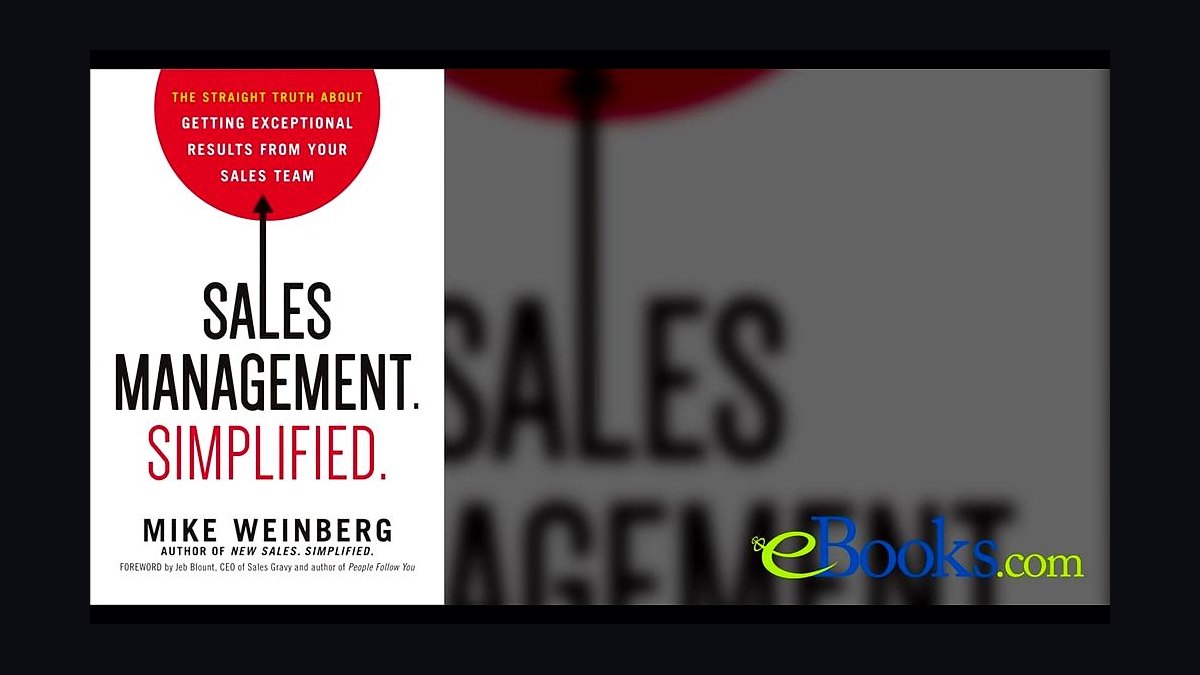
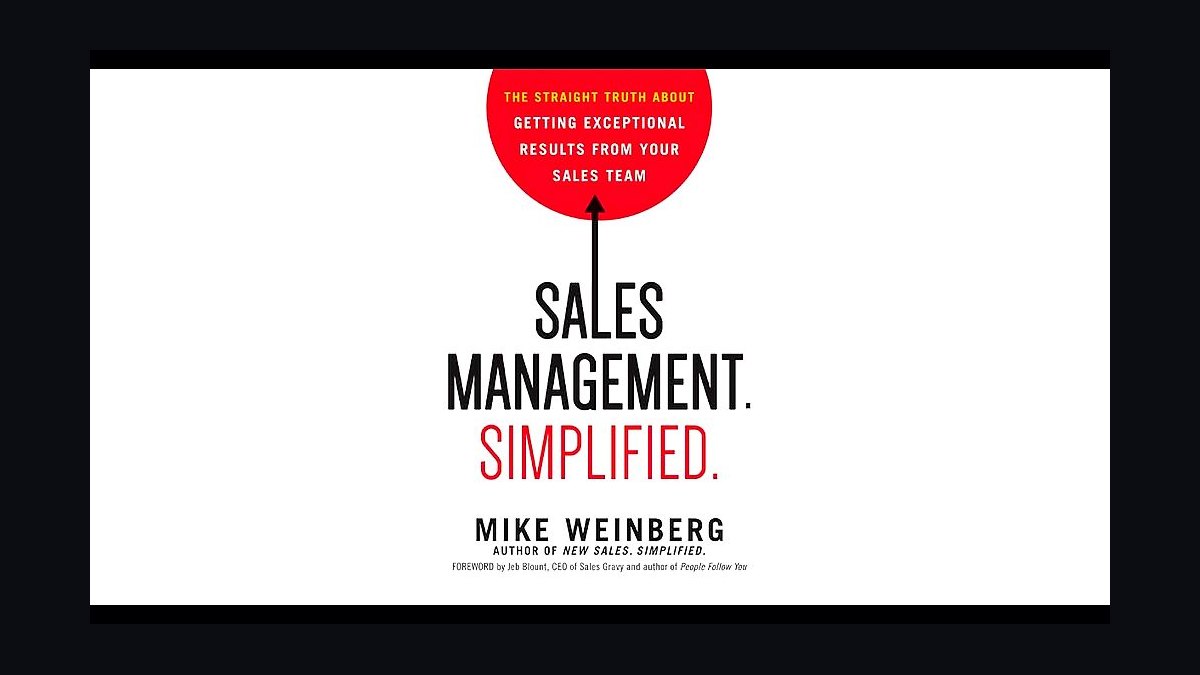
Sales Management. Simplified.: The Straight Truth About Getting Exceptional Results from Your Sales Team (AMACOM, 2015) by Mike Weinberg argues that broken sales teams are almost always a broken-management problem, not a broken-rep problem. The fix is a disciplined operating rhythm — calendar audit, mandatory weekly 1:1s, daily prospecting, and a lighter CRM touch — that any front-line manager can install starting Monday, with no budget and no RevOps team required.
What it is and why it matters
Weinberg wrote this 230-page book after a decade running The New Sales Coach, the St. Louis consultancy he founded after quota-carrying and sales-leadership roles at Anheuser-Busch InBev and Federal Express. Companies hired him to fix underperforming sales teams, and his diagnosis was consistent across engagements: the reps were rarely the root cause. The manager was. Most sales managers are former top reps promoted with no training, a CRM login, and a comp plan, and thrown into a role that has almost nothing in common with the individual-contributor job they were good at. The book is his attempt to give that manager a Management operating system rather than a pep talk.
The core argument is that sales Management has become an administrative discipline instead of a coaching discipline. Managers spend their weeks buried in CRM hygiene, internal meetings, and comp-plan mechanics — none of which close deals. Revenue comes from daily, in-person coaching on prospecting, qualification, and closing, delivered consistently enough that reps actually change behavior. Weinberg names this failure pattern across seven archetypes he sees repeatedly: the invisible manager who never leaves their office; the super-rep who closes deals personally instead of teaching reps to close them; the CRM administrator who spends 60% of the week on data hygiene; the conflict-averse manager who can't confront an underperformer; the yes-person who won't fight for the team cross-functionally; the over-quota-driven manager who treats reps as numbers; and the under-quota-driven manager who treats reps as friends instead of accountable professionals. His strategy for correcting all seven is the same: hold both accountability and humanity at once, and build a repeatable weekly cadence instead of relying on willpower.

This Summary matters most for directors, VPs, and front-line managers running teams of roughly 5 to 50 reps at companies in the $10M-$200M ARR range — organizations too small for a dedicated RevOps function or a formal manager-training program. It is deliberately the practical, no-budget counterpart to enterprise-scale operating playbooks: where a CRO at a $500M company can lean on process architects and enablement teams, Weinberg's reader has to build the operating rhythm themselves, by hand, on their own calendar.
The manager's operating cadence
Weinberg's rebuild plan is sequential rather than a grab-bag of tips — each step depends on the one before it, which is why the book reads as a strategy document rather than a tips list.

Step one: run the calendar audit. Pull the last 30 days of the manager's actual calendar and bucket every hour into categories — field time with reps, 1:1 coaching, team meetings, cross-functional internal meetings, CRM/reporting/admin, email and Slack, customer escalations, recruiting, and everything else. Weinberg's data from 200+ consulting engagements shows the average underperforming sales manager spends 8-12% of their week in the field and 40-55% in admin and internal meetings — almost exactly inverted from where it needs to be.
Step two: rebuild the calendar to the healthy ratio. The target split is roughly 40-50% field-and-1:1 time, 15-20% recruiting and hiring, 10-15% team meetings, and 15-25% admin and internal work. The mechanical fix is blocking three field days per week for the next four weeks and defending them the way a board meeting would be defended — no double-booking, no "just this once."
Step three: install the mandatory weekly 1:1. This is the highest-leverage 45 minutes in the job and the most commonly skipped. Weinberg's five-part template runs: a five-minute personal check-in, a fifteen-minute walk of the rep's top five deals (stage, next step, blocker, what they need from the manager), a ten-minute prospecting review of new pipeline and next week's committed activity, a ten-minute "skill of the week" coaching topic, and a five-minute close where both rep and manager state their commitments for the week. The discipline — same time weekly, never canceled, never delegated — matters more than the exact template.

Step four: enforce daily prospecting. Every AE prospects 60-90 minutes a day, every day, with no exceptions for tenure or past performance. The manager blocks the time on every calendar (commonly 8-9:30am, ahead of internal meetings), inspects the raw activity numbers, coaches message and sequence quality, and — critically — prospects personally against at least one target account, because a manager who has stopped prospecting loses credibility coaching it.
Step five: correct the CRM relationship. The CRM should serve the rep, not the other way around; any required field that doesn't help the rep sell more is a tax on selling time. Inspection happens in conversation during the 1:1, not in a dashboard — the report is an input to the conversation, not a substitute for it.
Costs, timelines, and typical ranges
Weinberg's book is unusually specific about the time and cost math behind bad Management, which is part of why it reads as operational rather than motivational.
The calendar reset takes about 60 days. Managers who run the audit, discover they're at 8-12% field time, and force the rebuild to 40-50% typically see the rep relationship and pipeline quality shift within two months — not because the reps changed, but because they're finally being coached.

A bad hire costs 3-6 months of team productivity; a slow-fired bad hire costs 9-18 months. Weinberg's "hire slowly, fire quickly" rule is a direct cost argument: the damage of keeping a culture-eroding or underperforming rep compounds well past the cost of the hiring mistake itself.
The underperformer decision window is capped at six months, not nine or twelve. His protocol runs month-by-month: month one is diagnosis (is the gap activity, skill, territory, product-market fit, or personal?); month two is a targeted coaching intervention matched to that diagnosis; month three is a formal performance improvement plan with named metrics and dates; months four and five are PIP execution with regular check-ins; month six is the decision — continue, rarely extend, or exit. Most exits, in his experience, should land at month six; managers who let it run to nine or twelve months damage their own credibility with the rest of the team, who can see the underperformance as clearly as the manager can.
Losing a top performer costs 6-12 months of productivity to replace and rebuild. Weinberg's consulting data puts the top 20% of reps at producing 60-70% of team revenue, which is why he treats their retention as a cost-avoidance problem, not a nice-to-have: more 1:1 time, bigger strategic problems to solve, an explicit path to the next role, comp upgrades substantial enough to signal genuine investment, and specific public recognition rather than generic praise.

Meeting load should shrink by roughly 70%. The average sales manager runs or attends 18-25 internal meetings a week; Weinberg's target surviving set is four: the weekly 1:1 (45 min per rep), a Monday team meeting (60 min, hard stop), a monthly pipeline deep-dive (90 min), and a quarterly business review per rep (90 min). Everything else gets cut unless it demonstrably moves pipeline or develops people.
Only about 22% of B2B AEs generate more than a quarter of their own pipeline, per Pavilion's benchmarking — which is the data point behind Weinberg's insistence that prospecting can't be optional or delegated entirely to marketing-sourced leads.
Where teams get it wrong
The most common failure Weinberg documents is substituting CRM visibility for actual coaching. A manager who inspects pipeline exclusively through Salesforce dashboards, without ever sitting in on a live sales call, ends up managing what he calls "beautiful CRM records of bad deals" — reps learn to optimize for whatever they're inspected on, and if the inspection is a dashboard field instead of a real conversation, the dashboard gets pretty while the pipeline stays sick.

A second recurring mistake is tolerating one or two norm-setting reps and letting their behavior define team culture by default. The chronic late-arriver, the sandbagger, the lead-hoarder, or the rep who skips CRM hygiene doesn't just cause an isolated problem — every tolerated violation quietly lowers the standard for the whole team, because everyone is watching what actually gets enforced versus what's just written in a values deck. Weinberg's corrective is direct and uncomfortable: praise the team publicly, but correct the norm-setting behavior itself in the open, in the appropriate forum, with a clear before-and-after standard — a private-only correction leaves the rest of the team unsure whether the new standard is even real. Firing decisions, by contrast, should stay private and be handled decisively, since airing them publicly just creates rumor and fear rather than clarity.
A third mistake is waiting far too long on underperformers — Weinberg's consulting experience is that most managers wait six to nine months past the point where the pattern is obvious, usually because they like the rep personally and can't face the exit conversation. He reframes this as a kindness failure, not a compassion strength: releasing a struggling rep quickly gives them a real shot at finding a role where they can succeed, while dragging it out damages the rep, the manager's credibility, and the rest of the team's trust in the standard.
A fourth mistake is treating top performers as self-sufficient and quietly under-investing in their development because "they're doing fine" — the instinct to leave a top rep alone is precisely backwards, since top performers usually want a more engaged coach, not less of one, and a team that only coaches its strugglers eventually loses its best people to a competitor who pays attention to them.
A fifth mistake, especially relevant outside pure SaaS, is assuming inbound lead flow is stable enough to lean on. Weinberg's client base skews industrial — manufacturing, distribution, building products, services — and his insistence that every AE prospects daily, regardless of how strong inbound looks this quarter, comes from watching teams get blindsided when a marketing budget cut or channel shift dries up the pipeline overnight for reps who never built an independent prospecting muscle.
Decision framework: when to choose what
Not every underperformance signal calls for the same response, and Weinberg's framework is explicitly diagnostic before it's corrective — the wrong intervention (say, a PIP for what's actually a territory problem) wastes the six-month window without fixing anything.
The same either/or logic applies at the book level: teams with 5-25 reps at $10M-$200M in revenue and no dedicated RevOps function are Weinberg's core audience, and his lighter-touch CRM and meeting discipline fits that scale. Larger, more complex enterprise motions — full RevOps function, dedicated sales-ops managers, multi-year deal cycles — need the heavier deal-review and CRM formality that enterprise-focused operating playbooks describe; Weinberg's own chapter on CRM explicitly flags that his lighter rule set is calibrated for mid-market and SMB, not for a $1B enterprise pipeline with dozens of stakeholders per deal.
Related questions
Does Weinberg's playbook work for fully remote sales teams?
Yes, with substitution rather than abandonment: replace field ride-alongs with call-shadowing tools or live video drop-ins, replace office presence with deliberate weekly video 1:1s and monthly in-person gatherings. The underlying principle — the manager observes the actual selling motion — survives the change in medium.
How is this different from an enterprise-focused CRO playbook?
Weinberg writes for the front-line manager of a 5-25-rep team with limited RevOps support; enterprise playbooks target CROs running $200M+ orgs with full RevOps and dedicated managers. Both are correct for their scale — the practices are complementary, not competing.
What's the single highest-leverage idea in the book?
The calendar audit. Most managers discover they're spending 8-12% of their time in the field against a healthy target of 40-50%, and rebuilding to that ratio reshapes the team within roughly 60 days.
Does Weinberg think CRM tools are the problem?
No — he objects to CRM visibility substituting for real coaching, not to CRM tools themselves. The system should support the management work, not replace the manager's presence on live calls.
Is the book useful outside software sales?
Yes. Weinberg's consulting base is heavily industrial (manufacturing, distribution, building products, services), making the book more broadly applicable to complex B2B sales generally than titles written primarily for SaaS.
FAQ
Does Weinberg's playbook still work for fully remote sales teams in 2027? Yes, with adaptation. Replace field ride-alongs with video call-shadowing and replace office presence with deliberate weekly video 1:1s plus monthly in-person team gatherings. The core principle — the manager observes the actual selling motion rather than just its outputs — adapts cleanly to a remote medium.
How does this book differ from enterprise-focused sales-leadership playbooks? Weinberg writes specifically for the front-line manager of a 5-25-rep team inside a $10M-$200M company with little or no dedicated RevOps support. Enterprise-focused playbooks target CROs at $200M-$1B+ companies with full RevOps functions and dedicated sales-ops managers. Both are right for their respective audiences.
What is the single most important Weinberg principle?
The calendar audit. Establishing that 40-50% of a sales manager's time should sit in field-with-reps and 1:1 time is the highest-impact framing in the book — most managers who run the audit discover they're closer to 8-12%, and the resulting rebuild transforms team performance within about 60 days.
Why is Weinberg so skeptical of CRM-centric management? He isn't opposed to CRM as a tool — he's opposed to CRM substituting for coaching. A CRM is a record-keeping system that should support the management work, not stand in for the manager actually observing and coaching live sales calls.
How does Weinberg handle the prospecting-versus-inbound debate? Unambiguously: every AE prospects, no exceptions, even in inbound-heavy motions. Inbound lead flow is volatile — subject to marketing budget cuts, economic swings, and channel shifts — so a rep who can't generate their own pipeline is dependent on factors entirely outside their control.
Is the book applicable outside B2B SaaS specifically? Yes. Weinberg's client base skews industrial — manufacturing, distribution, building products, and services — making the book less software-centric and more broadly transferable to complex B2B sales in healthcare, financial services, professional services, and government sales.
Sources
- Weinberg, Mike. *Sales Management. Simplified.: The Straight Truth About Getting Exceptional Results from Your Sales Team.* AMACOM/HarperCollins Leadership, 2015. ISBN-13: 978-0814436431.
- HarperCollins Leadership publisher page: harpercollinsleadership.com
- Mike Weinberg's consultancy and author site: newsalescoach.com
- Mike Weinberg's personal blog: mikeweinberg.com
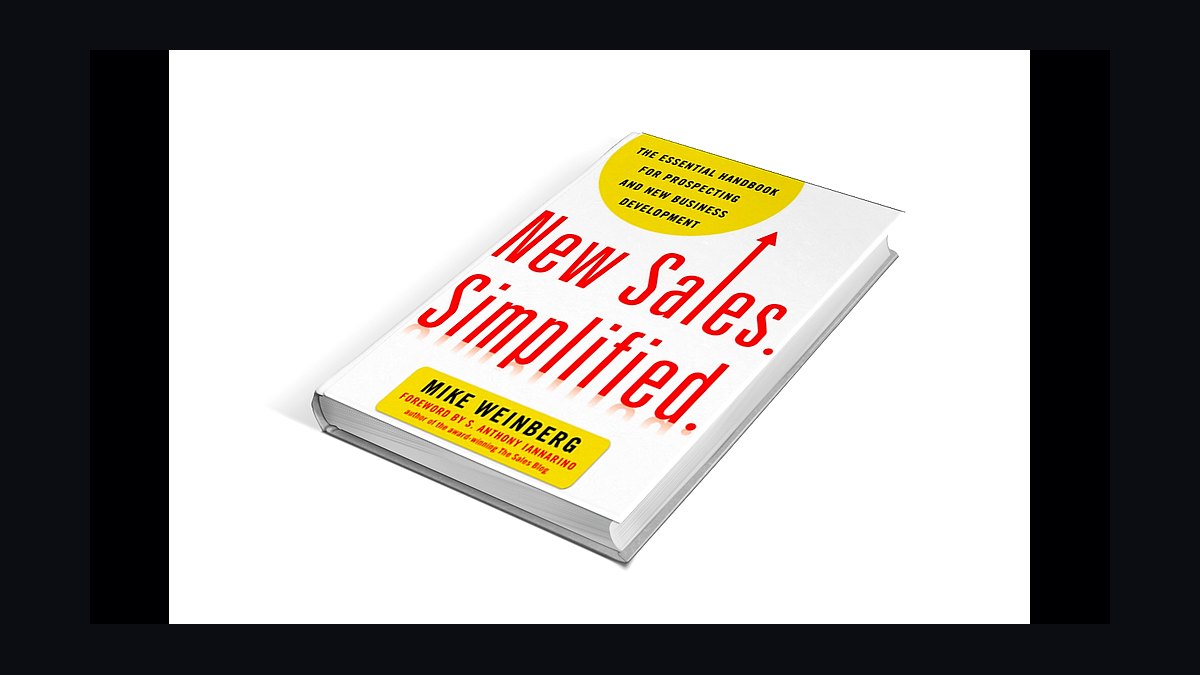
- Weinberg, Mike. *New Sales. Simplified.: The Essential Handbook for Prospecting and New Business Development.* AMACOM, 2012. ISBN-13: 978-0814431771.
- Weinberg, Mike. *#SalesTruth: Debunk the Myths. Apply Powerful Principles. Win More New Sales.* HarperCollins Leadership, 2019. ISBN-13: 978-1400216024.
- Pavilion (sales-leadership community and benchmarking research): joinpavilion.com
- Selling Power magazine, "Top Sales Books" coverage: sellingpower.com
Related on PULSE
- New Sales. Simplified. by Mike Weinberg — Cliff Notes Summary for AEs
- New Sales. Simplified. by Mike Weinberg — Cliff Notes Summary & Key Takeaways
- Sales Management Simplified — Cliff Notes Summary
- Sales Truth by Mike Weinberg — Cliff Notes Summary
- Cracking the Sales Management Code by Jason Jordan and Michelle Vazzana: Summary, Key Lessons, and RevOps Takeaways
- High Output Management by Andy Grove — Cliff Notes Summary
This page will be disappearing soon. Save it to your device for $1 — or read it free while it is here.
@Kory-White- · if Venmo asks, the last 4 of my number are 2012
This page is gone.
This one is off the shelf now. $1 keeps it on your phone for good — the whole page, pictures and diagrams included.
 book-summaryNew Sales. Simplified. by Mike Weinberg — Cliff Notes Summary for AEs
 pulse-recentWhat are the concrete steps in Strategic Selling for building a sales plan in 2027?
 pulse-recentSell or Be Sold by Grant Cardone — Top 10 Key Takeaways for Sales Leaders in 2027
 pulse-recentThe Challenger Customer by Brent Adamson — Top 10 Key Takeaways for Sales Leaders in 2027
 pulse-recentSales Engagement by Manny Medina — Top 10 Key Takeaways for Sales Leaders in 2027
 pulse-recentWhat is the second concrete step in Strategic Selling by Miller Heiman for identifying a sales coach in 2027?
 pulse-recentWhat is the first concrete step in The Sandler Rules by David Mattson for building a sales plan in 2027?
 pulse-recentThe Greatest Salesman in the World by Og Mandino — Top 10 Key Takeaways for Sales Leaders in 2027
 pulse-recentThe Collaborative Sale by Keith Eades — Top 10 Key Takeaways for Sales Leaders in 2027
 pulse-recentWhat is the step-by-step process for Strategic Selling by Miller Heiman in 2027?