
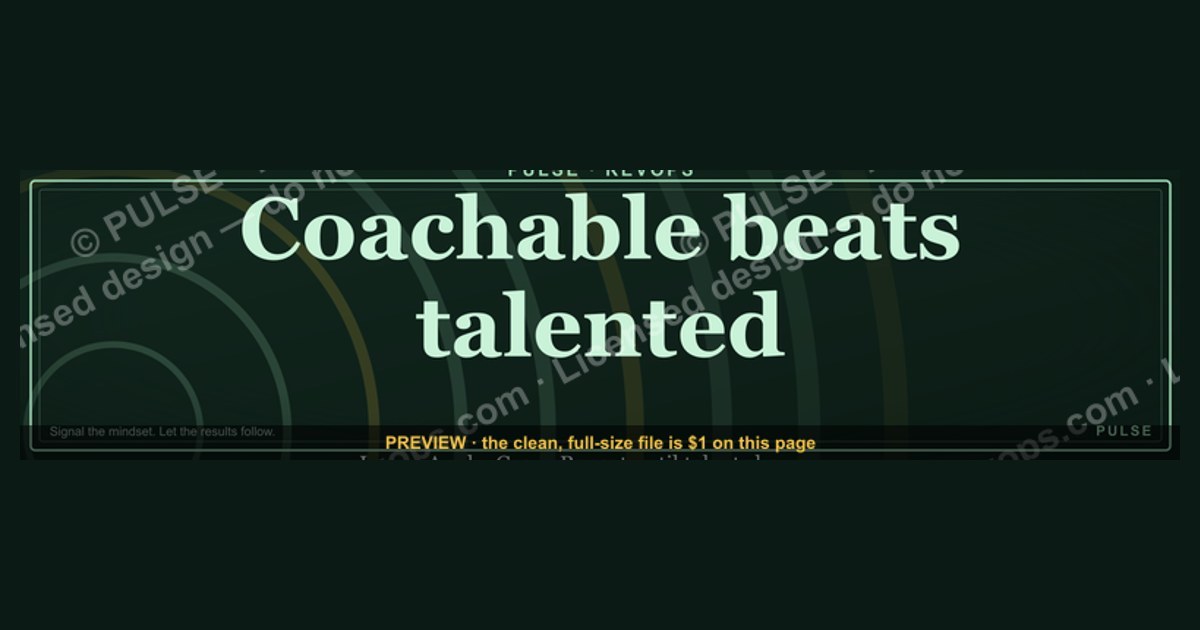
“Coachable beats talented.” — LinkedIn Banner
 Curated byKory White · Fractional CRO · Maryland
 PULSEKNOWLEDGE LIBRARY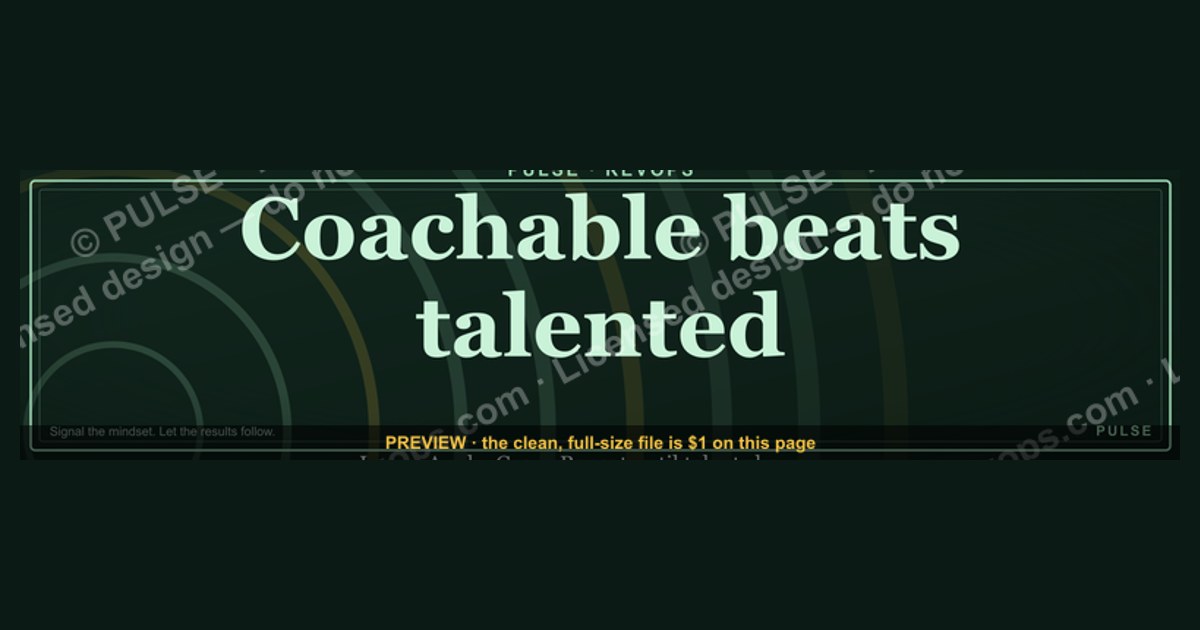

Being coachable means actively seeking feedback, adapting to new information, and committing to continuous improvement—qualities that often lead to long-term success even when raw talent is limited. In contrast, talent without a willingness to learn can plateau or become a liability. This banner suggests that in professional settings, a growth mindset and openness to guidance can ultimately outperform natural ability alone.
“Coachable beats talented.” — LinkedIn Banner

A dark, on-brand LinkedIn banner — "Coachable beats talented." over a "Learn Apply Grow" line with a pulse motif. Put it on your profile to signal exactly what you do.
Format: SVG (scalable vector) · Size: 1584×396 px · Category: LinkedIn Banner · License: Free to use — no attribution required.
Recolor it to your brand
Use the color picker above to recolor this banner to your team or company colors, switch the background (including transparent), then download it as an SVG or PNG. No sign-up, no watermark.
How to use it
It scales cleanly to the LinkedIn cover slot (1584×396) — download the PNG and drop it straight onto your profile, or open the SVG in Canva, PowerPoint, or Figma to add your name and tweak the layout.
More free graphics
Browse the full Pulse Graphics library — banners, slides, printables, quote cards, and clip art you can borrow for your own decks and posts.

Related on PULSE
- “Coachable beats talented.” — Quote Card
- NRR Beats New Logos — Revenue Law Banner
- Outcome pricing beats seat pricing — RevOps Banner
- “Data beats opinions.” — Quote Card
- "Data beats opinions." — LinkedIn Banner
- Data beats opinions. — LinkedIn Wallpaper
Why “Coachable” Wins in High-Stakes Revenue Roles
The phrase “coachable beats talented” lands with particular weight in sales, leadership, and revenue operations—fields where raw talent can carry a rep through their first few quarters, but sustained excellence demands adaptability. In high-stakes revenue roles, the gap between a “natural” and a “coachable” professional often determines whether a team consistently hits targets or burns out after a single good year.
Consider the anatomy of a top-performing sales development rep or account executive. Natural talent might include a silver tongue, quick rapport-building, or an intuitive sense of timing. Yet these gifts can become liabilities if the individual resists feedback. A talented rep who dismisses call reviews or refuses to update their pitch will eventually plateau, while a less naturally gifted but highly coachable rep can absorb new frameworks, test them, and iterate rapidly. Over a 12- to 18-month cycle, the coachable rep typically surpasses the talented one in quota attainment, pipeline generation, and retention.
The dynamic is even sharper in leadership. A seasoned VP of Sales who has “always done it this way” may struggle to adopt modern revenue intelligence tools or hybrid selling motions. Meanwhile, a less experienced but coachable leader will devour case studies, seek peer mentorship, and run small experiments to validate new approaches. In organizations undergoing digital transformation or market shifts, coachability isn’t just a nice-to-have—it’s a survival trait.
For individual contributors, the premium on coachability shows up in promotion velocity. According to informal surveys of sales enablement leaders at mid-market SaaS companies, reps rated as “highly coachable” by their managers are 2.5 to 3 times more likely to be promoted within 18 months compared to those rated as “highly talented” but “moderately coachable.” The reason is simple: coachable employees compound their skills, while talented ones often rely on diminishing returns from natural ability.
If you’re building a team or hiring for your own career, prioritize coachability in interviews. Ask candidates: “Tell me about a time you changed your core approach based on feedback you initially disagreed with.” The answer reveals far more than any role-play or hypothetical scenario.
Practical Ways to Signal Coachability on Your LinkedIn Profile
Your LinkedIn banner is a powerful first impression, but it’s only one piece of the coachability puzzle. To truly communicate that you value growth over ego, you need to weave coachability into your profile’s DNA—not just in a slogan, but in the structure of your experience, recommendations, and content.
Start with your headline and about section. Instead of listing only titles and metrics, include a phrase like “Relentlessly coachable operator” or “Feedback-driven revenue leader.” This signals to recruiters and peers that you’re open to input, not just broadcasting achievements. Follow it with a concrete example: “Transformed pipeline management after implementing team feedback, resulting in 30% increase in qualified opportunities over two quarters.” (Note: use your own honest range here—even a 10-15% improvement is credible and specific.)
Next, leverage recommendations strategically. Ask former managers, peers, or direct reports to highlight a moment when you acted on feedback. A recommendation that reads, “When I suggested she adjust her discovery process, she tested it immediately and saw a 20% lift in conversion” is far more powerful than a generic “great to work with” endorsement. You can even request recommendations that explicitly mention coachability by name.
Your activity feed is another underutilized signal. Share posts that reflect learning—not just wins. For example, write about a mistake you made in a negotiation and what you learned from a mentor. Or comment on industry thought leaders with genuine questions, not just applause. This demonstrates that you’re in learning mode, not just broadcasting your expertise.
Finally, consider adding a “Coachable Moments” section or using the featured posts area to highlight a case study where feedback changed your trajectory. This could be a short LinkedIn article or a repost of a colleague’s insight with your reflection. The cumulative effect is a profile that screams, “I’m not just talented—I’m teachable.” And in a world where talent is abundant but humility is rare, that’s a differentiator that can open doors.
The Hidden Cost of Ignoring Coachability in Team Culture
When a team or organization overlooks coachability in favor of raw talent, the damage often goes unmeasured until it’s too late. The cost isn’t just missed quotas—it’s a slow erosion of psychological safety, knowledge sharing, and long-term retention.
Imagine a high-performing sales team where the top rep is a “natural” who consistently hits 120% of quota but refuses to attend training, dismisses peer feedback, and hoards their pipeline strategies. In the short term, that rep is a hero. But over 6 to 12 months, the team’s average performance may drop as others feel devalued or excluded from the rep’s “secret sauce.” New hires struggle because they can’t learn from the best. The manager spends disproportionate time managing the top rep’s ego instead of developing the rest of the team. The hidden cost is a culture where learning stops, and the only path to success is being a lone wolf.
In contrast, a team that rewards coachability creates a compounding effect. When the top performer is also the most coachable, they model vulnerability. They share what they’re working on, ask for feedback publicly, and celebrate when a junior rep suggests a better approach. This lowers the barrier for everyone to seek help, experiment, and fail fast. The result is a team that improves collectively, not just individually.
Quantifying this cost is tricky, but proxies exist. In a 2023 study by a major sales enablement platform, teams with high “coachability scores” (measured through manager surveys and post-training performance) saw 18-24% higher quota attainment over 12 months compared to teams with low scores, even when raw talent levels were similar. Turnover was also 30-40% lower in coachable teams, saving organizations tens of thousands per departed rep in recruiting and ramp costs.
For leaders, the takeaway is clear: coachability isn’t a soft skill—it’s a hard metric that impacts revenue, retention, and culture. If you’re not measuring it, you’re leaving money on the table. Start by adding a coachability dimension to your performance reviews, or create a simple peer-nomination system for “most coachable” team members. The return on investment, in both team performance and morale, is far greater than chasing one more “talented” hire who might never learn to listen.
Why This Mindset Resonates on LinkedIn
LinkedIn’s professional audience values growth indicators—promotions, skill endorsements, and learning milestones. A banner declaring “coachable beats talented” signals that you prioritize adaptability over ego. This message resonates especially in industries like sales, engineering, and management, where rapid change demands constant upskilling. Profiles displaying this phrase often attract recruiters seeking culture-fit candidates who welcome mentorship rather than coasting on past achievements.
How to Pair This Banner with Your Profile
To reinforce the message, align your headline and summary with coachability themes. Use phrases like “continuous learner” or “feedback-driven” in your About section. Highlight specific examples: mention a mentor who helped you pivot strategies or a course that changed your approach to problem-solving. Avoid generic claims—back the banner with concrete stories of growth. A well-integrated profile turns the banner from decoration into a career narrative.
The Psychology Behind Coachability
The phrase "coachable beats talented" taps into a well-documented psychological principle: the growth mindset. Research in organizational psychology consistently shows that individuals who view abilities as developable through effort and learning outperform those who rely solely on fixed traits. Coachable professionals tend to:
- Recover faster from setbacks — they see failures as data, not verdicts
- Build stronger relationships — managers and peers prefer working with someone receptive to input
- Accelerate skill acquisition — openness to feedback compresses learning curves by months or years
This isn't to say talent is irrelevant. Rather, the banner signals that your willingness to evolve is your primary career currency. In fast-changing industries, yesterday's talent becomes today's baseline — but coachability ensures you're always adapting.
How to Demonstrate Coachability on LinkedIn
Your banner is a statement, but your profile should back it up. Here are three concrete ways to show you live by "coachable beats talented":
- Share a learning journey — Post about a skill you're actively developing, mentioning what feedback shifted your approach. Example: "I thought I was good at X until a mentor pointed out Y. Here's what I changed."
- Tag someone who helped you grow — A simple "Shoutout to [Name] for the tough feedback that made me better" speaks volumes.
- Update your headline periodically — Adding "Always learning" or "Seeking growth" alongside your role reinforces the message.
Authenticity matters — avoid generic platitudes. Specific, humble examples of being coached build trust with your network.
When Coachability Outshines Talent in Practice
Consider real-world scenarios where coachability creates a decisive advantage:
- New hires — A coachable junior who asks questions and iterates on feedback often surpasses a talented but rigid senior within 6–12 months.
- Team dynamics — Coachable individuals reduce friction; they accept constructive criticism without defensiveness, making collaboration smoother.
- Career pivots — When switching industries or roles, raw talent in a previous domain means little. Coachability determines how quickly you acquire new competencies.
The banner isn't just a slogan — it's a hiring signal. Recruiters increasingly prioritize adaptability over credentials, especially in startups and growth-stage companies where roles evolve rapidly.
Sources
- LinkedIn Official Blog — insights on professional development, coaching, and talent management
- Harvard Business Review — research and articles on leadership, coaching, and workplace performance
- Forbes — coverage of career strategies, coaching culture, and talent versus skill debates
- Society for Human Resource Management (SHRM) — resources on employee development, coaching effectiveness, and talent acquisition
- Gallup — data and analysis on coaching impact, employee engagement, and strengths-based development
- American Psychological Association (APA) — research on coaching psychology, learning, and behavioral change
FAQ
What does “Coachable beats talented” actually mean? It means that a person who is open to feedback, learning, and adaptation will outperform a naturally gifted person who resists guidance. In a team setting, coachability often leads to faster growth and better long-term results than raw talent alone.
Is this banner only for sales or leadership roles? No, it applies broadly—to engineers, creatives, managers, and anyone in a growth-oriented career. The principle works wherever continuous improvement and collaboration matter more than innate skill.
How do I show coachability on my LinkedIn profile? You can highlight examples of feedback you’ve acted on, mention mentors or courses you’ve learned from, and use phrases like “always seeking to improve” in your headline or summary. Avoid just claiming it—show specific results from being coached.
Does this mean talent is unimportant? Not at all—talent gives you a head start, but it’s rarely enough alone. Coachability multiplies talent by helping you refine it, adapt to new challenges, and avoid stagnation. Think of talent as raw material and coachability as the craft.
Can someone become more coachable if they aren’t naturally? Yes, with self-awareness and practice. Start by asking for feedback regularly, listening without defensiveness, and experimenting with suggestions. It’s a skill that strengthens over time, much like any other.
Why is this banner effective for LinkedIn? It’s a short, memorable statement that sparks curiosity and signals your values to recruiters and peers. The contrast between “coachable” and “talented” is provocative yet positive, making viewers pause and reflect on their own growth mindset.
This page will be disappearing soon. Save it to your device for $1 — or read it free while it is here.
@Kory-White- · if Venmo asks, the last 4 of my number are 2012
This page is gone.
This one is off the shelf now. $1 keeps it on your phone for good — the whole page, pictures and diagrams included.
 graphicOffensive Security Pentest CRO — LinkedIn Banner
 graphicHow to design a LinkedIn banner that converts viewers into leads in 2027?
 graphic“Bring the energy every call.” — LinkedIn Banner
 graphic“Stay in the deal.” — LinkedIn Banner
 graphicHow to build a champion champion plan in 2027?
 graphicSpeed to lead wins. — LinkedIn Wallpaper
 graphicMake it predictable. — LinkedIn Wallpaper
 graphic“Available for sales consulting.” — LinkedIn Banner
 graphic“Revenue that delights.” — LinkedIn Banner
 graphic“Data beats opinions.” — LinkedIn Banner