
“Selling trust in FinTech.” — LinkedIn Banner
 Curated byKory White · Fractional CRO · Maryland
 PULSEKNOWLEDGE LIBRARY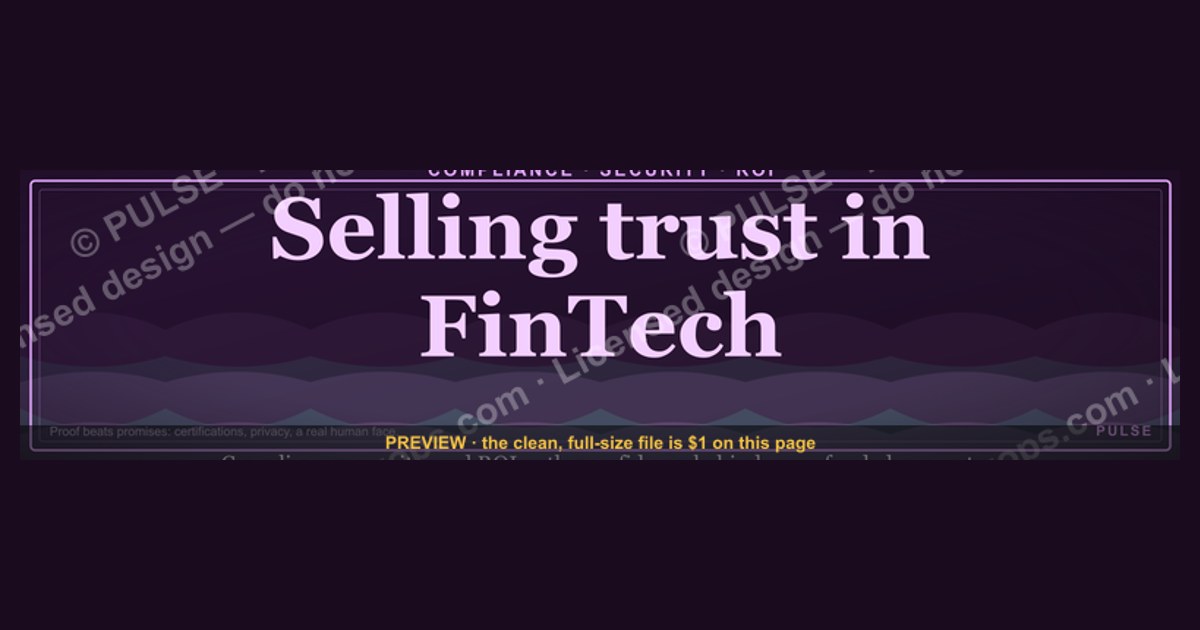
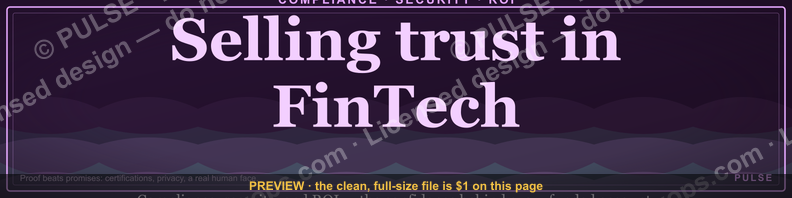
A LinkedIn banner reading "Selling trust in FinTech" tells a viewer, in four words, that your value proposition isn't speed, price, or features — it's the security, compliance, and transparency that make people comfortable putting money into a digital product. It's a positioning statement aimed at compliance, risk, product-marketing, partnerships, and revenue roles, where the job is to convert a stranger's hesitation into a funded account. Practically, the banner works best when it's backed by proof on the same profile — security certifications, a clear privacy stance, regulatory licenses, and a real human face — so the claim reads as a track record rather than a slogan. Use it when you want recruiters, buyers, and partners to immediately understand that you sell the one thing every FinTech ultimately competes on: confidence.
“Selling trust in FinTech.” — LinkedIn Banner

A dark, on-brand LinkedIn banner — "Selling trust in FinTech." over a "Compliance · Security · ROI" line with a pulse motif. Put it on your profile to signal exactly what you do.
Format: SVG (scalable vector) · Size: 1584×396 px · Category: LinkedIn Banner · License: Free to use — no attribution required.
Recolor it to your brand
Use the color picker above to recolor this banner to your team or company colors, switch the background (including transparent), then download it as an SVG or PNG. No sign-up, no watermark.
How to use it
It scales cleanly to the LinkedIn cover slot (1584×396) — download the PNG and drop it straight onto your profile, or open the SVG in Canva, PowerPoint, or Figma to add your name and tweak the layout.
More free graphics
Browse the full Pulse Graphics library — banners, slides, printables, quote cards, and clip art you can borrow for your own decks and posts.
Why “Selling Trust” Is the Only Sustainable Moat in FinTech
In the early 2010s, FinTech startups competed on speed, lower fees, and slick UX. By the mid-2020s, those advantages had become table stakes. The differentiator that survives copycat features and price wars is trust — and trust isn't a setting you toggle on. It's a system embedded in your product, your marketing, and your operations.

When you put "Selling trust in FinTech" on your banner, you're making a public claim that your company understands the gravity of handling money, data, and people's financial futures. Here's what that claim has to mean in practice.
Trust compounds slowly and decays fast. Unlike a feature that can be copied in weeks, trust accrues one good interaction at a time — a clean dispute resolution, a transparent fee disclosure, a proactive fraud alert. A single breach or regulatory fine can wipe out years of that work. That asymmetry is exactly what makes trust defensible: a competitor can ship your features, but they can't shortcut your operating history.
Trust has three pillars, and most FinTechs neglect one. Technical trust is encryption, uptime, and data integrity. Regulatory trust is licensing, compliance, and audit readiness. Relational trust is support, transparency, and fair treatment. Most companies over-invest in the first two and starve the third — yet relational trust is what actually drives referrals and repeat usage. A banner that says "Selling trust" only holds up if you can speak to all three.
You can manage trust like any other metric. Leading teams track trust-adjacent indicators alongside NPS and churn: time-to-resolve complaints, frequency of proactive communications, and outcomes of third-party audits. You don't need a single magic "trust score" — you need a small dashboard of leading indicators you review as seriously as revenue. If you're going to sell trust, instrument it.

The Visual and Verbal Language of Trust in FinTech Branding
Your banner is prime real estate for communicating trustworthiness, and the easiest way to waste it is with generic stock imagery — handshakes, padlocks, glowing servers. Those visuals are so overused they now read as a shortcut, which is the opposite of the signal you want.
What effective trust visuals do. The banner here uses a dark, restrained palette with a wireframe hand placing an element into a composition. It reads as precision and intent rather than flash — the same reason physical banking spaces lean on dark wood and clean lines. The "hand placing an element" suggests curation and care, not automation.
Color and type carry tone. Dark blue and charcoal are the conventional palette of financial services because they read as stable and authoritative; bright reds or oranges signal disruption, which you should only invoke deliberately. Pair that with a clean sans-serif — Inter, Plus Jakarta Sans, or Helvetica Neue — at a semi-bold weight with generous kerning. Script and decorative fonts feel unserious next to money.
Framing changes meaning. "We are the most secure platform" is an unverifiable claim. "We earn your trust every day" is a commitment, and commitments invite less skepticism. Leading with trust at all is itself differentiating — most profiles sell features, speed, or savings — so "Selling trust in FinTech" earns a second look simply by being unexpected.

Stay consistent. A banner that promises trust while your posts read as aggressive pitches creates a gap people notice. The visual is only as credible as the behavior behind it.
Operationalizing Trust: What Happens After Someone Clicks Your Banner
A banner is a handshake; the real work of selling trust starts after the click. A common failure is a trust-forward banner pointing to a landing page that asks for sensitive information with no explanation, or a product that buries fees in fine print.
Pass the first-click test. Whatever your banner promises, the destination should reinforce it within seconds: a visible privacy policy, a recognized security certification (SOC 2, ISO 27001, or PCI DSS), and a human face — yours or your team's. Abstract pages with no social proof or security signal quietly undercut the banner.
Use transparency as a tactic. Public, plain-language fee schedules and real-time status pages are among the most underused trust tools in FinTech; companies like Monzo and Revolut built loyal followings partly on that openness. If your banner sells trust, a "Trust Center" link — certifications, licenses, uptime history in one place — makes the claim checkable.

Treat support as a trust surface, not a cost center. Trust is made or lost in moments of friction. A dispute that reaches a capable human quickly deepens confidence; a chatbot that can't understand the problem erodes it. If you publish a response-time commitment, it should be one you can actually hold.
Let your activity prove the point. Posts about security practices, regulatory changes, and how people can protect their own finances reinforce the narrative; an feed that's only funding rounds and growth metrics reads as self-serving. Every post is a chance to show the banner isn't just a graphic.
Play the long game. Trust isn't a campaign, it's a culture — reviewing security protocols, engaging regulators, listening to customer concerns, and training teams on ethical practice. The banner signals you're that kind of operator. It earns its keep only when your daily actions match it.
Why “Trust” Is the Only Real Moat in FinTech
In a market where dozens of apps offer near-identical transfers, budgeting, or lending features, trust becomes the single sustainable differentiator. A banner that says “Selling trust” signals you understand that regulatory licenses (e.g., money transmitter permits, SOC 2 Type II, PCI-DSS compliance) aren’t just checkboxes — they’re the product itself. FinTech buyers and partners know that a single data breach or compliance failure can destroy years of growth. By leading with trust, you position yourself as the person who prevents that catastrophe, making you invaluable to any organization where reputation is the most fragile asset.

How to Make the Banner Work Harder on Your Profile
A banner is a headline, not the full story. To convert viewers, pair it with a featured section containing: a clear list of relevant certifications (e.g., “ISO 27001 certified,” “SOC 2 Type II”), a link to your company’s public trust page or security whitepaper, and a brief “Trust in practice” bullet showing how you’ve reduced fraud or improved onboarding compliance. Also include your photo — faces build trust faster than logos. This combination transforms the banner from a clever line into a verifiable promise, making recruiters and decision-makers more likely to click “Connect” rather than scroll past.
Why “Selling Trust” Works Better Than “Selling Features”
FinTech buyers are conditioned to expect feature parity—every neobank offers instant transfers, every lending platform promises low rates, every robo-advisor touts AI-driven returns. What differentiates a funded startup from a forgotten one is the willingness to hand over sensitive financial data. By leading with “trust,” you signal that you understand the emotional friction behind every sign-up: the fear of fraud, the anxiety of data breaches, the skepticism about hidden fees. This framing resonates especially well with compliance officers and risk managers who are the real gatekeepers in B2B FinTech deals. They don’t buy speed; they buy safety. A banner that names that priority tells them you speak their language before they even click your profile.
How to Back Up the Claim on Your Profile
A trust slogan without evidence is just marketing fluff. To make “Selling trust in FinTech” land, your LinkedIn profile should immediately reinforce it with concrete signals. In your headline, include a specific credential like “SOC 2 Type II | PCI DSS Level 1” or “Regulated by FCA/FinCEN.” In your featured section, pin a post about a security audit, a compliance milestone, or a customer testimonial that mentions peace of mind. Even your profile photo matters—a professional headshot with a neutral background conveys transparency better than a logo or abstract art. The goal is to create a visual chain: banner catches attention, headline validates competence, featured content proves results. Without that chain, the banner becomes a hollow boast.
When to Rotate the Banner for Different Audiences
While “Selling trust in FinTech” is a strong evergreen message, its effectiveness varies by audience segment. For a product launch targeting early adopters, you might swap it for “Speed meets compliance” to emphasize both innovation and safety. For a hiring push aimed at engineers, consider “Build where security is the feature” to attract talent who value robust infrastructure. Keep the trust banner as your default, but treat it as part of a rotating toolkit—change it quarterly to match your current funnel focus, whether that’s fundraising, partnership development, or talent acquisition. The core message stays consistent, but the framing adapts to who you need to convince right now.
Sources
- World Bank — Global Findex and research on financial inclusion and digital payments infrastructure
- Financial Stability Board (FSB) — regulatory frameworks for financial technology and digital trust
- Harvard Business Review — articles and case studies on consumer trust and brand reputation
- Deloitte — industry reports on digital trust, cybersecurity, and FinTech adoption
- Federal Trade Commission (FTC) — consumer protection and fraud-prevention guidance for financial services
- McKinsey & Company — analysis of trust-building and growth strategies in financial services
Related on PULSE
- FinTech CRO — LinkedIn Banner
- The Value Selling Ladder — Infographic
- SPIN Selling — Infographic
- Make selling effortless. — LinkedIn Wallpaper
- “Selling outcomes, not hours.” — LinkedIn Banner
- “Selling science and scale.” — LinkedIn Banner
FAQ
What does “selling trust in FinTech” actually mean? It means your primary product isn't a feature set — it's the confidence users have in your security, reliability, and transparency. In financial services, people are handing over money and sensitive data, so the deciding factor in whether they sign up and stay is whether they believe you'll protect both. "Selling trust" is the explicit decision to lead with that confidence rather than with speed or price.
How do you know whether a FinTech brand is actually trusted? Look at behavioral signals rather than a single headline number: retention and repeat usage, the share of churn tied to security or billing concerns, complaint resolution times, and third-party audit results. Public proof points — SOC 2 or ISO 27001 certification, regulatory licenses, transparent status pages — also indicate a brand that's willing to be measured. No one metric captures trust, so triangulate several.
Can a small FinTech startup compete with established banks on trust? Yes, but the playbook is different. Incumbents lean on legacy and scale; startups win by being radically transparent and personal — publishing security audits, posting clear fee structures, and responding to concerns in public. Because they lack a long track record, startups have to over-communicate their safety measures rather than assume the benefit of the doubt.
What’s the biggest mistake FinTechs make when trying to build trust? Overpromising — guaranteeing security or feature parity they can't yet deliver. A single breach or a hidden fee can undo a long run of careful trust-building, and the gap between the promise and the reality is what customers remember. It's safer to under-promise on claims and over-deliver on reliability.
How long does it take to build meaningful trust in FinTech? There's no fixed timeline, but durable loyalty generally comes from a sustained stretch of error-free service and responsive support, not a launch moment. Third-party endorsements, certifications, and regulatory approvals can accelerate the first impression, while a single high-profile failure can reset the clock. Treat it as ongoing maintenance, not a milestone you clear once.
Is a LinkedIn banner really effective for selling trust in FinTech? On its own, no — a banner can't close trust. What it can do is set positioning at the top of a professional profile and prime the next step. It works when the credibility signals it implies are confirmed deeper in the profile (certifications, a real photo, links to a Trust Center) and when your posts and behavior match the claim. Think of it as a strong first touchpoint, not the whole argument.
This page will be disappearing soon. Save it to your device for $1 — or read it free while it is here.
@Kory-White- · if Venmo asks, the last 4 of my number are 2012
This page is gone.
This one is off the shelf now. $1 keeps it on your phone for good — the whole page, pictures and diagrams included.
 graphic“Trusted advisor, never a vendor.” — LinkedIn Banner
 graphic“More pipeline, less panic.” — LinkedIn Banner
 graphicAI Observability Operator — LinkedIn Banner
 graphicSales Coach — LinkedIn Banner
 graphic“Open to sales leadership roles.” — LinkedIn Banner
 graphicInspect. Qualify. Commit. — LinkedIn Wallpaper
 graphicPipeline cures all. — LinkedIn Wallpaper
 graphicSIEM and Data Lake CRO — LinkedIn Banner
 graphic“Great reps are coached, not born.” — LinkedIn Banner
 graphicSell outcomes, not features. — LinkedIn Wallpaper