
Pipeline cures all. — LinkedIn Wallpaper
 Curated byKory White · Fractional CRO · Maryland
 PULSEKNOWLEDGE LIBRARY
Quality
Certified
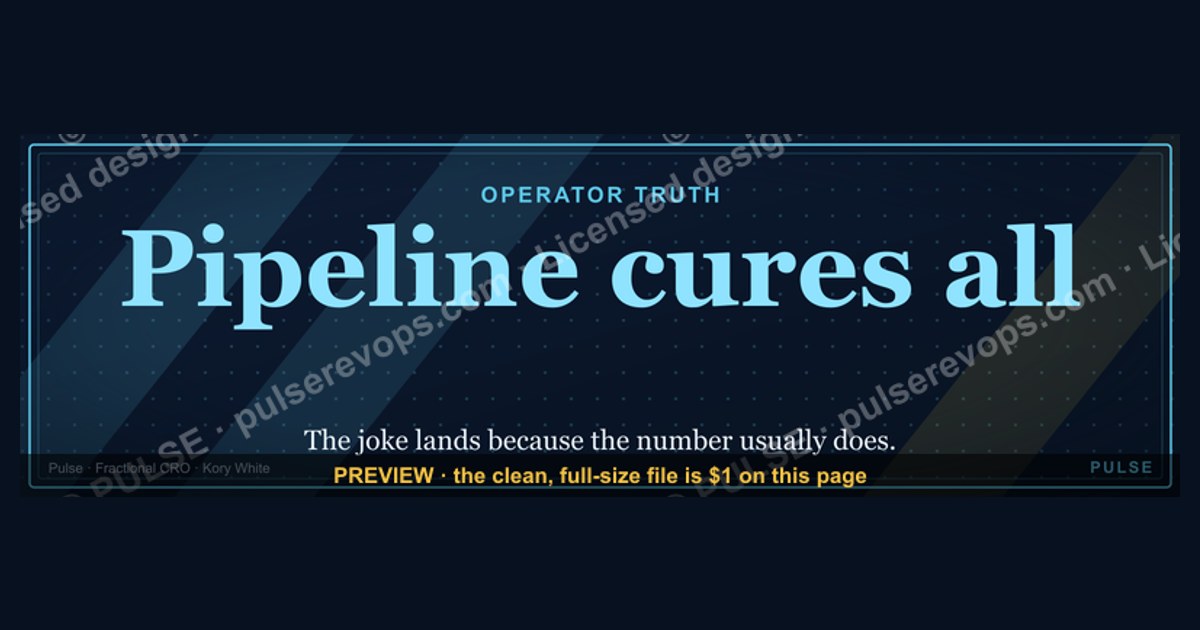
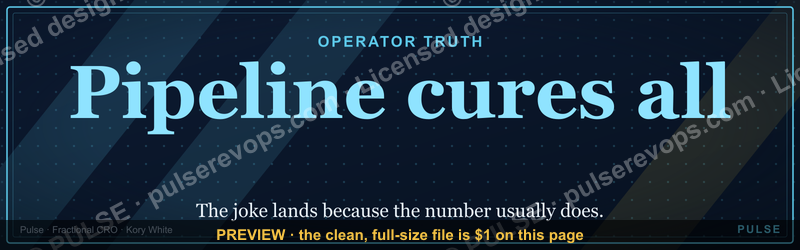
This is a LinkedIn banner (1600×500px) that reads "Pipeline cures all." in bold, condensed sans-serif type, white on a near-black background, styled after the deadpan motivational Wallpaper sales leaders post behind their profile photo. It's a free, downloadable PNG built for reps, SDRs, and RevOps leaders who want a pipeline-first mantra visible every time someone views their LinkedIn profile.
What it is and why it matters
The graphic itself is deliberately spare. Centered on the 1600×500px canvas is the line "Pipeline cures all." set in a heavy, all-caps or title-case sans-serif — something in the weight of Helvetica Bold, Inter Black, or Arial Black — sized large enough to read clearly even when LinkedIn crops it down for the mobile banner strip. Below or beside the main line, in much smaller type, sits the attribution "— LinkedIn Wallpaper," a wink at the fact that this exact phrase has circulated for years as a screenshot passed between sales Slack channels and reposted as profile art. The background is flat and dark — charcoal or true black — so the white type has maximum contrast and the file compresses cleanly as a PNG without banding. There's no logo, no photo, no gradient noise: just type on a field, which is exactly why it reads instantly at thumbnail size in a LinkedIn feed preview.
The reason this kind of banner works is that a LinkedIn profile background is one of the few pieces of real estate a salesperson controls that isn't gated by a CRM, a manager, or a brand style guide. A quota-carrying rep who wants to broadcast identity — "I live and die by pipeline, not vanity metrics" — has almost no other free, always-on channel to do it. The banner sits above the fold on every profile view: a prospect researching a rep before a call sees it, a recruiter sourcing candidates sees it, a peer scrolling LinkedIn sees it passively in their feed when the rep posts. Unlike a bio line, which requires someone to expand "see more," the banner image renders in full immediately. That's the mechanism: zero-friction, always-visible reinforcement of a single belief — that healthy pipeline is the one metric that fixes almost every other sales problem, from missed quota to shaky forecasts to a stalled deal.

The phrase "Pipeline cures all" also functions as a piece of internal sales culture, not just an external signal. Sales leaders use it in kickoff decks and 1:1s as shorthand for a simple diagnostic rule: when a rep is missing number, panicking about a forecast, or losing confidence, the leader's first question is almost never "what's wrong with your close rate" — it's "how much pipeline do you have, and is it enough." A banner that repeats that line to the rep every time they open their own LinkedIn profile is a small, constant nudge in the same direction: before you optimize messaging, before you tighten your deck, before you rework your discovery script, check whether you simply don't have enough opportunities in motion. This banner is meant to be worn as that reminder, publicly.
The step-by-step process
Putting this banner live takes under two minutes, but the crop step is where most people get it wrong, so it's worth walking through deliberately. First, download the PNG at its native 1600×500px resolution rather than a resized or screenshotted copy — a re-saved screenshot introduces JPEG-style compression artifacts around the text edges that look fine on a phone but turn visibly fuzzy on a widescreen monitor. Second, open your own LinkedIn profile in edit mode and tap the small pencil or camera icon that sits directly on the existing cover-image area (on desktop it's a hover-triggered icon in the top-right of the banner; on mobile it's a camera icon in the same spot). Third, upload the file from your device — LinkedIn accepts PNG and JPG for this slot, with no meaningful difference in outcome for a flat, text-only graphic like this one.
%2C_points_out_a_water_pipeline_trench_that_the_Navy_Seabees_dug.jpg)
Fourth, and most important: use LinkedIn's own in-app crop tool rather than trusting the raw upload. LinkedIn's desktop banner render area and its mobile render area are different aspect ratios cut from the same source image, so text that sits dead-center on desktop can drift close to the crop edge on a phone. Drag the crop frame so the "Pipeline cures all." line sits within the middle 60% of the image both horizontally and vertically — that middle band survives every LinkedIn crop variant. Fifth, before saving, preview the banner on both a desktop browser tab and the LinkedIn mobile app if you have it installed; the desktop editor's preview pane is not always a faithful mobile representation. If the text is tight against an edge or a descender is clipped, go back and either re-crop with more margin or re-download a version of the asset with wider side padding rather than trying to fix it inside LinkedIn's limited crop controls. Once the preview looks right on both surfaces, save, and the banner goes live immediately — there's no review delay or approval step on LinkedIn's side for a personal profile.
Costs, timelines, and typical ranges
The banner itself is free to download and use — there's no license fee, no attribution requirement beyond what's already baked into the "— LinkedIn Wallpaper" credit line on the graphic, and no watermark to strip. The only real cost is time, and that time is almost entirely spent in the crop-and-preview loop described above rather than in any design work, since the asset ships finished. For someone doing nothing but swapping their existing banner for this one, budget two to five minutes: thirty seconds to download, a minute to upload and crop, a minute to preview across desktop and mobile, and a minute of margin for a second attempt if the first crop clips the text.

If a rep or a RevOps lead wants to customize the wording, colors, or attribution before publishing — swapping "LinkedIn Wallpaper" for their own name, a team name, or a company tagline — that adds meaningfully more time because it typically requires a design tool rather than LinkedIn's crop box, which can't edit text. Using a free tool like Canva or Adobe Express to open a flat PNG, re-type the headline over a matching dark background, and export a new 1600×500px file usually takes ten to twenty minutes for someone comfortable with basic design software, and closer to thirty to forty-five minutes for someone doing it for the first time, mostly spent hunting for a font weight and background shade that match the original's contrast and legibility. Matching the exact same near-black background color takes a few extra minutes with a color picker tool, since eyeballing it tends to produce a shade that's slightly warmer or cooler than the original and looks mismatched if the two banners are ever seen side by side, as they would be on a sales team's set of LinkedIn profiles.
For a sales team rolling this out across every rep's profile as a small branding exercise, plan on a half-day for one person to build three or four wording variants — the original mantra plus a couple of role-specific lines like "Discovery cures all" for SDRs or "Coaching cures all" for managers — get quick sign-off from a manager on tone, and distribute the files with a one-page instruction sheet covering the upload steps above. That half-day is almost entirely design and coordination time; the per-person application time stays at the two-to-five-minute range regardless of team size, since each person uploads their own banner independently.

Where teams get it wrong
The single most common mistake is uploading the file without cropping deliberately and trusting LinkedIn's auto-center to handle it — it usually doesn't, because LinkedIn's default crop favors the image's geometric center, not necessarily where the text sits within the file. On a banner where the headline is vertically centered but pushed slightly left to leave room for the attribution line, an unchecked auto-crop can shave the last letter or two off "cures" on a mobile render. The fix is the manual preview-on-both-surfaces step covered above — skipping it is the difference between a banner that reads cleanly and one that quietly embarrasses whoever posted it the first time a colleague zooms in on their phone.
The second mistake is treating the banner as permanent installation rather than a rotating signal. A mantra like this lands hardest the first few times a connection sees it and fades into wallpaper — literally — after a few months on the same profile. Teams that get the most mileage out of this kind of asset treat it the way they'd treat a Slack status: swap it in around a kickoff, a quota reset, or a pipeline-generation push, then let it retire once the moment has passed, rather than leaving it as a permanent fixture that stops registering with repeat viewers.

The third and more consequential mistake is using this banner — or letting a team use it — as a substitute for an actual pipeline conversation rather than a reinforcement of one. "Pipeline cures all" is a useful diagnostic heuristic, not a universal one: a rep who has plenty of pipeline but consistently loses at the same stage to the same competitor doesn't need more pipeline, they need a win-loss review. A manager who leans on the banner's message in 1:1s as a stand-in for genuinely investigating a stuck deal is misapplying the mantra, and reps notice quickly when a slogan is being used to avoid a harder conversation about deal quality, not just deal quantity. The banner works as a cultural reminder precisely because it's lightweight; it backfires the moment it's treated as an answer rather than a prompt to ask the right next question.
A smaller but real fourth issue is brand mismatch on company or team LinkedIn pages rather than personal profiles. The stark black-and-white treatment reads as authentic personal voice on an individual rep's profile, but the same file dropped onto a company page banner can look like an off-brand meme next to a carefully designed logo and color palette. This asset is built for personal profiles; a company page generally warrants a custom version in brand colors rather than the stock file.

Decision framework: when to choose what
Use the stock file exactly as downloaded when the goal is speed and the "LinkedIn Wallpaper" attribution line doesn't need to change — this covers the large majority of individual reps who just want the mantra live on their profile today. Reach for a custom edit when the banner needs to carry a name, a team identity, or a role-specific variant of the line, since LinkedIn's own crop tool can reposition and trim the existing image but cannot add or change text — any wording change has to happen before upload, in an external editor.
Choose to rebuild the whole file rather than lightly editing it when the target surface is a company or team LinkedIn page instead of a personal profile; at that point the flat black-and-white treatment usually needs to be redone in the brand's actual color palette so it reads as intentional company communication rather than a borrowed meme. And choose to skip the banner entirely, or retire it if it's already live, when the message it sends no longer matches what a manager wants reinforced — a rep who's already pipeline-rich but struggling with close rate is better served by a different signal, since repeating "pipeline cures all" to someone whose actual gap is qualification or negotiation skill just reinforces the wrong diagnosis.

Related questions
Is this banner the same size LinkedIn recommends for cover photos?
Close but not identical. LinkedIn's official recommended personal profile banner size is 1584×396px; this asset ships at 1600×500px with extra margin so the crop tool has room to work without clipping the text.
Can I use this banner on a company LinkedIn page instead of a personal profile?
Technically yes, the upload mechanics are the same, but the flat black-and-white treatment usually reads better on a personal profile; a company page typically needs a version rebuilt in brand colors to look intentional.
Does changing my LinkedIn banner affect my post reach or algorithm ranking?
No. LinkedIn's feed ranking is driven by engagement signals on individual posts and profile activity, not by static profile elements like the banner image.
How often should a sales team refresh this kind of mantra graphic?
Treat it like a rotating signal rather than permanent branding — many teams swap it in around a kickoff, quota reset, or pipeline push, then retire it after a few weeks so it keeps landing rather than fading into background wallpaper.
FAQ
Is "Pipeline cures all" a real quote from someone, or just a meme? It's best treated as an anonymous, widely-circulated sales meme rather than an attributed quote — the "— LinkedIn Wallpaper" credit on the graphic itself is part of the joke, acknowledging it as internet-sourced sales folklore rather than crediting a specific person.
What file format should I download — PNG or JPG? PNG is the better choice for this asset because it's flat type on a solid background with no photographic detail; PNG's lossless compression keeps the text edges crisp, while JPG can introduce faint blocky artifacts around sharp letter edges.
Will this banner look right on both desktop and mobile LinkedIn? It's designed to, but only if you crop it so the text sits within the middle band of the frame — LinkedIn renders slightly different visible areas on desktop versus mobile, so always preview both before saving.
Can I edit the wording without design software? Not really — LinkedIn's built-in editor only crops and repositions the existing image, it can't add or change text, so any wording edit requires opening the file in something like Canva, Adobe Express, or similar layered-image editor first.
Is there a cost or license attached to using this banner? No, it's free to download and use as-is; the only "cost" is the couple of minutes spent uploading and cropping it correctly on your profile.
What's the actual message behind putting this on a sales profile? It signals that the person prioritizes building and maintaining active pipeline over chasing any single deal or vanity metric — a public, always-visible version of the same diagnostic managers use privately: when something's off, check pipeline health first.
Sources
- https://www.linkedin.com/help/linkedin
- https://blog.hubspot.com/sales/sales-pipeline
- https://www.salesforce.com/resources/articles/sales-pipeline/
- https://fonts.google.com
- https://color.adobe.com
- https://www.canva.com/create/linkedin-banners/
- https://www.gartner.com
Related on PULSE
- Pipeline health vs. pipeline size: what actually predicts a closed deal
- More free LinkedIn banner ideas for sales leaders and SDRs
- Building a pipeline review cadence that doesn't waste reps' time
- Why pipeline coverage ratio matters more than raw pipeline count
- Downloadable sales mantra graphics for your desk or Slack background
This page will be disappearing soon. Save it to your device for $1 — or read it free while it is here.
@Kory-White- · if Venmo asks, the last 4 of my number are 2012
This page is gone.
This one is off the shelf now. $1 keeps it on your phone for good — the whole page, pictures and diagrams included.
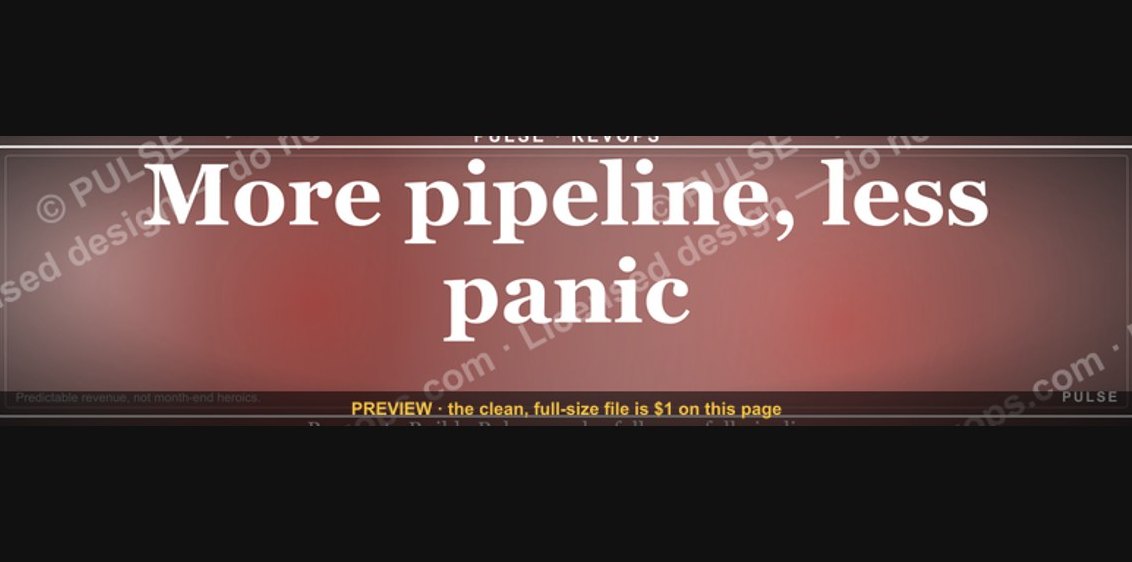 graphic“More pipeline, less panic.” — LinkedIn Banner
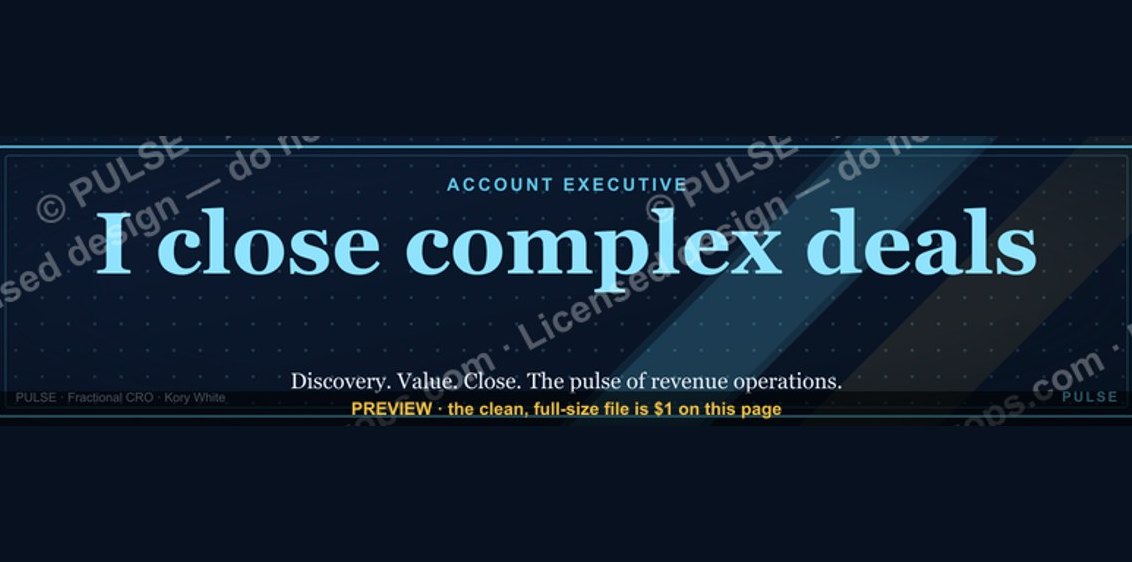 graphicAccount Executive — LinkedIn Banner
 graphicVector Database CTO — LinkedIn Banner
 graphicFaster deals, fewer leaks. — LinkedIn Wallpaper
 graphicTrust compounds. — LinkedIn Wallpaper
 graphicSales Coach — LinkedIn Banner
 graphic“Great reps wanted.” — LinkedIn Banner
 graphic“Clarity closes.” — LinkedIn Banner
 graphicStartup Founder — LinkedIn Banner
 graphicWhat do top-performing graphic designers do differently in 2027?