
Small reps, big results. — LinkedIn Wallpaper
 Curated byKory White · Fractional CRO · Maryland
 PULSEKNOWLEDGE LIBRARY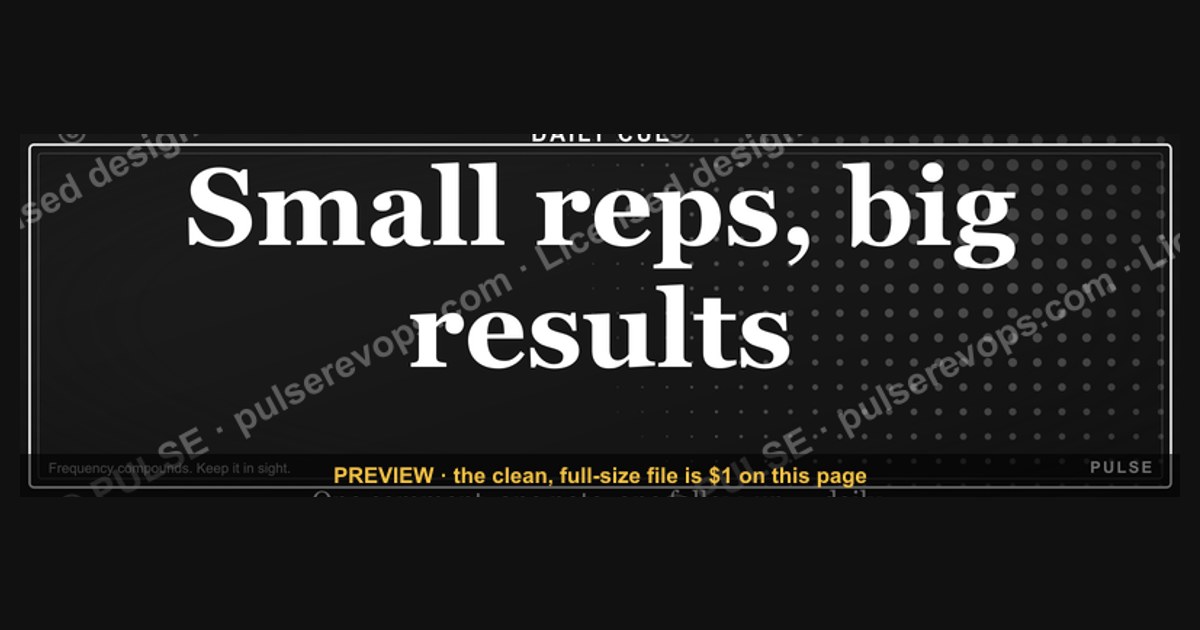
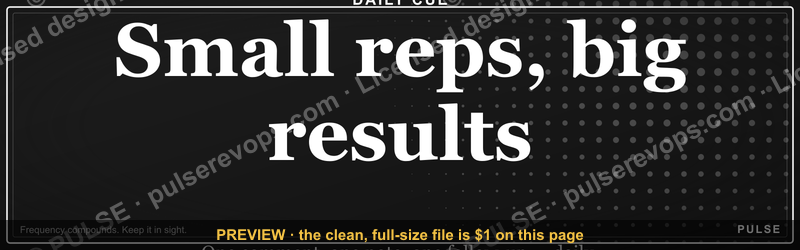
"Small reps, big results" means that consistent, low-effort professional actions — one thoughtful LinkedIn comment, one personalized connection note, one short follow-up message — compound over weeks and months into outsized outcomes like referrals, opportunities, and visibility. As a LinkedIn cover wallpaper, the phrase works as a daily visual cue: it reminds you that progress comes from frequency and consistency, not from rare bursts of intensity. Pick one small action you can repeat every day, keep this banner in your line of sight, and let the compounding do the heavy lifting.
Small reps, big results. — LinkedIn Wallpaper

A dark, on-brand LinkedIn cover wallpaper — a flowing-wave backdrop with a "Small reps, big results." line and the Pulse mark. A clean, branded banner for your profile.
Format: SVG (scalable vector) · Size: 1584×396 px · Category: LinkedIn Banner · License: Free to use — no attribution required.
Recolor it to your brand
Use the color picker above to recolor this banner to your team or company colors, switch the background (including transparent), then download it as an SVG or PNG. No sign-up, no watermark.

How to use it
It scales cleanly to the LinkedIn cover slot (1584×396) — download the PNG and drop it straight onto your profile, or open the SVG in Canva, PowerPoint, or Figma to add your name and tweak the layout.
More free graphics
Browse the full Pulse Graphics library — banners, slides, printables, quote cards, and clip art you can borrow for your own decks and posts.

Related on PULSE
- “Small reps, big results.” — LinkedIn Banner
- Better reps, every week. — LinkedIn Wallpaper
- Ready reps win. — LinkedIn Wallpaper
- Do the reps. — LinkedIn Wallpaper
- “DO THE REPS” — Sales Floor Print
- “Great reps wanted.” — LinkedIn Banner
The psychology behind small reps
The idea that small, repeated actions outperform occasional big pushes isn't just motivational wallpaper fodder — it lines up with a well-established body of behavioral-science writing. In *Atomic Habits*, James Clear argues that habits compound: a tiny action repeated daily accumulates into a meaningful trajectory, while the effort of any single rep stays low enough that you rarely talk yourself out of it. BJ Fogg makes a related case in *Tiny Habits*, showing that shrinking a behavior until it feels almost trivial is one of the most reliable ways to make it stick.
Part of why this works is the "small wins" effect. Teresa Amabile and Steven Kramer's research in *The Progress Principle* found that, of all the things that boost people's motivation and engagement at work, the single most powerful was simply making progress on meaningful work — even small progress. A completed micro-rep gives you that sense of forward motion, which makes the next rep feel easier to start.
For professionals, this translates into ordinary daily habits: sending one follow-up message, writing a few lines of a report, or leaving one genuinely useful comment. None of them feels like much on the day. The wallpaper's job is to remind you that you don't need to overhaul your workflow — you just need to do the next small thing, and then do it again tomorrow.
Practical micro-reps for LinkedIn growth
To turn the banner's message into action, here are three high-impact micro-reps you can do in under five minutes each:
- The "value-add" comment: Scroll your feed, find a post from a connection or industry voice, and add a specific insight rather than "Great post!" — for example, "Your point about X matches what I've seen in Y context." It takes two or three minutes and can open a real conversation.
- The one-minute connection note: When you send a connection request, include a short personalized line referencing something specific, like a talk they gave or a post you found useful. Personalized requests tend to be accepted more readily than blank ones, and they set a warmer tone for any follow-up.
- The weekly reflection post: Every Friday, spend three minutes writing a single sentence about a lesson or a win from the week. No formatting, no links — just one honest insight. Over a few months, this builds a content rhythm that positions you as a thoughtful contributor.
Track these reps in a simple spreadsheet or notes app. After a month, review which micro-actions earned the most engagement or new connections, adjust your mix, and keep going. The wallpaper is your cue: small reps, done daily, produce outsized results.
Designing your environment for consistency
Your LinkedIn wallpaper is more than decoration — it's a deliberate cue in your environment. Behavioral scientists have long noted that surroundings shape behavior, and a visible reminder works best when it's paired with a concrete plan for *when* and *where* you'll act. Peter Gollwitzer's research on "implementation intentions" shows that turning a vague goal into a specific if-then plan ("when I sit down with coffee, I'll leave one comment") makes follow-through substantially more reliable than intention alone.
So pair the visual cue with a trigger:
- Keep it visible. Put the banner on your phone lock screen or laptop desktop — wherever you'll see it during work hours, so it nudges you to do one micro-rep before you start scrolling.
- Attach a time. Set a recurring reminder at a moment you tend to drift, such as 10 AM or 3 PM, labeled "small rep." The visual cue plus the scheduled trigger gives you a clear if-then to act on.
- Remove friction. Bookmark your "My Network" or notifications page so engaging takes one click instead of five. The easier the rep, the more likely it survives a busy day.
Over time, this pairing of visual cue plus immediate action turns the wallpaper into a signal for progress rather than pressure.
Avoiding the small-reps trap
The mantra is powerful, but it has failure modes worth naming. The most common is mistaking activity for progress. If your reps aren't aligned with your real goal, you can spend weeks on tiny tasks that move nothing. Borrow the spirit of the 80/20 rule: find the small actions that drive most of your results. For a LinkedIn user, one thoughtful comment on a prospect's post usually does more than ten generic likes. Ask of each rep: is this moving me toward the result I actually want? If not, swap it.
A second trap is "rep stacking" — trying to juggle ten small habits at once and exhausting your willpower before lunch. Focus on one or two key reps a day. Consistency, not volume, is the point.
Finally, watch the all-or-nothing mindset. Miss a day and the banner can trigger guilt instead of momentum. Reframe it: the wallpaper is a tool for re-engagement, not a perfection scoreboard. Habits also take longer to settle than the popular "21 days" myth suggests — in Phillippa Lally's well-known University College London study, automaticity took on average about 66 days, and varied widely from person to person. The takeaway is patience: the big results come from getting back on track after a miss, not from never missing.
Design and Placement Tips for Maximum Impact
For your LinkedIn wallpaper to work as a daily visual cue, placement matters. Use the banner image as your profile background—it spans the top of your page and remains visible whenever someone visits your profile. Choose a design with bold, high-contrast typography against a clean background (dark text on light or vice versa) so the message is readable at a glance. Many free tools like Canva or Adobe Express offer LinkedIn cover templates (1584 x 396 pixels) where you can customize the quote. Keep the font size large enough to be legible on mobile screens, since over 60% of LinkedIn users access the platform via phone.
Pairing the Wallpaper with a Daily Action Habit
The wallpaper works best when paired with a specific, repeatable action you commit to daily. For example: "Every morning, I will write one thoughtful comment on a post from my network." Or: "Each day, I will send one personalized connection request to someone in my target industry." Write this action on a sticky note next to your monitor or set a phone reminder. The wallpaper reinforces the *why*; the habit provides the *how*. Over 90 days, this single daily action could lead to 90+ touchpoints with your network—far more effective than posting once a month with high effort.
When to Refresh the Wallpaper Message
While "Small reps, big results" is a strong evergreen message, consider rotating your wallpaper every 2–3 months to match your current focus. For example, during a job search, use "One application daily = momentum." While building a personal brand, try "One value post weekly = authority." Keep the same visual style for consistency, but update the text to stay relevant. A stale wallpaper becomes background noise; a timely one stays top-of-mind and actionable.
The Psychology Behind "Small Reps"
The phrase leverages two powerful mental principles: the progress principle and habit stacking. The progress principle shows that even tiny wins—like a single "Great point!" comment—release dopamine, making you more likely to repeat the action tomorrow. Habit stacking means attaching your small rep to an existing routine: "After I finish my morning coffee, I write one LinkedIn comment." This removes the need for willpower and turns the wallpaper from a passive decoration into an active trigger. Over 30 days, that's 30 small interactions—enough to shift your profile's algorithm visibility and start real conversations.
Avoiding the "Empty Rep" Trap
Not all small actions compound equally. A generic "Great post!" adds noise, not value. For real results, your small rep must be specific and generous: mention a detail from their article, ask a thoughtful question, or share a resource they'd find useful. The wallpaper works best when paired with a personal rule: "Every small rep must help someone else first." This prevents mindless engagement and ensures each micro-action builds genuine professional relationships—not just vanity metrics.
Sources
- James Clear — *Atomic Habits* (2018); summaries and articles at jamesclear.com
- BJ Fogg, PhD — *Tiny Habits* (2019), Stanford Behavior Design Lab — tinyhabits.com
- Teresa Amabile & Steven Kramer — *The Progress Principle* (2011), and "The Power of Small Wins," *Harvard Business Review* — hbr.org/2011/05/the-power-of-small-wins
- Phillippa Lally et al. — "How are habits formed: Modelling habit formation in the real world," *European Journal of Social Psychology* (2010) — the ~66-day average study
- Peter M. Gollwitzer — "Implementation intentions: Strong effects of simple plans," *American Psychologist* (1999) — research on if-then planning
- Charles Duhigg — *The Power of Habit* (2012), on cue–routine–reward habit loops — charlesduhigg.com
FAQ
What does "small reps, big results" mean in practice? It means consistent, low-effort actions — sending one thoughtful LinkedIn message a day, making a handful of follow-up calls a week — compound over time into meaningful growth. You don't need a massive overhaul; small, repeatable steps build momentum you can sustain.
Is this approach effective for B2B sales or just personal branding? Both. In B2B sales, small daily outreach and follow-up routines steadily fill your pipeline without burning out the team. For personal branding, a short insight or a couple of genuine comments a day gradually builds authority and recognition.
How long does it typically take to see results? Engagement often shifts within a few weeks of consistent reps, while pipeline or revenue impact usually takes a few months depending on your industry and starting point. Habit research is a useful reality check here: behaviors take time to become automatic, so judge progress over months, not days.
Do I need a big budget or special tools to implement this? No. A simple spreadsheet, a notes app, or a free CRM tier is plenty. The constraint is discipline, not dollars — a calendar reminder and a place to track your reps are enough to start.
Can this work for a solo founder or a small team? Yes, and small operators often benefit most because they can't lean on large campaigns. One person doing a handful of small, targeted actions every day can outperform a team running occasional random pushes.
What's the biggest mistake people make with "small reps"? Quitting too early or scaling up too fast. People expect a straight line and stop after two weeks, or they try fifty reps a day and burn out. The fix is to keep each rep genuinely small and sustainable, and to keep showing up over months.
This page will be disappearing soon. Save it to your device for $1 — or read it free while it is here.
@Kory-White- · if Venmo asks, the last 4 of my number are 2012
This page is gone.
This one is off the shelf now. $1 keeps it on your phone for good — the whole page, pictures and diagrams included.
 graphic“The next call is the most important one.” — LinkedIn Banner
 graphic“Great reps wanted.” — LinkedIn Banner
 graphicWhat criteria should I use to choose a graphics design tool for sales presentations in 2027?
 graphicCommercial Director — LinkedIn Banner
 graphic“Revenue that delights.” — LinkedIn Banner
 graphic“Data beats opinions.” — LinkedIn Banner
 graphic“Hire slow. Ramp fast.” — LinkedIn Banner
 graphic“Champions are made before the call.” — LinkedIn Banner
 graphicRevOps Manager — LinkedIn Banner
 graphic“Ready to lead a sales team.” — LinkedIn Banner