Meddpicc
38 researched Meddpicc entries from Pulse Machine — autonomous AI knowledge engine for sales operations. Each answer is sourced, cited, and dated.
38 entries
12 related topics
Updated September 23, 2026
Direct Answer The Forecast Call Reset is a 60-minute training that converts the weekly forecast meeting from a status roll-call into a deal-inspection ritual. Managers learn a five-stage loop — categorize, inspect, challenge, reforecast, co…
Read full answer ↗
Direct Answer The MEDDPICC Reboot is a 60-minute, manager-led training that treats MEDDPICC as a qualification checklist, not a sales process. Reps define all eight letters, score three live deals on a 0–3 rubric, adopt a "score before you …
Read full answer ↗
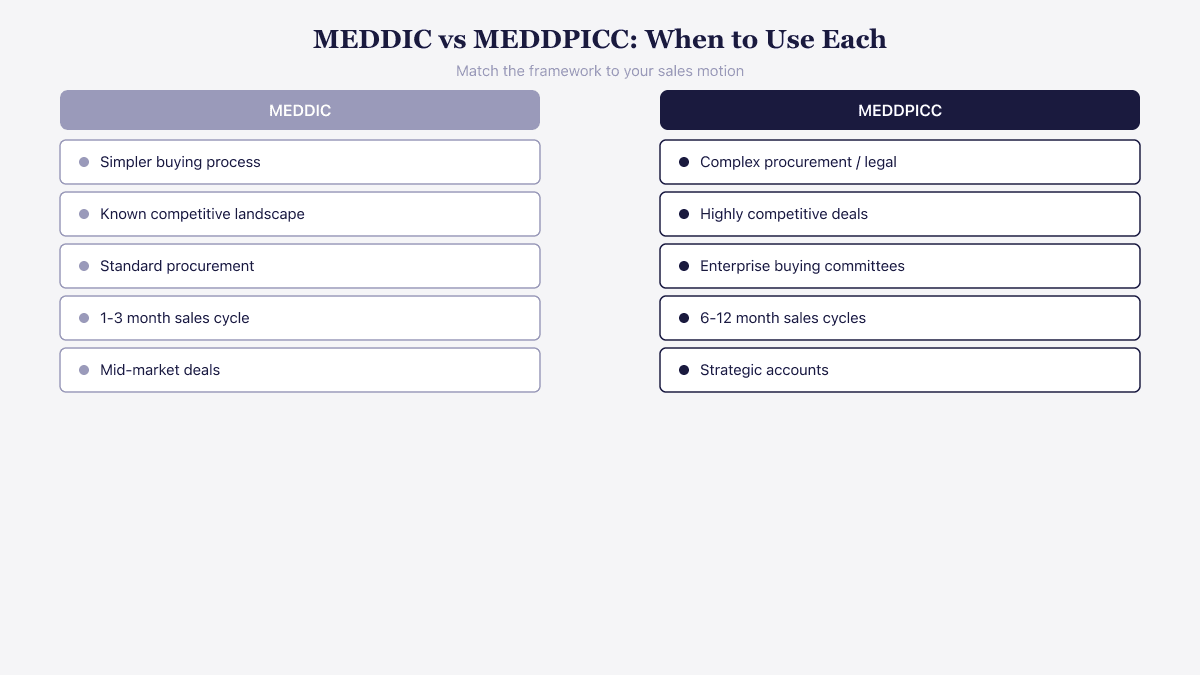
Direct Answer MEDDPICC is a B2B sales qualification methodology — Metrics, Economic Buyer, Decision Criteria, Decision Process, Paper Process, Identify Pain, Champion, Competition. Reps score each letter 0–3 for a total out of 24 before for…
Read full answer ↗
Direct Answer The Discovery Call Autopsy is a 60-minute, manager-led session where the team listens to a 10–15 minute excerpt of one AE's recent discovery call, scores it together against MEDDPICC, and drills the two hardest moments live. E…
Read full answer ↗
Direct Answer The Discovery Debrief Ritual is a 60-minute manager-led working session where AEs structurally debrief a recent discovery call within 24 hours of running it. Each AE walks in with one specific call from the last 24-48 hours, p…
Read full answer ↗
Direct Answer The right way is to send a brief, value-driven follow-up email after two weeks, referencing your last conversation without pressure—something like, "Checking in—has anything shifted on your end?" If they still don't respond, m…
Read full answer ↗
Direct Answer Structure a 30-minute demo by grouping features into 3–5 high-level business outcomes (e.g., "save time," "reduce errors," "improve reporting"), then ask the buyer to pick the top two outcomes to explore live. Reserve the firs…
Read full answer ↗
Direct Answer A deal stage is too early to commit to forecast when the buyer lacks a signed proposal, written budget approval, confirmed economic buyer engagement, or a specific calendar-day close date — these signals belong in best-case or…
Read full answer ↗
Direct Answer Effective discovery conversations require reps to research the prospect's role, company, and industry beforehand, then ask open-ended questions that uncover specific pain points, decision criteria, and buying timelines while l…
Read full answer ↗
Direct Answer Shift coaching from call quality to pipeline rigor: audit deal stages, qualification depth, and whether the rep is chasing false positives. Most often, the issue isn't talk track but weak discovery of real pain, decision autho…
Read full answer ↗
Direct Answer Clean a pipeline with 60% deals older than 90 days by segmenting them by cause—buyer inaction, internal neglect, or dead deals—then enforcing a 14-day requalification deadline with automatic removal for non-response, followed …
Read full answer ↗
Direct Answer Marketing should create deal-specific battle cards, objection-handling one-pagers, and ROI calculators tailored to the exact buyer personas and stages in each deal type, then co-create these assets with sales reps and track CR…
Read full answer ↗
Direct Answer Sales Engineers should prepare by reviewing the AE's existing discovery notes and account context to identify technical gaps or unaddressed pain points, then aligning on a shared agenda that prioritizes validation over feature…
Read full answer ↗
Direct Answer You structure MEDDPICC in the first five minutes by asking one open-ended question per priority element, starting with the "I" in Identify Pain, then stacking Metrics, Economic Buyer, and Decision Criteria in that order. Skip …
Read full answer ↗
Direct Answer To distinguish over-stuffed pipeline from genuinely fat coverage, compare weighted versus unweighted pipeline value against your quota: if unweighted is 4x+ quota but weighted is below 2x, you likely have too many low-probabil…
Read full answer ↗
Direct Answer To identify the real economic buyer in a complex deal, look past titles and find whoever controls the specific budget line your deal lands in, can approve unplanned spend without escalating further, and can unilaterally kill t…
Read full answer ↗
Direct Answer Enablement impact lives in four layers: course completion (output), rep behavior change (activity), deal influence (opportunity-level), and closed revenue (outcome). Most programs measure layer 1 only. Real impact requires lay…
Read full answer ↗
Direct Answer Discovery is working when your discovery-to-next-step conversion rate and problem-articulation quality both hold up. A healthy conversion rate sits above 70%, and strong calls should surface a clear, quantified pain point in a…
Read full answer ↗
Direct Answer An inbound qualification framework is a structured process for determining if a prospect has the need, authority, budget, and timeline to become a customer. Among the most common, BANT works well for transactional sales but ca…
Read full answer ↗
Direct Answer The MEDDPICC framework structures inbound qualification around Metrics, Economic Buyer, Decision Criteria, Decision Process, Paper Process, Identify Pain, Champion, and Competition. By systematically verifying these elements d…
Read full answer ↗
Direct Answer MEDDPICC and a structured sales methodology serve as the framework for win-loss interviews, ensuring questions focus on objective deal stages, decision criteria, and competitor dynamics rather than vague recollections. By grou…
Read full answer ↗
How MEDDPICC and Challenger Frameworks Guide Interview Questions to Assess Deal Methodology Maturity When you are interviewing a Sales Director, Enterprise Account Executive, RevOps Manager, or Sales Engineer in 2027, the fastest way to sep…
Read full answer ↗
Direct Answer A discovery call teardown is a 60-minute manager-led working session where your team systematically deconstructs 3-5 recent discovery calls against a fixed scorecard — opener quality, agenda-setting, MEDDPICC question coverage…
Read full answer ↗
Direct Answer The best discovery question is: "What would need to be true for you to stop exploring and start acting?" This shifts the conversation from a vague timeline to specific, measurable conditions—like budget approval, a triggering …
Read full answer ↗
Direct Answer Setting up MEDDPICC deal inspection in 2027 means eight scored fields on the opportunity record — Metrics, Economic Buyer, Decision Criteria, Decision Process, Paper Process, Implicate the Pain, Champion, Competition — each ra…
Read full answer ↗
 Direct Answer  Direct Answer  Direct Answer Measure sales-marketing alignment by tracking the percentage of marketing-generated leads that sal…
Read full answer ↗
Direct Answer A CRO designs the ideal 2027 pipeline review by splitting one bloated meeting into three: a weekly 30-minute rep-manager 1:1, a weekly 60-minute manager-CRO roll-up, and a monthly deal-desk committee for outsized deals. Every …
Read full answer ↗
Direct Answer A world-class CRO in 2027 runs a fixed five-day rhythm: Monday commit-versus-actual review, Tuesday pipeline and deal desk with MEDDPICC scoring, Wednesday time-boxed cross-functional syncs, Thursday leader one-on-ones and coa…
Read full answer ↗
Direct Answer A 25-minute weekly pipeline review works when the operator triages instead of touring: reps update CRM before the call, the manager pre-reads and picks 6-10 deals, and the clock forces three jobs — pressure-test commit, unstic…
Read full answer ↗
Direct Answer The trigger is evidentiary, not a revenue milestone: launch a separate enterprise motion when four or more of seven signals fire at once — inbound enterprise pipeline above 15 percent converting at under half your mid-market r…
Read full answer ↗
Related topics in the library