
How do you apply *Fanatical Prospecting* to LinkedIn outreach in 2027?
 Curated byKory White · Fractional CRO · Maryland
 PULSEKNOWLEDGE LIBRARY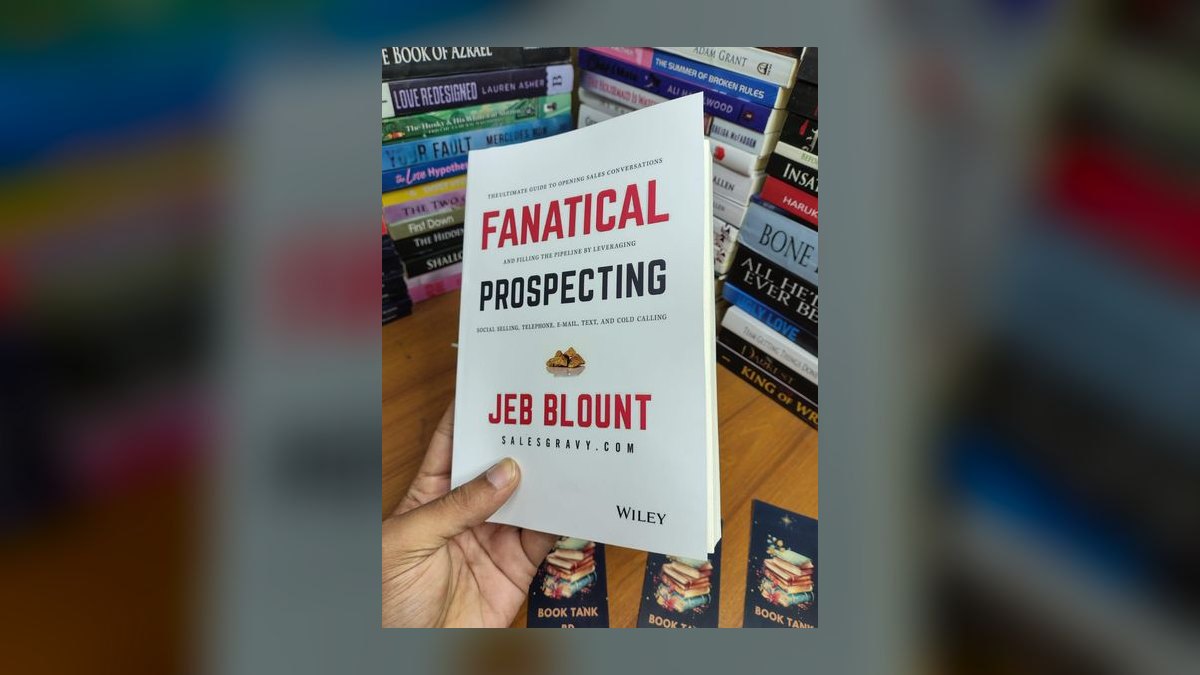
Applying *Fanatical Prospecting* to LinkedIn outreach in 2027 means treating LinkedIn as one tier in Jeb Blount's Prospecting Pyramid, not the whole strategy: run a disciplined, calendared multi-touch cadence (custom-note connection request, value comment, voice or video note, direct ask) for warm-but-slow accounts, and a trigger-based speed-to-lead response for hot buying signals — then move every real conversation off LinkedIn to a call within 24-48 hours.
Two ways to run the Fanatical Prospecting cadence on LinkedIn
Blount's central claim in *Fanatical Prospecting* is that prospecting is a daily, measurable discipline rather than a personality trait, and on LinkedIn in 2027 that discipline splits into two workable systems that most reps blend rather than choose between outright.
The first is the scheduled cadence approach. You build a fixed, calendared sequence — a connection request with a custom note on day one, a value-add comment or share on day three, a voice or video note on day seven, and a direct ask for a call on day fourteen — and you run it against a defined list of target accounts regardless of what those accounts are doing that day. This is the "Prospecting is a habit, not a mood" half of Blount's philosophy: you do the outreach whether you feel like it or not, because volume and consistency are the leading indicators that predict pipeline. The strength of this approach is predictability — you always know how many touches are in flight and can staff a Power Hour around it. The weakness is that it ignores context: a scheduled day-three comment lands the same whether the prospect just got promoted or just went on vacation.

The second is the trigger-based, speed-to-lead approach. Instead of working a fixed calendar, you build a watch-list of buying signals — a prospect liking, commenting on, or viewing your content; a job change; a funding announcement; a competitor mention — and you fire a personalized touch within 30-60 minutes of the trigger. This directly extends Blount's speed-to-lead principle, originally built around inbound web leads and phone response times, into the LinkedIn feed. The strength is relevance: a message sent five minutes after someone comments on a post about warehouse automation reads as attentive, not scripted. The weakness is that it doesn't scale linearly — it requires either constant attention to notifications or a monitoring workflow, and it produces uneven daily volume, which makes it harder to hold a rep accountable to a flat activity number.
Neither approach is "the" *Fanatical Prospecting* method for LinkedIn; Blount's own framework argues for blending them — a baseline scheduled cadence that guarantees a volume floor, with trigger-based touches layered on top to catch the highest-intent moments the calendar would otherwise miss by a day or two.

How to decide between them
The decision is less about picking a winner and more about matching the approach to your book size, your role, and how much of your day is genuinely available for real-time monitoring.
If you're carrying more than roughly 150-200 target accounts, a pure trigger-based system becomes unmanageable without dedicated tooling — you simply cannot watch that many notification streams in real time, and Blount's own warning against automation-without-authenticity means you can't hand the "personalized" part to a bot. In that case, the scheduled cadence should carry most of your volume, with trigger-based touches reserved for a short list of top-20 strategic accounts you can realistically monitor by hand.

If your book is smaller — a strategic or enterprise territory of 20-40 named accounts — trigger-based speed-to-lead can carry more of the weight, because the volume of signals is low enough to track manually and each account is valuable enough to justify a same-hour response.
A second decision factor is role. An SDR working a high-volume outbound motion is judged on activity counts, which favors the scheduled cadence because it produces a clean, reportable number every day. An AE or a rep working named enterprise accounts is judged on relationship depth and timing, which favors trigger-based response because a single well-timed touch on a real signal outperforms a dozen calendar-driven ones. Sales leaders applying Blount's "what gets measured gets done" rule should assign the approach by role rather than leaving it to individual preference — otherwise activity reporting becomes inconsistent across the team and the accountability loop breaks down.
The numbers behind each approach
Concrete numbers matter here because Blount's whole framework rests on activity math, not intuition, and LinkedIn's mechanics in 2027 impose real constraints on both approaches.
For the scheduled cadence: a realistic daily Power Hour produces 15-20 personalized connection requests, because writing a genuine custom note referencing a specific post or mutual connection takes roughly 2-3 minutes per prospect — more than that and the notes stop being personalized in any meaningful sense. Across a 14-day, four-touch sequence, a rep working a 150-account list is carrying roughly 40-50 accounts in active sequence at any given time if new accounts enter the top of the funnel every few days. Only a fraction of connection requests convert to accepted connections in the same week, which is why the cadence explicitly waits for acceptance before firing the day-three touch rather than queuing it blind. Comment-based touches take less time per prospect (60-90 seconds to write something substantive) but only work at all if you've narrowed to a top-20 list, since reading enough of someone's post to comment intelligently doesn't scale past that.

For the trigger-based approach: the entire value proposition depends on the 30-60 minute response window, because a comment sent within an hour of a prospect's own post reads as attentive while the same comment two days later reads as coincidental or scripted. That window requirement caps how many accounts one rep can genuinely monitor — realistically 20-40 without dedicated alerting, since checking a notification feed often enough to hit a 60-minute window across more accounts than that starts consuming the whole workday. The trade-off is response rate quality over response volume: a handful of same-hour, trigger-based messages per week typically produces a higher reply rate than the same number of cold, calendar-driven touches, because the message ties directly to something the prospect just did.
Across both approaches, the follow-up math matters more than the opening touch: Blount's research-backed instinct that most reps quit after one or two attempts means a rep who reliably completes a full four-to-five touch sequence — cadence or trigger-based — is already outperforming a large share of the field simply by not stopping early. The accountability numbers worth tracking daily are connection requests sent, comments left, voice or video notes recorded, and follow-ups completed — never likes or post views, which are vanity metrics that don't correlate with pipeline.

Implementation details and sequencing
Building either approach into a repeatable weekly system requires the same underlying skeleton: a defined list, a defined cadence or trigger set, a logging mechanism, and a hard rule about when a LinkedIn conversation graduates to a phone or video call.
Start by building the account list itself — pull 40-150 named accounts (fewer for trigger-based, more for scheduled) into a simple tracker, whether that's a CRM view, a spreadsheet, or a LinkedIn Sales Navigator saved search. For the scheduled cadence, assign each account an entry date so you always know which day-of-sequence touch is due. For the trigger-based list, set up whatever alerting you have access to — Sales Navigator alerts, native LinkedIn notifications, or a manual daily scan of your top-20 accounts' recent activity — so signals surface without requiring you to sit on the platform all day.

Day one of the scheduled cadence is the connection request itself, and it should never read as a form letter: reference the specific post, shared connection, or company event that prompted the outreach, and never include a pitch or a link in the note. Day three, contingent on acceptance, is a value-add touch with no ask attached — an article, a specific insight, or a genuine question about their role. Day seven is where the voice or video note earns its place: a 30-60 second message that references something specific about the prospect and offers one concrete piece of value, which cuts through text-message fatigue precisely because it requires a small amount of real effort to send. Day ten is a lighter touch — sharing a relevant post from your own feed and tagging them, which keeps you visible without adding message volume. Day fourteen is the direct ask: a specific, low-friction request for a 15-minute call, not an open-ended "let's connect sometime."
For the trigger-based system, the sequence compresses into a single high-quality response fired inside the 30-60 minute window, followed by the same value-first logic — no pitch in the first message, a specific reference to the trigger event itself, and a soft opening rather than a scheduling ask. If the prospect responds, the conversation should move toward a call within 24-48 hours rather than continuing indefinitely inside LinkedIn's messaging thread, because Blount's multi-channel principle treats LinkedIn as the door-opener and the phone or video call as the place deals actually get worked.

Objection handling threads through every stage rather than sitting at the end of the sequence: a "not interested" reply is logged as a timing signal and routed to the 90-day nurture list with a note on what prompted it, while a "too busy" reply triggers a lower-friction offer — a short video instead of a call ask — rather than a repeated pitch. Every objection gets logged as data, not treated as a dead end, so that after a few dozen cycles you can see whether a specific title, industry, or message variant is generating a disproportionate share of one objection type and adjust the opening touch accordingly. Closing the loop weekly — reporting your four activity numbers to a manager or peer — is what keeps either system running past the first few weeks, since Blount's accountability principle assumes motivation fades and structure has to carry the discipline instead.
Related questions
How many touches should a LinkedIn outreach sequence include before giving up?
Four to five touches across roughly 14 days is the practical floor. Fewer than that and you're quitting before most replies arrive; log non-responders to a 90-day nurture list rather than deleting them.
Should the first LinkedIn message ever include a pitch?
No. Both the scheduled and trigger-based approaches treat the connection request and first reply as permission-building, not selling — the ask comes only after two or more value-first touches.
When should a LinkedIn conversation move to a phone call?
As soon as the prospect responds with genuine interest, ideally within 24-48 hours. LinkedIn opens the relationship; Blount's multi-channel principle treats the call as where the deal actually progresses.
What's the single biggest LinkedIn prospecting mistake reps make?
Sending a pitch in the very first message, before any value has been exchanged. It collapses the permission-building step that both cadence types depend on.
FAQ
How many personalized connection requests should a rep send per day? 15-20 during a dedicated daily block is realistic for genuinely personalized notes; pushing much higher usually means the personalization is being faked, which undercuts the entire approach.
Is automation compatible with a Fanatical Prospecting LinkedIn strategy? Automation can support monitoring and alerting, but every message a prospect actually reads should be written by a human. Blount's framework treats authenticity as the differentiator, and generic automated messages read as exactly that.
What should happen if a prospect says they don't use LinkedIn for business? Respect the channel objection and pivot to email or phone rather than abandoning the relationship — the goal is reaching the person, not forcing a specific platform.
How is the trigger-based approach different from just replying to notifications? The difference is the response window and the personalization standard: a trigger-based system commits to a 30-60 minute reply built around the specific signal, not a generic acknowledgment sent whenever convenient.
Do LinkedIn voice or video notes actually outperform text messages? They tend to stand out because they require visible effort and convey tone, which text can't. They work best on day seven of a cadence or as the first reply to a strong trigger, not as the opening connection-request note.
What metrics should a manager review in a weekly accountability check-in? Connection requests sent, comments left, voice or video notes recorded, and follow-ups completed — activity counts, not likes or profile views, since those don't reliably predict pipeline.
Sources
- https://www.salesgravy.com/
- https://www.wiley.com/en-us/Fanatical+Prospecting-p-9781119144760
- https://www.goodreads.com/book/show/27040305-fanatical-prospecting
- https://business.linkedin.com/sales-solutions/blog
- https://blog.hubspot.com/sales
- https://www.gartner.com/en/sales
Related on PULSE
- [How can *Fanatical Prospecting* change your approach to social selling and LinkedIn outreach in 2027?](/knowledge/bs0409)
- [What's the biggest mistake *Fanatical Prospecting* warns against when following up with a warm lead in 2027?](/knowledge/bs0416)
- [How can *Fanatical Prospecting* help you maintain a full pipeline without burning out in 2027?](/knowledge/bs0395)
- [How does *Fanatical Prospecting* define the perfect prospecting day for a remote sales team in 2027?](/knowledge/bs0381)
- [How does *Fanatical Prospecting* change your daily routine for outbound sales?](/knowledge/bs0340)
- [Fanatical Prospecting by Jeb Blount — Cliff Notes Summary & Key Takeaways](/knowledge/bs0008)
@Kory-White- · if Venmo asks, the last 4 of my number are 2012
 bsWhat are the key lessons from *Never Split the Difference* for negotiating a raise in 2027?
 bsHow does *Gap Selling* help you close more deals in a recession in 2027?
 bsWhat sales script does *New Sales. Simplified.* recommend for cold calls in 2027?
 bsDoes *The Psychology of Selling* still hold up for modern sales techniques in 2027?
 bsWhat’s the most actionable principle from *How to Win Friends and Influence People* for remote work in 2027?
 bsWhat’s the biggest mistake *SPIN Selling* warns against in complex B2B sales?
 bsHow does *Fanatical Prospecting* change your daily routine for outbound sales?
 bsWhat’s the most persuasive technique from *Pitch Anything* for investor pitches?
 bsWhat’s the key insight from *The Challenger Sale* for leading a sales team in 2027?
 bsHow do you use *Never Split the Difference* to handle difficult conversations with customers in 2027?