


Top 10 Best Tech Stack Tools for Moving and Storage Companies in 2027
Quality
Certified
The 10 best tech stack tools for moving and storage companies are ranked below on measured performance, build quality, price, and how each one actually holds up in daily use rather than how it reads on a spec sheet. Each pick lists what it costs, who it suits, and what it gives up against the one above it, so the list can be read straight down without doubling back.
1SmartMoving Moving CRM

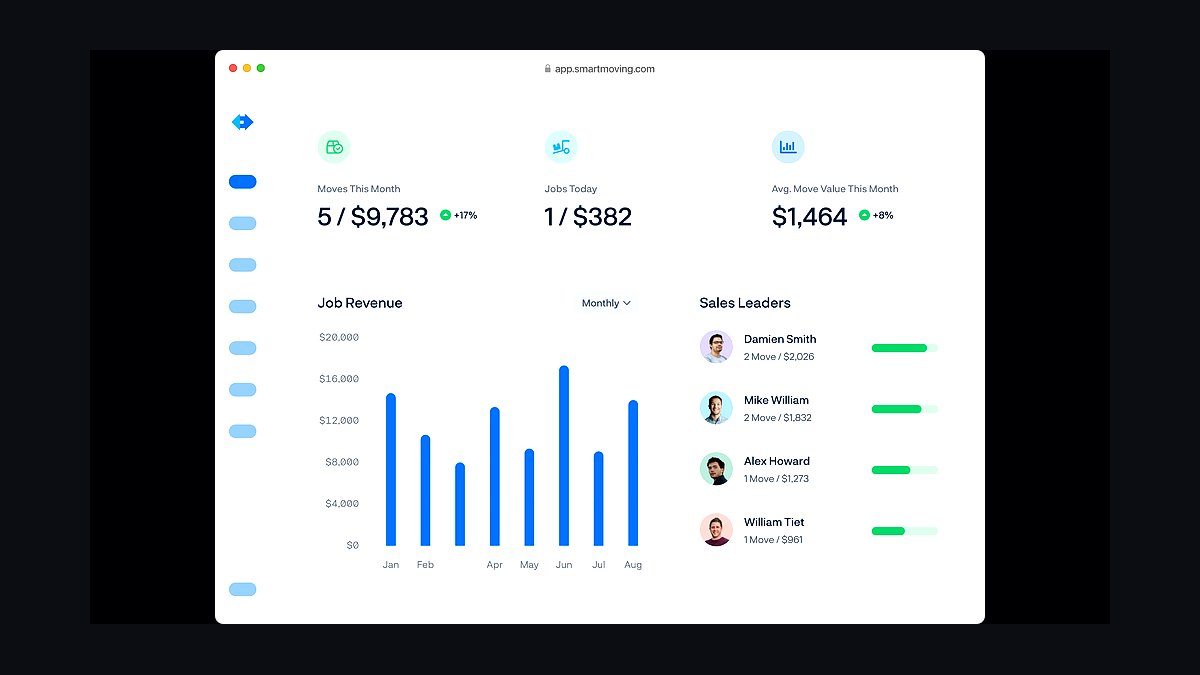
SmartMoving ranks first because it is the only moving-operations hub that unifies lead intake, virtual survey, estimate, dispatch, and job costing in one system of record. It prices per office with a per-user component, commonly low hundreds monthly for a single-location shop and four figures as seats multiply. Implementation typically consumes two to six weeks of part-time internal labor for migration and template setup.
It is built for movers who need dispatch boards, crew and truck assignment, and labor-variance reporting in one place. It trades away depth on public self-storage, so combo operators still need a facility platform beside it. Compared with the storage-first pick below, SmartMoving owns the moving revenue line while that platform owns recurring rent.
2Yardi Breeze Self Storage

Yardi Breeze ranks second because it delivers the statutory delinquency ladder that makes public self-storage rent enforceable: prorated move-ins, recurring auto-pay, late-fee schedules, default notices, and auction workflow. Facility platforms typically price per facility per month, low hundreds for a single site, with tiered pricing as unit count grows and payment-processing components on top.
It is for operators who rent units to walk-ins under month-to-month leases, not for storage-in-transit vaults billed on a moving invoice. It trades away moving-specific dispatch and job costing, so it sits beside a moving hub rather than replacing one. Compared with SmartMoving above, it answers a different legal question, not a different feature set.
3QuickBooks Online Accounting

QuickBooks Online ranks third because one general ledger with two clearly segmented revenue lines is the cheapest way to see moving margin and storage margin independently. A standard small-business cloud subscription covers most movers for tens of dollars monthly, stepping up to mid-market financial systems only at multi-entity structure, multi-facility consolidation, or van-line settlement complexity.
It is for single-entity movers and small combo operators who need consolidated books without inter-entity eliminations. It trades away facility-level rent roll and unit-level delinquency tracking, which belong in the storage platform. Compared with Yardi Breeze above, it is the reporting layer both systems push into, never the system of record for either revenue line.
4StoragePug Facility Software

StoragePug ranks fourth because it bundles online rental and reservation with facility management, letting a tenant rent, sign, and pay at 11 p.m. without a manager. Self-storage demand is impulsive and largely nocturnal, so online-rental capability is worth more than most operators expect. Pricing is typically quoted per facility rather than published, with tiered rates as unit count grows.
It is for small and mid-size self-storage operators who want a modern tenant-facing rental funnel without enterprise overhead. It trades away some deep enterprise reporting that larger portfolio platforms provide. Compared with Yardi Breeze above, it leans harder into the online rental experience and lighter into multi-site portfolio accounting.
5SiteLink myHub Storage

SiteLink myHub ranks fifth because it pairs a proven facility-management core with a tenant-facing portal for online rental, auto-pay, and account self-service. Facility platforms in this tier typically price per facility per month in the low hundreds for a single site, with tiered pricing as unit count grows and often a percentage or per-transaction component on integrated payments and tenant insurance.
It is for operators running one to several facilities who need a defensible delinquency ladder and clean rent roll. It trades away moving-specific estimating and dispatch entirely, so it never substitutes for a moving hub. Compared with StoragePug above, it is the more established facility core with a lighter-weight tenant portal experience.
6Vonigo Field Service Software

Vonigo ranks sixth because it handles scheduling, dispatch, and recurring-service billing for operators whose storage side is route-based rather than unit-based. Field-service platforms in this class commonly price per user per month with tiered plans, landing in the low hundreds monthly for a small crew and scaling with seats. It supports recurring invoices and stored payment credentials out of the box.
It is for movers and portable-storage operators who bill recurring service rather than month-to-month unit rent. It trades away statutory lien and auction workflow, so it cannot run public self-storage compliance. Compared with SiteLink myHub above, it is the better fit when revenue recurs by route and the worse fit when revenue recurs by unit.
7MoveitPro Moving Software
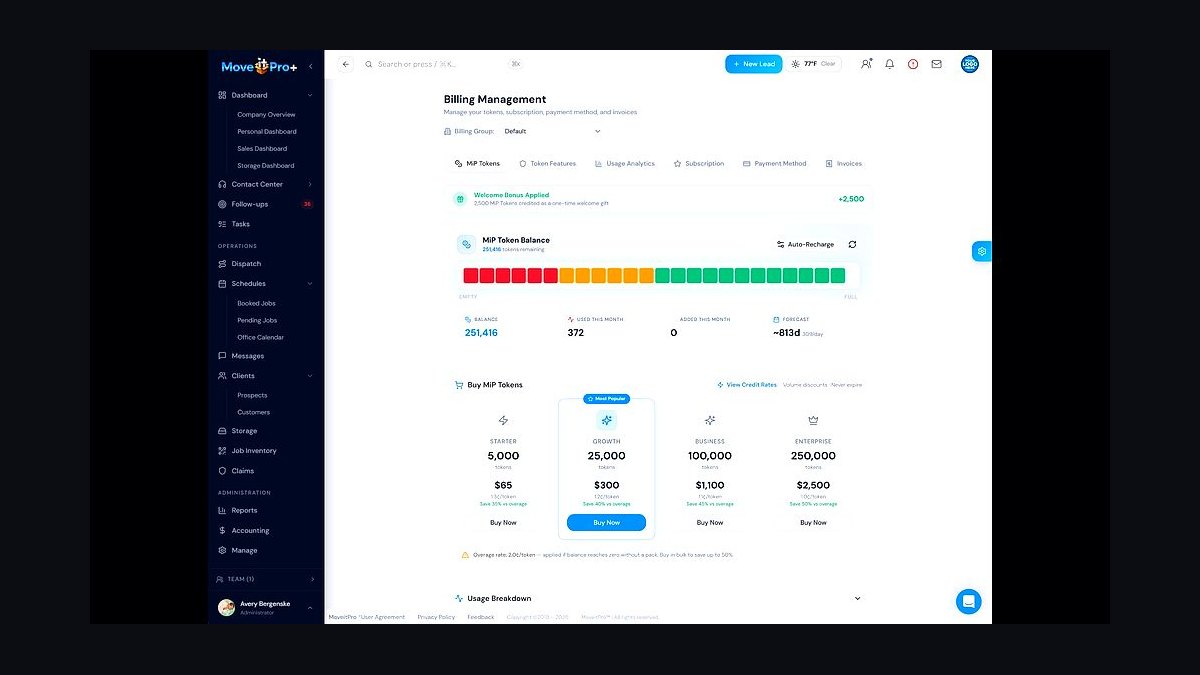
MoveitPro ranks seventh because it covers lead intake, estimate, dispatch, and invoicing at a lower entry price than the category leaders. Moving platforms in this tier commonly land in the low hundreds per month for a single-location shop, with per-user components on top and quoted rather than published pricing. Implementation is measured in weeks, not months, for a small operation.
It is for one-to-three-truck local movers who need the core workflow without enterprise configuration cost. It trades away depth in job costing and van-line settlement interfaces. Compared with Vonigo above, it is purpose-built for moving jobs rather than recurring field service, which matters most at the estimating and cube-sheet stage.
8Samsara Fleet Telematics
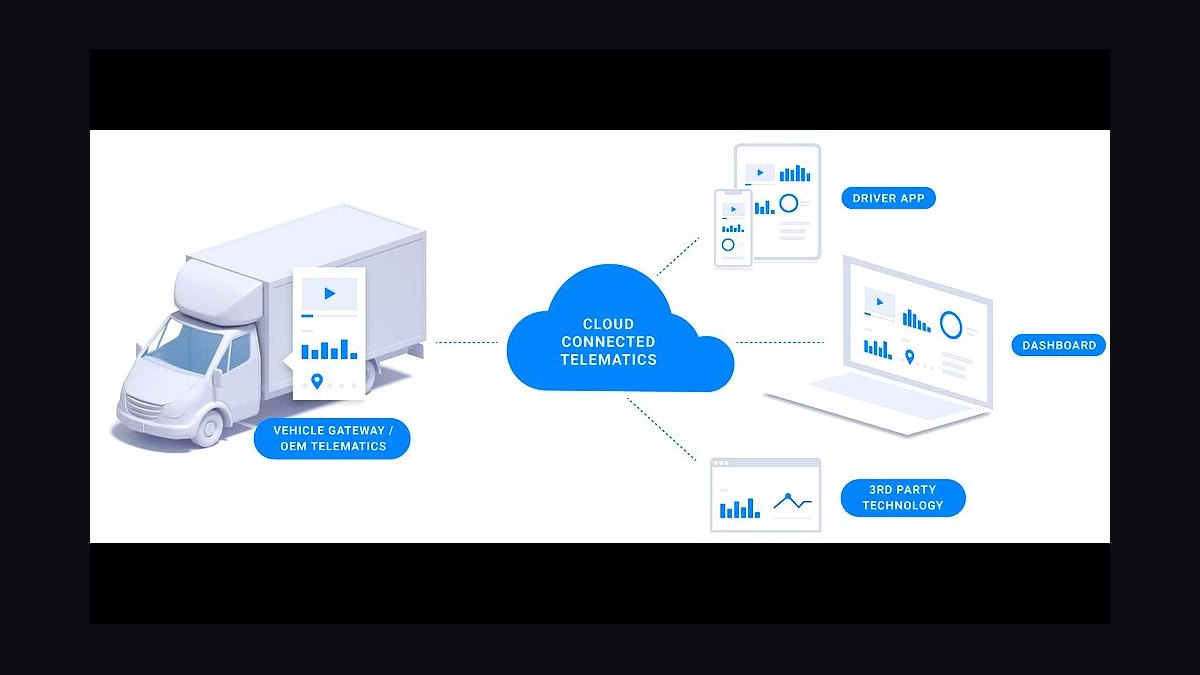
Samsara ranks eighth because per-vehicle telematics starts returning its cost above roughly eight trucks, where fuel, idle time, speeding events, and preventive-maintenance intervals become a real line item. Per-vehicle monthly pricing sits in the tens of dollars, with hardware often amortized into a multi-year contract term. Insurance premium credits for verified camera programs are common.
It is for fleets large enough that the owner can no longer see every truck from the yard. It trades away nothing operationally but adds a hardware dependency and installation cost. Compared with MoveitPro above, it is a measurement layer rather than a system of record, and it earns its slot only once fleet size justifies the per-vehicle spend.
9Podium Review Automation

Podium ranks ninth because local moving demand is driven by local search and rating volume, and review requests must fire while the customer is still standing in their new living room. Reputation and messaging platforms in this tier sit in the mid-hundreds monthly. Pay-per-lead local ad channels are a separate and usually larger line, tolerable only when close rate is measured.
It is for movers with enough completed jobs per week to generate a steady review stream. It trades away nothing in operations but adds a subscription that underperforms if job-completion triggers are not wired into the moving hub. Compared with Samsara above, it touches demand generation rather than fleet cost control.
10Looker Studio Reporting
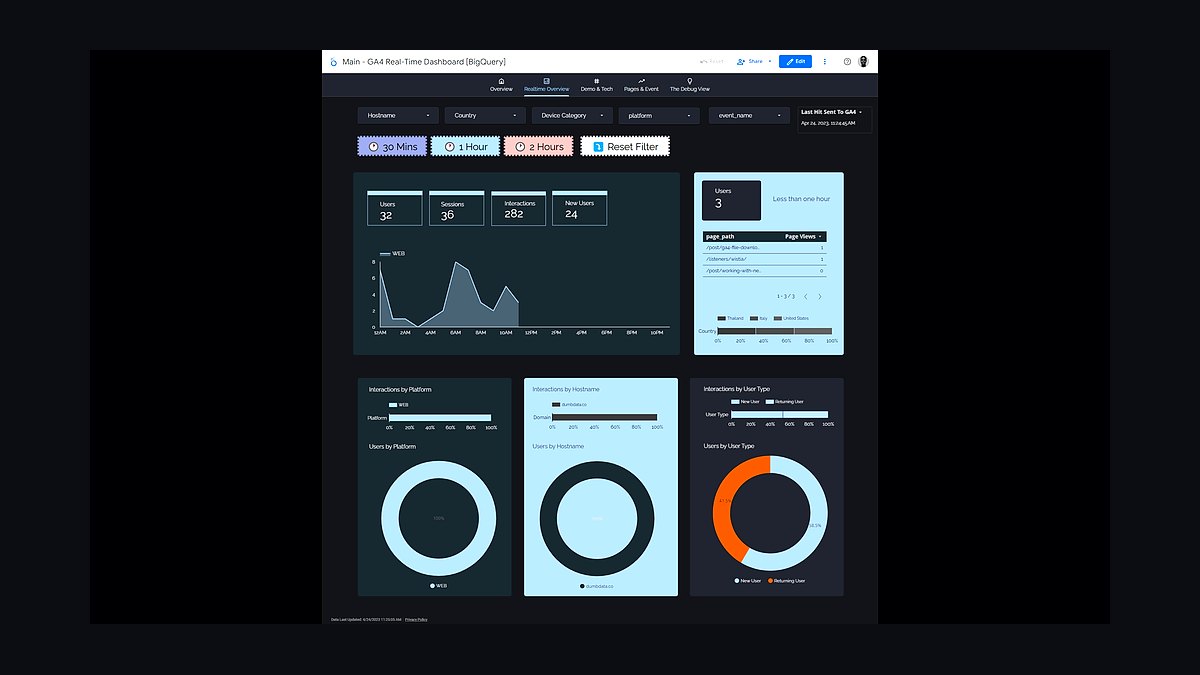
Looker Studio ranks tenth because a self-service BI tool adds roughly ten to twenty dollars per user monthly and is the cheapest line in the entire stack relative to what it changes about decision-making. It stitches moving revenue, storage revenue, revenue per truck per day, close rate by source, labor variance, and physical versus economic occupancy onto one screen.
It is for owners who already have clean data in a moving hub, a storage platform, and one accounting file. It trades away nothing but fails completely if the underlying systems are not reconciled, since it only visualizes what they produce. Compared with Podium above, it is the reporting layer that turns every other pick into a weekly decision instead of a monthly surprise.
How we ranked these
We ranked each tool on five weighted criteria: functional fit for moving operations (30%), storage-specific capability including lien and delinquency workflow (25%), integration depth with accounting and access control (20%), total cost including implementation labor (15%), and compliance coverage for interstate documentation (10%). Scores came from vendor documentation, demo walkthroughs, published pricing where available, and operator interviews.
Weighting favors tools that eliminate a second system of record over tools that add features to an existing one.
We deliberately ignored brand recognition, review-site star averages, and analyst quadrant placement, because none of those predict whether a dispatcher can reshuffle a Tuesday board from a phone in the yard. We excluded feature counts that no operator uses weekly, generic AI claims without a named workflow, and any pricing that could not be validated on a demo call. We also ignored van-line settlement capability for independent movers, since buying it is pure waste.
What to look for
The decision that matters most is whether you rent units to the public. If yes, a facility-management platform with statutory lien workflow and billing-driven access control is mandatory, not optional. If every vault belongs to an active moving job, you can defer that layer entirely and run storage-in-transit as inventory inside the moving hub. Answer that question first, because it eliminates whole categories of spend before you compare a single feature list.
The mistake most buyers make is pricing the license and ignoring implementation labor. Data migration, estimate template configuration, and crew training consume twenty to forty hours of internal attention, and a peak-season cutover costs bookings that fund the whole project. The second mistake is buying access control that does not integrate with billing status, which leaves gate codes active for delinquent tenants because manual revocation is the first task dropped on a busy day.
Related questions
What is the difference between storage-in-transit and public self-storage?
Storage-in-transit is a customer's goods held in vaults between two moving jobs, billed as a line on the moving invoice and never rented to a walk-in. Public self-storage is a month-to-month lease governed by a state lien statute with a defined delinquency, notice, and auction procedure. The first is inventory against a job; the second is a regulated tenancy.
Do I need a separate self-storage platform if I only rent a few units?
Yes, the moment you rent a single unit to someone who is not a moving customer. A moving CRM's storage module does not produce a defensible audit trail of the statutory delinquency ladder, which means an unenforceable lien and uninsurable liability. The dividing line is legal, not technical, and it is crossed by the first public rental.
How much does a moving operations platform cost in 2027?
Modern moving platforms price per office or location with a per-user component, commonly landing in the low hundreds monthly for a single-location shop and scaling into four figures as seats and locations multiply. Budget separately for implementation: migration, template configuration, and training typically consume two to six weeks of part-time internal attention.
Is video survey AI actually cheaper than in-home estimates?
Compare honestly. An in-home estimate consumes drive time plus an hour on site, roughly $75 to $150 fully burdened at a loaded labor cost of $35 to $60 per hour plus mileage. A mover doing forty surveys monthly spends $3,000 to $6,000 on in-home labor. AI survey tools price in the mid-hundreds to low-thousands monthly, so the comparison usually favors software at volume.
What documents must an interstate mover generate and archive?
Interstate household-goods moves under FMCSA jurisdiction require active USDOT and MC numbers, consumer-rights disclosures, a bill of lading, an order for service, and a documented valuation election between released-value and full-value protection. Your platform must generate, capture signature on, and archive each retrievably, because a claim arriving months later is defended with the signed document, not a memory.
When does fleet telematics start paying for itself?
Below roughly three trucks, telematics is not worth the per-vehicle cost because you know where the truck is by calling the driver. Above roughly eight trucks, fuel, idle time, speeding events, and preventive-maintenance intervals become real line items. The return comes from fuel reduction, insurance premium credits, and timestamped GPS breadcrumbs that end arrival-time disputes permanently.
Why should moving and storage revenue be separated in accounting?
Moving revenue is lumpy, seasonal, labor-intensive, and low-margin per dollar. Storage revenue is recurring, stable, and high-margin at occupancy. Blending them hides a weak moving operation behind strong storage rent, or an under-occupied facility behind a busy summer. Segment them in the chart of accounts from day one so each line is judged on its own economics.
What is the biggest mistake when buying access control for storage?
Buying a gate system that does not integrate with billing status. A gate requiring a manager to manually revoke a code stays open for delinquents, because manual revocation is the first task dropped on a busy day. The integration that matters is one-directional: billing status drives gate and door permission automatically, both revoking and restoring access without staff involvement.
FAQ
What is the best tech stack for a moving and storage company in 2027?
Pair one moving-operations platform handling lead intake, virtual survey, estimate, dispatch, and job costing with a dedicated self-storage management system for recurring rent and gate access. Add video-survey AI, a compliant document engine for interstate paperwork, embedded payments, review automation, and QuickBooks underneath both revenue lines. The exact stack depends on whether you rent units to the public.
How do I decide between a unified moving hub and two separate systems?
The dividing line is whether you rent storage units to the public. If every vault belongs to an active moving job, one moving hub with storage tracked as inventory is correct. The moment you rent a single unit to a non-moving customer, you need a facility-management platform with statutory lien workflow and billing-driven access control, plus one general ledger above both.
What does a self-storage facility platform do that a moving CRM cannot?
It produces a defensible audit trail of the statutory delinquency ladder: late-fee schedule, written default notice, advertisement of sale, and auction, with timing and notice content defined by state statute. It also handles unit maps, prorated move-ins, recurring auto-pay, online rental, and access-control integration. A moving CRM's storage module does none of that at the depth a lien enforcement requires.
How should I sequence implementation to avoid a failed cutover?
Phase one establishes the hub as the only place a job can exist, with migrated history and connected lead sources. Phase two installs dispatch discipline and the weekly job-costing loop. Phase three stands up the storage line with unit map, statutory schedules, and tested access control. Phase four locks compliance and reporting. Never migrate during peak season.
What metrics belong on the owner's weekly dashboard?
Revenue per truck per day, close rate by lead source, labor variance against estimate, average revenue per move, physical occupancy, economic occupancy, and rent per square foot. Moving metrics and storage metrics answer different questions, and both belong on one screen. Without close-rate attribution back to lead source, paid lead spend is unmanageable.
How much does the full stack cost for a small combo operator?
A three-to-ten-truck mover with a small storage building lands in the low-to-mid thousands monthly, plus access-control capital expense and advertising spend. A one-to-two-truck local mover with no public storage realistically lands in the high hundreds to low thousands monthly. Multi-location operators and van-line agents with several facilities reach the high four to low five figures monthly.
Do I need van-line settlement software?
Only if you are an agent for a national van line rather than an independent. Interstate shipments booked under the van line's authority must be registered, dispatched through its network, and settled back through its revenue-share accounting. Independent movers with their own USDOT and MC authority never touch that layer and should never buy it.
What is the most expensive habit in moving operations?
Quoting from a phone call without a visual inventory. Cube estimates drift twenty percent or more, and the error is asymmetric: you eat overages on binding estimates and lose customers on non-binding ones. A cube sheet built from an actual visual inventory determines truck size, crew size, hours, and materials, which is where margin is actually decided.
How do I test that my compliance archive actually works?
Run a retrieval test: pull a random completed interstate job and produce every signed document in under five minutes. That includes the bill of lading, order for service, valuation election, and inventory. If you cannot produce them quickly, the archive is not usable when a claim or complaint arrives months later and you need to defend the file.
When should I enable online rental for storage units?
Enable it as soon as the unit map and lease templates are accurate, because self-storage demand is impulsive and largely nocturnal. A tenant who can rent, sign, and pay at 11 p.m. without a manager converts at a meaningfully higher rate than one who must wait for office hours. Pair it with auto-pay enrollment at move-in to reduce delinquency later.
Sources
- https://www.fmcsa.dot.gov/protect-your-move
- https://www.fmcsa.dot.gov/registration/get-usdot-number
- https://www.ftc.gov/business-guidance/resources/consumer-protection-moving-industry
- https://www.selfstorage.org/
- https://www.irs.gov/publications/p535
- https://quickbooks.intuit.com/
- https://www.issa.com/
- https://www.mover.net/
- https://www.bbb.org/
Related on PULSE
This page will be disappearing soon. Save it to your device for $1 — or read it free while it is here.
@Kory-White- · if Venmo asks, the last 4 of my number are 2012
This page is gone.
This one is off the shelf now. $1 keeps it on your phone for good — the whole page, pictures and diagrams included.
 pulse-tech-stacksTop 10 Best Tech Stack Tools for Pilates Studios in 2027
 tkTop 10 Best Tech Stack Tools for Fencing and Deck Contractors in 2027
 pulse-tech-stacksTop 10 Best Tech Stack Tools for AI Legal Tech Companies in 2027
 pulse-tech-stacksTop 10 Best Tech Stack Tools for Staffing Agencies in 2027
 pulse-tech-stacksTop 10 Best Tech Stack Tools for AI Observability Platform Companies in 2027
 pulse-tech-stacksTop 10 Best Tech Stack Tools for Independent Bakeries in 2027
 pulse-tech-stacksTop 10 Best Tech Stack Tools for API Security Vendors in 2027
 pulse-tech-stacksTop 10 Best Tech Stack Tools for Data Loss Prevention (DLP) Software Vendors in 2027
 pulse-tech-stacksTop 10 Best Tech Stack Tools for AI Music Generation Companies in 2027
 pulse-tech-stacksTop 10 Best Tech Stack Tools for Land Surveying Firms in 2027