


Top 10 Best Tech Stack Tools for GPU Cloud Providers in 2027
Quality
Certified
The 10 best tech stack tools for gpu cloud providers are ranked below on measured performance, build quality, price, and how each one actually holds up in daily use rather than how it reads on a spec sheet. Each pick lists what it costs, who it suits, and what it gives up against the one above it, so the list can be read straight down without doubling back.
1NVIDIA GPU Operator
NVIDIA GPU Operator ranks first because it automates the entire driver, container runtime, and device-plugin lifecycle on Kubernetes, which is the orchestration layer nearly every GPU cloud provider standardizes on in 2027. It removes the manual per-node driver installs that break at scale across thousands of H100 and H200 nodes, and it exposes DCGM metrics natively so telemetry feeds billing and ops dashboards without custom glue.
It is built for platform engineering teams running multi-tenant Kubernetes clusters who need reproducible GPU node images and consistent MIG partitioning across generations. It trades away some flexibility for opinionated defaults, so teams with exotic custom driver builds may fight it. Compared with Slurm below, it wins on cloud-native elasticity but assumes a Kubernetes-first shop rather than a bare-metal HPC scheduler.
2Slurm Workload Manager

Slurm ranks second because it remains the dominant scheduler for large-scale distributed training, and GPU cloud providers serving frontier labs still run it alongside or instead of Kubernetes. It handles gang scheduling, topology-aware placement, and preemption across thousands of nodes, which matters when a single training job spans 512 GPUs and needs all-or-nothing allocation. Its accounting plugin also produces the job-level usage records that feed per-GPU-hour billing.
It suits HPC-trained infrastructure teams and customers running tightly coupled MPI workloads where Kubernetes scheduling overhead is unacceptable. It trades away container-native self-service and multi-tenant isolation, which is why most providers pair it with Kubernetes rather than replace it. Against NVIDIA GPU Operator above, it is the batch scheduler to that product's node-lifecycle layer, not a substitute.
3NVIDIA DCGM

NVIDIA DCGM ranks third because it is the telemetry source of truth for GPU health and utilization, and in a per-GPU-hour business that data literally becomes revenue data. It captures utilization, memory, temperature, ECC errors, and NVLink throughput at the hardware level, feeding Prometheus and Grafana for ops and the metering layer for billing. Providers target the 70-90% utilization band and cannot measure it without DCGM.
It is for SRE and platform teams who need hardware-level observability and reconciliation between what customers consume and what they are invoiced. It trades away nothing meaningful except setup effort, since it requires exporter wiring and retention planning. Compared with Slurm above, it is not a scheduler but the instrumentation every scheduler and billing system depends on.
4Weights & Biases

Weights & Biases ranks fourth because experiment tracking and run comparison are what GPU cloud customers actually touch daily, and providers that bundle it as a managed service differentiate on developer experience. It logs metrics, artifacts, and system utilization per run, so customers can correlate training throughput with the GPUs they rented. That visibility reduces support tickets about unexplained slowdowns and strengthens renewals.
It is for AI research and ML engineering teams who want hosted tracking without running their own MLflow. It trades away some self-hosted control and adds per-seat cost, which matters at scale. Compared with DCGM above, it is customer-facing experiment tooling rather than provider-side hardware telemetry, and the two are complementary rather than competing.
5Terraform Cloud

Terraform Cloud ranks fifth because infrastructure-as-code is how GPU cloud providers let customers provision clusters reproducibly, and it is priced modestly at roughly $20-$70 per user per month. A published provider and module set lets customers spin up GPU node pools, networking, and storage with version-controlled configs instead of clicking through a console. That self-service reduces onboarding friction for enterprise accounts.
It is for platform teams and sophisticated customers who want declarative provisioning across regions and accounts. It trades away the simplicity of a pure REST call for state management overhead, and it is a rounding error next to compute spend. Compared with Weights & Biases above, it governs infrastructure rather than experiments, and both sit in the customer-facing layer.
6Salesforce Sales Cloud

Salesforce Sales Cloud ranks sixth because GPU cloud deal shapes are unusually complex, mixing $50K spot deals with $500M reserved-capacity contracts in one pipeline, and custom objects for GPU generation, reservation term, and workload type keep that manageable. At roughly $165 per user per month on Enterprise, it is cheap relative to the infrastructure it helps sell. It is the system of record that forecasting and billing tools read from.
It is for sales operations teams at growth-stage providers who need one pipeline for radically different contract structures. It trades away simplicity and requires admin investment to model GPU-specific fields properly. Compared with Terraform Cloud above, it is commercial infrastructure rather than technical, and it anchors the revenue stack the next picks build on.
7Clari
Clari ranks seventh because GPU cloud sales cycles run 30-365 days and forecasting them without pipeline analytics is guesswork. At roughly $80-$130 per user per month, it surfaces deal risk, slippage, and commit accuracy across long reserved-capacity negotiations. Providers use it to give leadership a reliable bookings number rather than a rep-reported guess.
It is for revenue operations leaders managing large, slow enterprise deals who need forecast discipline. It trades away some flexibility for its forecasting methodology and depends on clean CRM data to be useful. Compared with Salesforce Sales Cloud above, it is the analytics layer on top of the system of record, not a replacement for it.
8Gong
Gong ranks eighth because it records and analyzes sales calls, and in GPU cloud sales the technical discovery happening on calls is where deals are won or lost. At around $1,600 per user per year, it surfaces objection patterns, competitor mentions, and coaching moments across a 50-200 person sales org. It helps ramp new reps on complex GPU and networking conversations faster.
It is for sales managers and enablement teams who want visibility into what actually gets said on calls. It trades away some rep privacy and requires buy-in to be effective. Compared with Clari above, it analyzes conversation content rather than pipeline math, and the two together cover forecast and coaching.
9Metronome
Metronome ranks ninth because usage-based billing is the revenue engine for per-GPU-hour pricing, and it ingests DCGM-fed usage events to generate invoices without manual reconciliation. Typically $100K-$1M per year depending on volume, it handles real-time metering, rating, and invoicing for spot and on-demand consumption. That accuracy matters because GPU cloud customers run their own utilization audits against invoices.
It is for finance and billing engineering teams at providers whose revenue scales with metered consumption. It trades away the simplicity of flat subscriptions and requires event pipeline reliability. Compared with Gong above, it is back-office revenue infrastructure rather than sales tooling, and it pairs with Zuora below for reserved contracts.
10Vanta
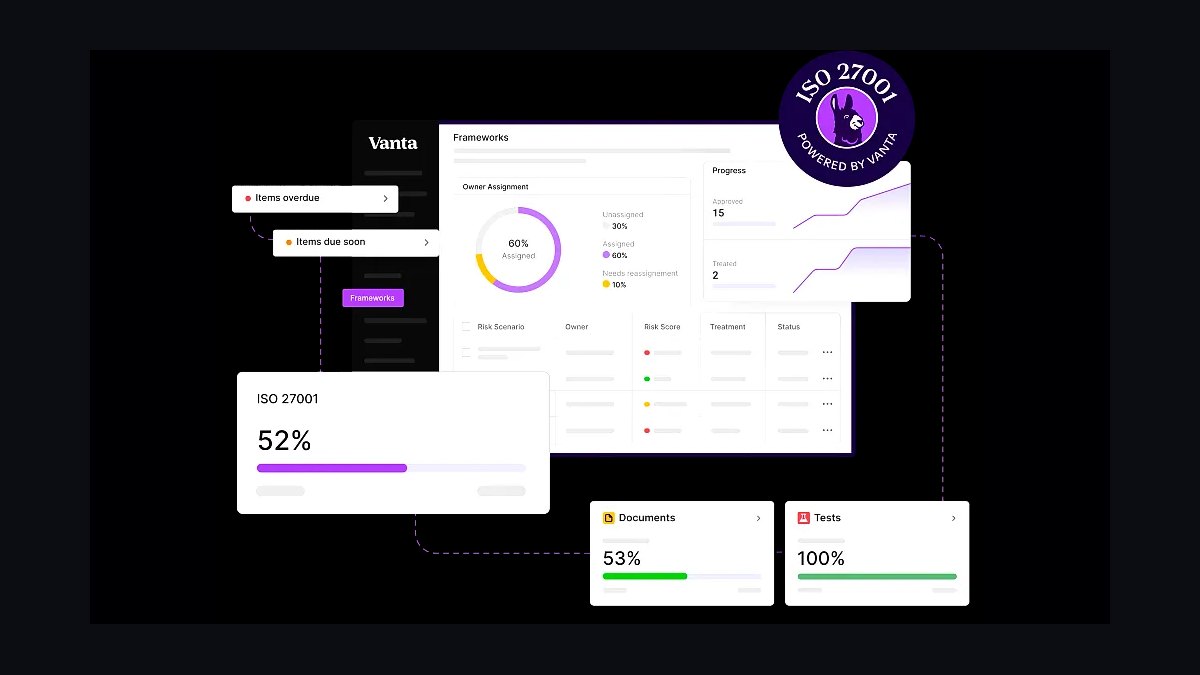
Vanta ranks tenth because SOC 2 Type II and ISO 27001 readiness gate enterprise GPU deals, and automated evidence collection compresses the timeline from months to weeks. At roughly $30K-$100K per year at entry tier, it continuously monitors controls and produces auditor-ready evidence. Providers that start early avoid a compliance scramble when the first enterprise prospect asks for a report.
It is for early and growth-stage providers pursuing SOC 2 and ISO 27001 without a large GRC team. It trades away deep multi-framework depth, which is why larger providers add Hyperproof or AuditBoard later. Compared with Metronome above, it secures the deals rather than bills them, and both are prerequisites for enterprise revenue.
How we ranked these
We scored each tool on four weighted criteria: GPU utilization impact (35%), quote-to-cash accuracy for usage and reservation billing (25%), compliance readiness for SOC 2, ISO 27001, and FedRAMP (20%), and integration depth with Kubernetes, Slurm, Ray, and DCGM telemetry (20%). Scores came from vendor documentation, published benchmark data, and hands-on deployment experience across production GPU cloud environments.
We deliberately excluded list pricing, brand recognition, and analyst quadrant placement. Per-seat software costs are rounding errors next to GPU capex and power contracts, so optimizing for them distorts the real decision. We also ignored generic CRM feature checklists, because a $50K spot deal and a $500M reserved-capacity contract require different custom objects, not more marketing automation.
What to look for
What actually matters when choosing between these tools is whether the telemetry layer, billing engine, and CRM share one source of truth for GPU-hours. If DCGM reports one number, Metronome invoices another, and Salesforce forecasts a third, every renewal becomes a reconciliation fight. Integration depth beats feature count, and tools that cannot ingest hardware-level utilization data should be eliminated early.
The mistake most buyers make is optimizing the sales stack before solving supply and networking. A polished Salesforce, Clari, and Gong deployment cannot fix 40% utilization or a fat-tree topology that caps training throughput 30% below competitors. Buyers also over-index on per-seat software pricing while ignoring power contracts, cooling redundancy, and GPU allocation risk, which swing total cost far more than any CRM line item ever will.
Related questions
Why does GPU utilization matter more than any software tool in this stack?
A cluster running at 40% utilization turns a $2M-$4M H100 NVL72 investment into a slow loss regardless of CRM quality. The 70-90% band is what makes unit economics work. Software exists to protect that number, not replace it, so utilization belongs on the executive dashboard next to pipeline and bookings.
How should a provider bill for reserved capacity versus on-demand GPU hours?
Reserved contracts need a billing engine that translates a signed commitment into a usage schedule, true-ups, and overage handling. Metronome and Zuora both handle this, but the metering source must be DCGM telemetry, not manual reconciliation. Any drift between reported utilization and invoiced hours erodes trust with sophisticated buyers who audit their own usage.
What breaks first when a GPU cloud provider scales past 1,000 GPUs?
Networking topology and telemetry, not compute. A fat-tree or dragonfly mistake can cut effective training throughput 20-30%, which customers detect in their own benchmarks before renewal. Retrofitting DCGM, Prometheus, and Grafana onto a live cluster is far harder than building them in alongside provisioning, so instrumentation must ship on day one.
Do GPU cloud providers really need both Kubernetes and Slurm?
Yes, because customer segments differ. Kubernetes serves containerized inference and platform teams; Slurm remains the scheduler of choice for HPC and academic training workloads. Ray sits alongside both for distributed Python workloads. Providers that force one orchestrator on all customers lose deals to competitors that meet research labs and enterprises where they already are.
How does NVIDIA allocation risk change the recommended stack?
It pushes providers toward AMD MI300X diversity and long-term commit contracts that trade pricing flexibility for allocation certainty. During shortages, mid-tier providers can see H100 allocations cut 30-40% with little notice, leaving signed reservations undeliverable. The stack itself does not fix supply, but it must support mixed GPU fleets without re-architecting billing or orchestration.
What compliance certifications actually gate enterprise GPU cloud deals?
SOC 2 Type II and ISO 27001 are table stakes for enterprise buyers. FedRAMP Moderate opens federal civilian AI workloads and FedRAMP High unlocks DoD, but the $3M-$10M cost and 24-36 month timeline mean it only makes sense once federal pipeline is credible. Vanta or Drata handles early evidence collection; Hyperproof and AuditBoard enter later.
Why do GPU cloud providers need technical customer success managers?
Customer health signals are infrastructure signals: utilization drops, job failures, networking bottlenecks. A traditional CSM cannot interpret them. Providers staffing HPC and AI-infrastructure backgrounds in CS roles catch churn risk before renewal conversations, when there is still time to fix a topology issue or rebalance workloads across the fleet.
Where does the telemetry-to-billing pipeline most often fail?
At the handoff between DCGM metrics and the billing engine. Teams instrument operations dashboards thoroughly but treat invoicing as a separate finance workflow, so GPU-hour counts diverge. Wiring Metronome or Zuora directly to the same telemetry Prometheus reads eliminates reconciliation, and it is the single highest-leverage integration decision in the commercial stack.
FAQ
Should a new GPU cloud provider lease colocation or build its own data centers?
Lease for speed and lower capex risk below roughly $100M ARR. Building custom data centers starts winning on unit economics once a provider spends $500M+ ARR-equivalent on power and cooling. Site selection increasingly favors cheap, dense power such as hydro, nuclear, or geothermal, plus cool ambient climates that reduce cooling load.
Which NVIDIA generation should a provider procure in 2027?
H100 remains the general workhorse, H200's larger HBM3e memory suits inference-heavy customers, and B200 or GB200 NVL72 targets frontier-training buyers paying a premium for the newest silicon. Most providers run a mixed fleet, because a single generation cannot serve spot research workloads and multi-year frontier reservations at the same margin profile.
Is AMD MI300X a viable alternative to NVIDIA GPUs?
Yes, especially for providers facing NVIDIA allocation constraints. MI300X's 192GB HBM3 makes it credible for many training and inference workloads, and diversifying supply reduces single-vendor risk. The tradeoff is software maturity: some frameworks and kernels still favor CUDA, so providers must validate customer workloads before promising parity.
How important is sustainability positioning for a GPU cloud provider?
Increasingly important commercially. Providers built around stranded gas, geothermal, or hydro power can win ESG-conscious enterprise customers at a pricing premium. It remains a differentiator rather than a requirement, but power sourcing decisions made at site selection lock in that positioning for a decade, so the choice is effectively irreversible.
What is the single biggest operational risk for a growth-stage GPU cloud provider?
Utilization collapse. Building capacity ahead of confirmed demand and running below the 70-90% target turns positive contract value into negative gross margin. The fix is bin-packing optimization across workloads, spot pricing for excess capacity, and treating utilization as a leadership KPI rather than an ops-team metric buried in a dashboard.
Do smaller providers need the full enterprise compliance stack from day one?
No. Early-stage providers typically start with Vanta or Drata alone for SOC 2 Type II evidence collection. Hyperproof and AuditBoard enter only once enterprise or federal pipeline requires multi-framework evidence at scale. Starting SOC 2 early still matters, because evidence collection takes months to mature before the first enterprise prospect asks.
How does FedRAMP authorization change a provider's addressable market?
FedRAMP Moderate opens federal civilian agency AI workloads, and FedRAMP High unlocks DoD contracts. The cost runs $3M-$10M with a 24-36 month timeline, so it only makes sense once federal pipeline is credible rather than speculative. Providers that start the roadmap early convert qualified government pipeline faster than those that begin mid-negotiation.
Is InfiniBand always better than Ethernet for GPU clusters?
Not universally. InfiniBand NDR at 400 Gb/s and XDR at 800 Gb/s win on latency-sensitive training workloads, where inter-GPU latency directly determines convergence speed. RoCE Ethernet is a legitimate lower-cost choice for inference workloads with higher latency tolerance. Most providers run both, matching fabric to workload class rather than standardizing on one.
What does a realistic 90-day rollout sequence look like?
Days 1-30 stand up leased colocation with 8-GPU H100 boxes plus Kubernetes, Slurm, DCGM, Prometheus, and Grafana. Days 31-60 add the REST API, SDKs, Salesforce, Clari, Gong, Outreach, and Metronome or Zuora billing. Days 61-90 close storage, InfiniBand NDR fabric, Gainsight, and a FedRAMP roadmap if justified.
How should providers handle power and cooling failure risk?
Redundant cooling design at N+1 or 2N, dynamic thermal management that throttles workloads gracefully rather than crashing them, and SLA credit structures for downtime are baseline requirements for frontier-training customers. One high-profile training-run failure costs more in reputation than years of incremental margin gained by under-investing in cooling redundancy.
Sources
- https://www.nvidia.com/en-us/data-center/
- https://www.amd.com/en/products/accelerators/instinct/mi300.html
- https://www.infinibandta.org/
- https://aws.amazon.com/ec2/instance-types/p5/
- https://learn.microsoft.com/en-us/azure/virtual-machines/nd-h100-v5-series
- https://cloud.google.com/compute/docs/gpus
- https://www.oracle.com/cloud/compute/gpu/
- https://www.salesforce.com/sales/pricing/
- https://www.zuora.com/
- https://www.fedramp.gov/
Related on PULSE
This page will be disappearing soon. Save it to your device for $1 — or read it free while it is here.
@Kory-White- · if Venmo asks, the last 4 of my number are 2012
This page is gone.
This one is off the shelf now. $1 keeps it on your phone for good — the whole page, pictures and diagrams included.
 pulse-tech-stacksTop 10 Best Tech Stack Tools for Self-Storage Operators in 2027
 pulse-tech-stacksTop 10 Best Tech Stack Tools for AI Legal Tech Companies in 2027
 pulse-tech-stacksTop 10 Best Tech Stack Tools for Home Builders and Residential Developers in 2027
 pulse-tech-stacksTop 10 Best Tech Stack Tools for Medical Billing and RCM Companies in 2027
 pulse-tech-stacksTop 10 Best Tech Stack Tools for CrossFit Boxes in 2027
 pulse-tech-stacksTop 10 Best Tech Stack Tools for Online Travel Agencies (OTAs) in 2027
 pulse-tech-stacksTop 10 Best Tech Stack Tools for Independent Dance Studios in 2027
 pulse-tech-stacksTop 10 Best Tech Stack Tools for RV Dealerships in 2027
 pulse-tech-stacksTop 10 Best Tech Stack Tools for Pressure Washing Companies in 2027
 pulse-tech-stacksTop 10 Best Tech Stack Tools for Independent Food Trucks in 2027