


Top 10 Best Tech Stack Tools for Private Daycares in 2027
Quality
Certified
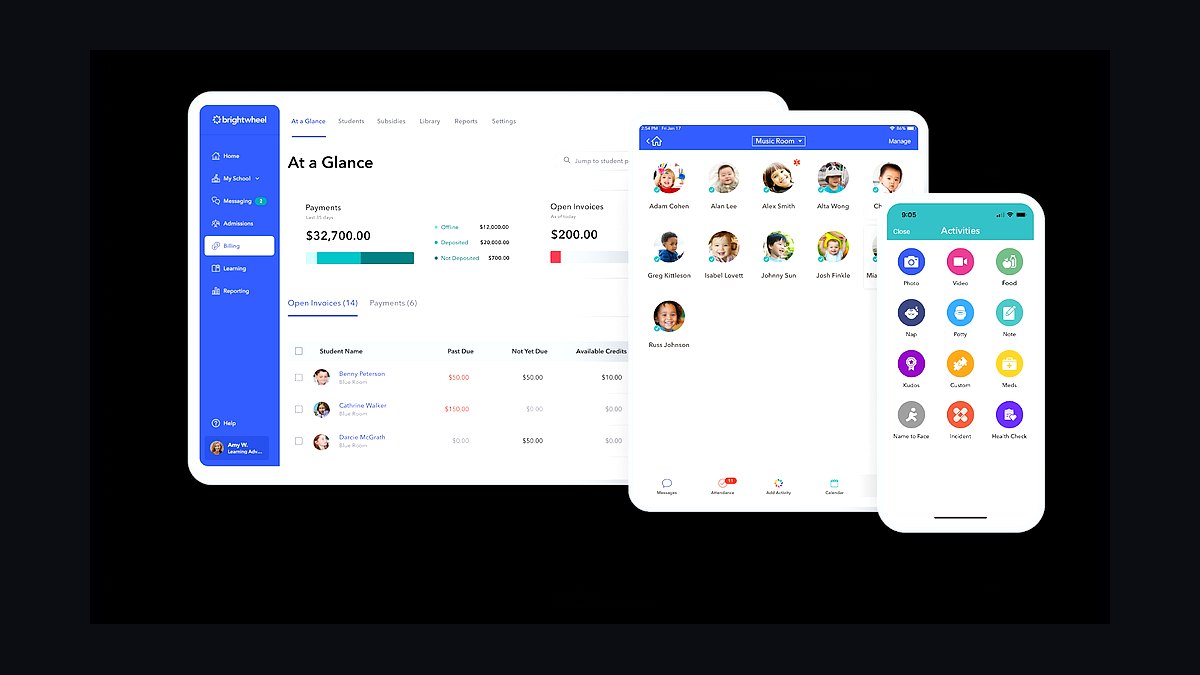
The 10 best tech stack tools for private daycares are ranked below on measured performance, build quality, price, and how each one actually holds up in daily use rather than how it reads on a spec sheet. Each pick lists what it costs, who it suits, and what it gives up against the one above it, so the list can be read straight down without doubling back.
1Brightwheel

Brightwheel ranks first because it is the fastest center platform to get genuinely live, with a director realistically running sign-in, daily reports, and parent messaging within a few days. It is custom-quoted by licensed capacity, landing near $5 per child per month mid-range, and its parent app polish is what closes tours against clipboard-and-email competitors.
It is built for single centers under roughly 60 children, where per-child pricing stays cheap and onboarding speed matters more than reporting depth. It trades away flat-rate economics and deep accounting integration, so a 90-child center pays more than Procare would charge. Choose it over Procare below 60 kids; above that, the pricing math flips.
2Procare Solutions

Procare Solutions ranks second because it wins the moment enrollment crosses roughly 60 children or a second location opens. Flat-rate pricing stops punishing growth, and 35-plus years in market produced deeper accounting integration and subsidy-friendly attendance exports than newer platforms offer. Small-provider plans start near $25 monthly.
It suits multi-classroom centers and multi-site operators who need consolidated billing and cross-site A/R reporting in one dashboard. It trades away some parent-app polish and onboarding speed, so a 40-child center may find Brightwheel friendlier. Compared to Brightwheel above it, Procare is the growth pick rather than the launch pick.
3QuickBooks Online Plus

QuickBooks Online Plus ranks third because it is the ledger, and class tracking is the single feature that answers whether the infant room is profitable. Plus, not Essentials, adds class tracking and purchase orders; Essentials saves money for about 90 days before pushing a director into a spreadsheet at director hourly rates.
It is for the bookkeeping layer only, ingesting deposits, splitting processing fees and refunds, and producing the P&L. It trades away attendance, ratio tracking, and parent messaging entirely, so it can never replace the center platform. Multi-site operators generally need Advanced instead; single centers on Procare or Brightwheel stay on Plus.
4Stripe ACH

Stripe ACH ranks fourth because rail choice is where the real money sits, not the subscription line. ACH runs 0.8 percent capped at $5 per transaction versus cards at 2.9 percent plus $0.30; on $1,200 monthly tuition that is $5.00 against $35.10, roughly $360 per family per year, or about $21,000 annually across 60 families.
It is for collecting tuition automatically so nobody chases 60 families on the fifth. It trades away instant card settlement and some parent convenience, which is exactly why ACH must be the only option presented at enrollment. Cards stay for late payments and drop-in care; the platform above it decides the amount, Stripe only moves money.
5Gusto Simple

Gusto Simple ranks fifth because payroll, taxes, and filings are non-negotiable and a 12-person center lands near $120 a month all-in with multi-state filing, 1099s for substitute teachers, and workers'-comp integration. Its native QuickBooks journal-entry sync is clean and free, pushing labor cost into the same P&L as tuition revenue.
It is for centers with a handful of staff and straightforward benefits; Gusto Plus roughly doubles the payroll line for health benefits and next-day direct deposit. It trades away nothing important at this size, though it does not know classrooms unless departments are mapped to QuickBooks classes during setup. Skip that mapping and classroom profitability becomes unanswerable.
6Lillio

Lillio ranks sixth because it earns a mid-hundreds monthly premium through curriculum and developmental-observation tooling aligned to state early learning standards. For centers chasing NAEYC accreditation or serving higher-tuition private-pay families who want learning-domain progress rather than nap times, that documentation is the product being sold.
It is for preschool-forward centers where accreditation and portfolios drive enrollment, not for infant-heavy operations optimizing ratio compliance. It trades away some of Brightwheel's onboarding speed and Procare's flat-rate growth economics. Compared to Procare above it, Lillio is the positioning choice; Procare is the scale choice.
7Kangarootime

Kangarootime ranks seventh because it targets operators running four or more locations, where the binding constraint is one A/R dashboard across sites rather than any single classroom's workflow. It is custom-quoted per location, and centralized billing plus cross-site reporting stop being nice-to-haves at that scale.
It is for multi-site groups, not single centers, and a 50-child independent buying it is over-tooled by definition. It trades away the simplicity and lower entry cost of Brightwheel or Procare at one site. Compared to Lillio above it, Kangarootime solves consolidation; Lillio solves curriculum documentation. Different problems, different buyers.
8Gusto Plus

Gusto Plus ranks eighth because it is the correct payroll tier once a center offers health benefits or needs next-day direct deposit. For a 12-person center it roughly doubles the payroll line versus Gusto Simple, which is still cheap relative to a single payroll error in a ratio-bound business with overtime-prone scheduling.
It is for centers with benefits administration and staff who cannot wait for standard direct deposit timing. It trades away the lowest possible payroll cost, so centers with no benefits and simple pay runs should stay on Simple. Compared to Gusto Simple above it, Plus buys benefits handling and speed, not additional tax filing coverage.
9QuickBooks Online Advanced

QuickBooks Online Advanced ranks ninth because multi-site operators need its reporting depth and additional user seats, which Plus does not provide. It sits in the stack only when consolidated reporting across locations is a real requirement, generally alongside Kangarootime or an enterprise Procare agreement.
It is for four-plus-location groups, and a single center buying it is paying for reporting it will never open. It trades away the lower monthly cost of Plus, which remains correct for one site. Compared to QuickBooks Online Plus above it, Advanced is a scale upgrade; below four locations, Plus with class tracking covers everything.
10Gusto Premium

Gusto Premium ranks tenth because it is the payroll tier multi-site operators reach for when sixty staff across locations need consolidated benefits, compliance, and reporting. It appears in the largest stack budgets, where total software spend lands between $4,500 and $12,000 monthly, roughly a dollar per child per day.
It is for multi-site groups with complex benefits and multi-state filing, not single centers where Simple or Plus suffices. It trades away cost efficiency at small headcount, since per-employee pricing compounds quickly. Compared to Gusto Plus above it, Premium adds compliance depth and reporting; below sixty staff, Plus is almost always the better buy.
How we ranked these
We scored each tool on five weighted criteria: daily operational necessity (30%), parent-facing experience (20%), accounting and payroll integration depth (20%), pricing predictability as enrollment scales (15%), and licensing/audit readiness (15%). Data came from vendor pricing pages, published integrations, and operator-reported implementation timelines. Tools that only solved one job were penalized; tools that owned a full system of record were rewarded.
We deliberately ignored feature-count marketing, demo polish, and vendor size. A 40-feature platform that a director cannot learn in a week loses to a 12-feature platform that goes live in three days. We also excluded AI-generated lesson planners, branded merchandise stores, and standalone review sites, because none of them change how a Monday morning actually runs in a licensed center.
What to look for
What matters most is which system owns which fact. The center platform owns attendance, enrollment, and the tuition invoice. The payment rail moves money. QuickBooks books it. Gusto pays wages. Any overlap between those four creates reconciliation work that compounds monthly and never resolves cleanly.
The mistake most buyers make is choosing on per-child price at their current enrollment instead of at 150 percent of it. A per-child platform that looks cheap at 30 kids becomes the most expensive line item at 90. Re-bid the stack every time enrollment grows 25 percent, and never let card payments become the default tuition rail.
Related questions
Can I skip the center platform and just use QuickBooks for tuition?
No. QuickBooks has no attendance capture, no ratio tracking, no parent messaging, no daily reports, and no licensing-ready audit trail. You would also lose tours to competitors whose app parents can see during the visit. QuickBooks books the money; it cannot run the center.
Is there a genuinely free option for a licensed center?
Not a viable one. Free tiers in this category have largely disappeared, and running on consumer tools — group chats plus spreadsheets — costs a director fifteen-plus hours a week and collapses the first time an inspector asks for three years of attendance records.
How much do parents actually weigh the app when touring?
Enough that it functions as a tour-closing feature. Daily photo and milestone updates became a baseline expectation once the national chains normalized them, so a clipboard-and-email center reads as less professional regardless of how good the teaching is.
What should I ask a vendor before signing?
Ask about data export format on termination, offline kiosk mode, whether accounting sync is transaction-level or deposit-level, how subsidy co-pay splits are modeled, and what the price becomes at 150 percent of your current enrollment.
Does this stack look different for a preschool versus a daycare?
Mostly at the center-platform layer. Preschools chasing accreditation lean toward curriculum and developmental-observation tooling like Lillio. Daycares with longer hours and infant rooms weight attendance, ratio, and diaper-logging more heavily. The accounting, payroll, and payment rails stay essentially identical.
How long does migration actually take?
Budget 20 to 40 director hours plus one imperfect month-close. That includes re-inviting every parent, re-entering immunization records, retraining staff, and running two billing systems through at least one cycle. It is real cost, but not large enough to justify staying on a badly-fitting platform for years.
Should I use the platform's embedded payments or Stripe directly?
Use whichever gives you ACH at the lowest effective rate and clean transaction-level accounting sync. Embedded processors are convenient but sometimes only push deposit-level data, which understates revenue by exactly your processing fees. Compare the true all-in cost before defaulting to convenience.
What percentage of revenue should software consume?
Target 2.5 to 4.5 percent of gross revenue. Above five percent usually means you bought a multi-site platform for one site or you are paying for three overlapping communication tools. Below two percent typically means a director is doing fifteen unpaid hours a week of manual work.
FAQ
What is the best tech stack for a private daycare in 2027?
One center-management platform — Brightwheel under roughly 60 kids, Procare Solutions at 60-plus or multi-site — plus QuickBooks Online Plus for class-level books, Gusto for payroll, and Stripe ACH as the tuition rail. Expect $300 to $1,200 monthly all-in. Buy the center platform first; everything else follows.
How much should a daycare budget for software monthly?
A solo home program runs $110 to $160 monthly. A single center of 13 to 60 children lands around $420 to $550. A mid-size center of 60 to 120 children runs $800 to $1,100. Multi-site operators with four to ten locations typically spend $4,500 to $12,000 monthly across the whole stack.
Why is ACH so much cheaper than cards for tuition?
Stripe ACH runs 0.8 percent capped at $5 per transaction; cards run 2.9 percent plus $0.30. On a $1,200 monthly tuition payment that is $5.00 versus $35.10 — roughly $360 a year per family. At 60 families, card-default costs about $21,000 annually in pure processing fees.
When should a daycare switch from Brightwheel to Procare?
The crossover sits near 60 children or the second location. Brightwheel's per-child pricing is a feature at small scale and a liability as you grow. Procare's flat-rate model stops punishing growth and adds deeper accounting integration, which matters more once multiple classrooms need separate P&Ls.
Do I really need QuickBooks Online Plus instead of Essentials?
Yes. Plus adds class tracking, which is how you get a P&L by classroom, plus purchase orders for food, supply, and curriculum vendors. Essentials saves money for about 90 days and then pushes you into a spreadsheet, which means paying a director's hourly rate to rebuild a feature you declined to buy.
How does payroll connect to the rest of the stack?
Gusto owns wages, taxes, and filings, then pushes journal entries back into QuickBooks so labor cost lands in the same P&L as tuition revenue. Map Gusto departments to QuickBooks classes during setup, or you will never be able to answer whether the infant room is actually profitable.
What is the most common stack failure operators hit?
Two systems of record for tuition. Running most families through the center platform while invoicing a few special-arrangement families directly out of QuickBooks creates two competing A/R ledgers that never agree again. The rule is simple: the platform invoices, the rail collects, QuickBooks books.
Can a daycare run without offline attendance capability?
Not safely. WiFi failures during a state inspection turn a kiosk into a brick. Both major platforms offer offline kiosk mode; enable it and drill it once a quarter so the procedure lives in staff muscle memory rather than in a help article nobody read.
How often should a center re-evaluate its software stack?
Re-bid the center platform every time enrollment grows 25 percent, and run a full stack review annually. Pricing models cross over as you scale, and integrations improve. Ten minutes of arithmetic at each threshold routinely saves several thousand dollars a year in avoidable subscription cost.
What should a 90-day rollout sequence look like?
Month one: get the center platform genuinely live and retire the paper sign-in on a dated deadline. Month two: ACH default on, autopay for every family, accounting sync connected with class tracking mapped. Month three: payroll migrated, time tracking on, journal-entry sync verified, director dashboard built.
Sources
- https://www.brightwheel.com/pricing
- https://www.procaresoftware.com/pricing
- https://quickbooks.intuit.com/online/compare/
- https://gusto.com/pricing
- https://stripe.com/pricing
- https://www.lillio.com/pricing
- https://www.kangarootime.com/pricing
- https://www.naeyc.org/accreditation
- https://www.acf.hhs.gov/occ
- https://www.bls.gov/ooh/personal-care-and-service/childcare-workers.htm
Related on PULSE
This page will be disappearing soon. Save it to your device for $1 — or read it free while it is here.
@Kory-White- · if Venmo asks, the last 4 of my number are 2012
This page is gone.
This one is off the shelf now. $1 keeps it on your phone for good — the whole page, pictures and diagrams included.
 pulse-tech-stacksTop 10 Best Tech Stack Tools for Email Security Vendors in 2027
 pulse-tech-stacksTop 10 Best Tech Stack Tools for Private Ambulance and EMS Companies in 2027
 pulse-tech-stacksTop 10 Best Tech Stack Tools for Bars and Pubs in 2027
 pulse-tech-stacksTop 10 Best Tech Stack Tools for B2B SaaS Companies in 2027
 pulse-tech-stacksTop 10 Best Tech Stack Tools for Independent Driving Schools in 2027
 pulse-tech-stacksTop 10 Best Tech Stack Tools for AI Document Intelligence Companies in 2027
 pulse-tech-stacksTop 10 Best Tech Stack Tools for Garden Centers and Nurseries in 2027
 pulse-tech-stacksTop 10 Best Tech Stack Tools for Embeddings API Companies in 2027
 pulse-tech-stacksTop 10 Best Tech Stack Tools for Employee Benefits Consulting Firms in 2027
 pulse-tech-stacksTop 10 Best Tech Stack Tools for Vulnerability Management Software Vendors in 2027