 Pulse Reviews and Analysis
The 10 Best Time-Series Databases for AI in 2027
 Curated by Kory White · Fractional CRO, CRO Syndicate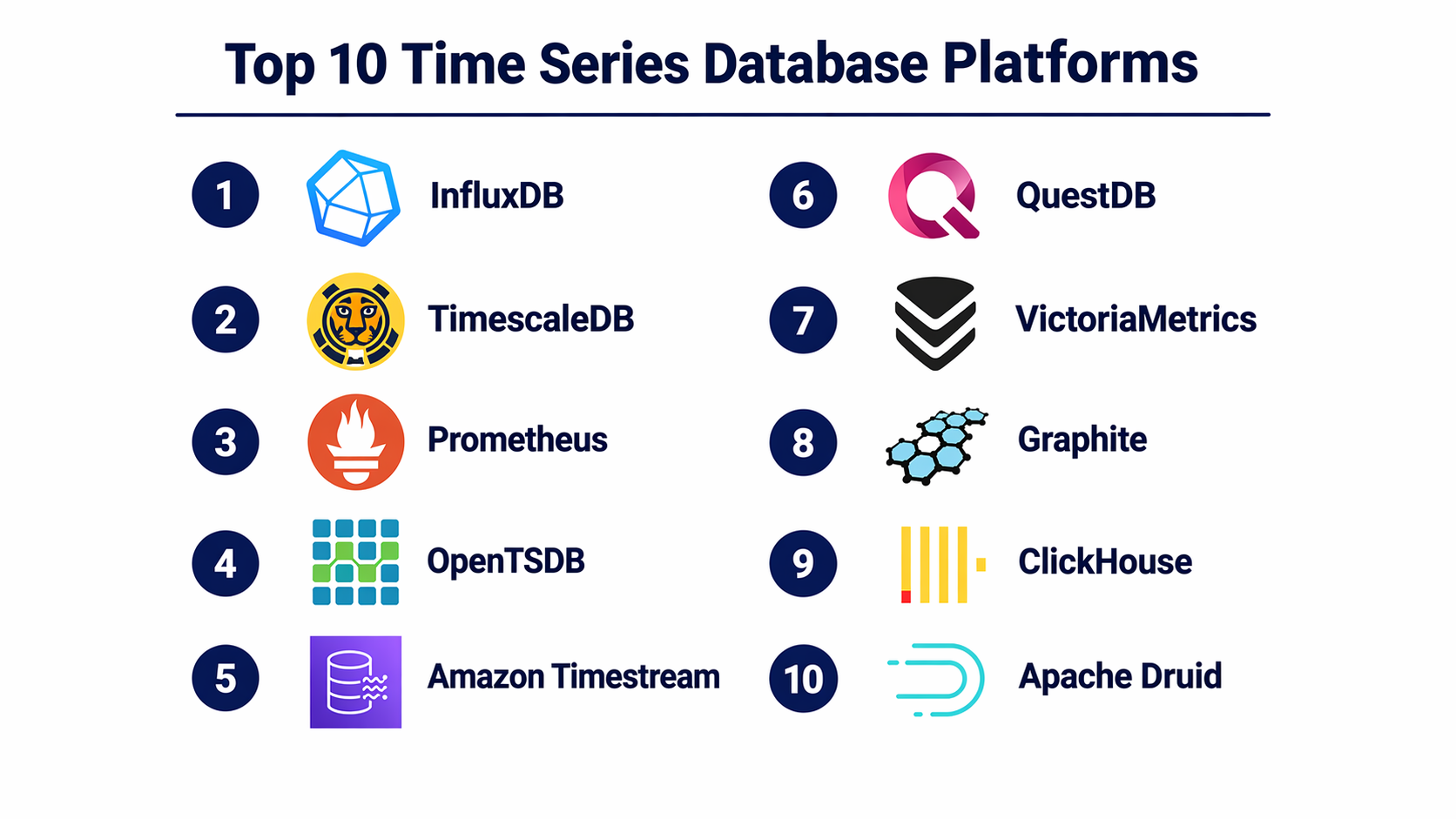
The 10 Best Time-Series Databases for AI in 2027
AI systems run on a firehose of timestamped data: GPU utilization metrics, model latency traces, IoT sensor streams, financial ticks, and the feature histories that drive forecasting and anomaly-detection models. A time-series database (TSDB) is purpose-built to ingest, compress, and query this data at high write rates and over long retention windows, which is exactly what general-purpose stores struggle with.
The teams building reliable AI infrastructure in 2027 lean on a TSDB both to observe their own platform and to power the temporal features their models consume. This ranking covers the ten time-series databases AI teams rely on most.
Direct Answer
TimescaleDB is the best overall because it layers true time-series performance — automatic partitioning, columnar compression, and continuous aggregates — on top of full PostgreSQL, so AI teams get hypertable scale without leaving SQL or losing joins to their feature tables. VictoriaMetrics is the best value because it delivers extremely high ingestion and low resource usage as a permissively licensed open-source project, making it the cheapest way to store huge volumes of metrics.
Your choice depends on whether you need SQL and relational joins (Timescale), pure metrics monitoring (Prometheus/VictoriaMetrics), or a real-time analytics engine for sub-second queries (QuestDB, ClickHouse).
How We Ranked These
We evaluated each database on five criteria: ingestion throughput (sustained write rate under load), query performance (latency for range scans, downsampling, and aggregation), compression and retention (storage efficiency over long windows), AI fit (integration with feature stores, ML libraries, and forecasting workflows), and operability (clustering, ecosystem, and cost).
Because AI workloads are write-heavy and retention-hungry, we weight ingestion and compression most heavily.
1. TimescaleDB 🏆 BEST OVERALL
TimescaleDB is a time-series extension to PostgreSQL that turns ordinary tables into hypertables automatically partitioned by time and space. It adds native columnar compression (often 90%+ savings), continuous aggregates for pre-rolled rollups, and data-retention policies, all while preserving full SQL, joins, and the Postgres ecosystem.
For AI teams that already store features and metadata in Postgres, that means temporal data and relational data live in one queryable place.
What it is: PostgreSQL extension for time-series at scale. Strengths: full SQL and joins, compression, continuous aggregates, huge Postgres ecosystem. Best for: teams wanting time-series power without leaving relational SQL.
Pricing/availability: open-source (Apache 2 core) and self-hosted; managed via Timescale Cloud with usage-based tiers.
2. VictoriaMetrics 💎 BEST VALUE
VictoriaMetrics is a fast, cost-efficient time-series database and monitoring solution that is Prometheus-compatible and known for very high ingestion with a small memory and disk footprint. It scales from a single binary to a clustered deployment and supports MetricsQL, an extended PromQL.
For AI platform teams drowning in GPU and inference metrics, it is one of the cheapest ways to retain everything.
What it is: open-source, Prometheus-compatible TSDB optimized for cost. Strengths: extreme ingestion efficiency, low resource use, long retention, drop-in for Prometheus. Best for: large-scale metrics monitoring on a budget.
Pricing/availability: open-source single-node free; clustered enterprise and managed VictoriaMetrics Cloud available.
3. Prometheus
Prometheus is the de facto open-source standard for metrics-based monitoring in cloud-native and Kubernetes environments. It pulls metrics from instrumented targets, stores them in an efficient local TSDB, and queries them with PromQL. While its local storage is intentionally short-retention, it pairs with long-term backends (Thanos, Cortex, Mimir, VictoriaMetrics) for durability.
Nearly every AI platform running on Kubernetes uses Prometheus to watch GPU and pod health.
What it is: CNCF metrics monitoring system with built-in TSDB. Strengths: Kubernetes-native, huge exporter ecosystem, PromQL, alerting. Best for: infrastructure and GPU monitoring on Kubernetes. Pricing/availability: free open-source; managed via Grafana Cloud and others.

Reach Kory White, Fractional CRO: 📅 Book a Quick Call · 💼 Kory on LinkedIn · 🏢 CRO Syndicate
4. InfluxDB
InfluxDB is a widely used purpose-built time-series platform spanning IoT, monitoring, and real-time analytics. InfluxDB 3.x rebuilt the engine on Apache Arrow and Parquet for columnar performance and SQL/InfluxQL querying, and it integrates with Telegraf for collecting metrics from hundreds of sources.
It is a strong fit for sensor and edge data feeding ML pipelines.
What it is: dedicated time-series platform with a broad collector ecosystem. Strengths: Telegraf integration, Arrow/Parquet engine, IoT and edge focus, SQL support. Best for: IoT and sensor-driven AI workloads. Pricing/availability: open-source core; InfluxDB Cloud and enterprise tiers.
5. QuestDB
QuestDB is a high-performance open-source time-series database designed for fast ingestion and low-latency SQL queries, with native support for the InfluxDB Line Protocol and PostgreSQL wire protocol. Its column-oriented storage and time-partitioning make it excellent for financial ticks, real-time dashboards, and feature computation where query speed matters.
What it is: fast columnar TSDB with SQL and InfluxDB-line ingestion. Strengths: very fast ingest and queries, familiar SQL, lightweight. Best for: real-time analytics, finance, and low-latency feature serving. Pricing/availability: open-source (Apache 2); QuestDB Enterprise and Cloud available.
6. ClickHouse
ClickHouse is a column-oriented OLAP database that, while not exclusively a TSDB, is one of the fastest stores for time-stamped analytical data at scale. Its vectorized query engine and aggressive compression make it a favorite for storing observability data, event streams, and large training-feature tables that need fast aggregation over billions of rows.
What it is: columnar OLAP database excellent for time-stamped analytics. Strengths: blistering aggregation speed, strong compression, SQL, massive scale. Best for: large-scale analytical time-series and event data. Pricing/availability: open-source (Apache 2); ClickHouse Cloud managed service.
7. Apache Druid
Apache Druid is a real-time analytics database built for sub-second OLAP queries on high-volume event and time-series data. It combines streaming ingestion (from Kafka or Kinesis) with columnar storage and indexing, powering interactive dashboards over fresh data. AI teams use it for real-time feature analytics and operational monitoring at scale.
What it is: distributed real-time analytics database. Strengths: streaming ingestion, sub-second queries, high concurrency. Best for: real-time, user-facing analytics over event streams. Pricing/availability: open-source (Apache 2); managed via Imply.
8. Amazon Timestream
Amazon Timestream is AWS's fully managed, serverless time-series database that automatically tiers recent data to memory and older data to cost-optimized storage. It scales ingestion without server management and integrates with the AWS ecosystem, including SageMaker for ML and Grafana for visualization.
It suits teams that want zero operational overhead inside AWS.
What it is: serverless managed TSDB on AWS. Strengths: no servers to manage, automatic tiering, AWS-native integrations. Best for: AWS-centric teams wanting managed time-series. Pricing/availability: usage-based pricing for ingestion, storage, and queries.
9. Grafana Mimir
Grafana Mimir is an open-source, horizontally scalable long-term storage backend for Prometheus metrics, designed to handle billions of active series with high availability. It extends Prometheus retention and scale and integrates tightly with Grafana for visualization. AI platform teams use it as the durable metrics tier behind their monitoring stack.
What it is: scalable long-term Prometheus storage backend. Strengths: massive cardinality, multi-tenancy, HA, Grafana integration. Best for: large multi-team Prometheus deployments needing long retention. Pricing/availability: open-source (AGPL); managed via Grafana Cloud.
10. MongoDB Time Series Collections
MongoDB offers native time-series collections that automatically optimize storage and indexing for timestamped data while keeping MongoDB's flexible document model and query language. For teams already running MongoDB for application data, it provides a way to keep sensor and metrics data alongside documents without adding a separate system.
What it is: document database with native time-series collections. Strengths: unified with existing MongoDB data, flexible schema, managed Atlas option. Best for: teams standardized on MongoDB wanting time-series in-place. Pricing/availability: open-source community edition; MongoDB Atlas managed tiers.
How to Choose for Your AI Stack
If your features and metadata already live in PostgreSQL, TimescaleDB keeps everything in one SQL surface. If you are drowning in GPU and inference metrics and want the lowest cost per series, VictoriaMetrics or Prometheus + Mimir is the path. For real-time, low-latency feature serving or financial data, reach for QuestDB or ClickHouse.
For zero-ops inside a cloud, Amazon Timestream removes the operational burden. Match the database to your dominant access pattern — relational joins, pure monitoring, or real-time analytics — rather than chasing a single "best."
Frequently Asked Questions
Do I need a time-series database for AI, or will Postgres do? Plain PostgreSQL works at small scale, but as write rates and retention grow you hit partitioning and index pain. TimescaleDB gives you Postgres with time-series superpowers, while pure-metrics workloads are better served by VictoriaMetrics or Prometheus.
What is the difference between a TSDB and a metrics monitoring system? A metrics system like Prometheus is a TSDB plus collection, alerting, and a query language tuned for monitoring. General TSDBs like TimescaleDB or QuestDB are storage engines you can use for monitoring, IoT, finance, or ML features alike.
How do time-series databases help with forecasting models? They store the historical signal your model learns from and serve clean, downsampled, gap-aware windows for training and inference. Continuous aggregates and downsampling make it cheap to compute the lagged and rolling features forecasting models need.
Which TSDB is best for IoT and sensor data feeding ML? InfluxDB (with Telegraf) and QuestDB are strong for high-rate sensor ingestion, while TimescaleDB is ideal when you also need to join sensor data with relational context.
Can I use ClickHouse as a time-series database? Yes. ClickHouse is an OLAP engine rather than a dedicated TSDB, but its compression and aggregation speed make it excellent for large time-stamped analytical data, observability, and event streams.
Sources
- TimescaleDB documentation — https://docs.timescale.com/
- VictoriaMetrics documentation — https://docs.victoriametrics.com/
- Prometheus documentation — https://prometheus.io/docs/
- InfluxDB documentation — https://docs.influxdata.com/
- QuestDB documentation — https://questdb.io/docs/
- ClickHouse documentation — https://clickhouse.com/docs
- Apache Druid documentation — https://druid.apache.org/docs/latest/design/
- Amazon Timestream documentation — https://docs.aws.amazon.com/timestream/
- Grafana Mimir documentation — https://grafana.com/docs/mimir/latest/
- MongoDB time series collections — https://www.mongodb.com/docs/manual/core/timeseries-collections/