
“Be the signal, not the noise.” — LinkedIn Banner
 Curated byKory White · Fractional CRO · Maryland
 PULSEKNOWLEDGE LIBRARY
"Be the signal, not the noise" means your LinkedIn presence should deliver clear, useful, relevant content instead of adding to the endless scroll of self-promotion and filler. The phrase borrows from information theory: the signal is the meaningful information someone actually wants, and the noise is the interference that buries it. On your profile, being the signal is a concrete commitment — every post, comment, and headline should pass a single test: *does this help the reader, or just fill space?* Putting the line on your banner sets that expectation for anyone who lands on your page, and your activity has to back it up for it to mean anything.
“Be the signal, not the noise.” — LinkedIn Banner

A dark, on-brand LinkedIn banner — "Be the signal, not the noise." over a "Relevant Useful Brief" line with a pulse motif. Put it on your profile to signal exactly what you do.
Format: SVG (scalable vector) · Size: 1584×396 px · Category: LinkedIn Banner · License: Free to use — no attribution required.
Recolor it to your brand
Use the color picker above to recolor this banner to your team or company colors, switch the background (including transparent), then download it as an SVG or PNG. No sign-up, no watermark.

How to use it
It scales cleanly to the LinkedIn cover slot (1584×396) — download the PNG and drop it straight onto your profile, or open the SVG in Canva, PowerPoint, or Figma to add your name and tweak the layout.
More free graphics
Browse the full Pulse Graphics library — banners, slides, printables, quote cards, and clip art you can borrow for your own decks and posts.


Related on PULSE
- “Be the signal, not the noise.” — Quote Card
- Be the signal, not the noise. — LinkedIn Wallpaper
- “Always Be Closing” — Sales Floor Poster
- “Sell like you'd want to be sold to.” — Quote Card
- “Sell like you’d want to be sold to.” — LinkedIn Banner
- Deals Do Not Stall, People Do — Banner
Why “Be the Signal, Not the Noise” Resonates on LinkedIn
The phrase endures because it names a real problem in plain language: attention is scarce, and most professional feeds are crowded. The metaphor comes from information theory, where the *signal* is the meaningful data you want to receive and the *noise* is the interference that degrades it. Applied to LinkedIn, being the signal means your content, comments, and profile consistently deliver clarity and relevance instead of adding to the clutter.
What makes this line work on a banner is that it's self-referential. By placing it on your profile, you're not just stating a philosophy — you're making a promise to anyone who visits. The banner acts as a small commitment device. When a recruiter, client, or peer lands on your page and reads it, they form an expectation: *this person values substance over fluff.* When your actual posts and comments reinforce that expectation, trust builds faster than a generic headline ever could.
There's a recognized economics idea underneath this. In *signaling theory* — work for which Michael Spence shared the 2001 Nobel Memorial Prize in Economics — people make judgments about competence under incomplete information by reading credible signals. A banner like this is a low-cost claim on its own; its credibility comes entirely from whether your behavior matches it. That's why the line is most powerful for consultants, executives, and subject-matter experts, whose personal brand directly affects revenue or career trajectory — the gap between claim and conduct is exactly what their audience is trained to spot.
The phrase is also useful because it's actionable. It hands the viewer a lens for evaluating your whole profile. Every post, comment, and recommendation becomes part of a pattern. If your content aligns with the banner, you've built a coherent narrative; if it doesn't, the disconnect is jarring. The strongest uses come from people who have already defined what "signal" means in their specific field — original research, contrarian-but-defensible takes, or simply the best-curated resources in a niche.
How to Design a LinkedIn Banner That Reinforces Your Brand
A strong message can still be undercut by weak execution. Your banner is the second thing people see after your photo, so it sets the visual tone for everything below it. Here's how to make the design work with the words.
Respect the safe zone. LinkedIn cover images are 1584 × 396 pixels, but the profile photo and UI cover parts of the left and bottom edges, and the crop differs on mobile. Keep your key text in the upper-center or center-left, and don't rely on the bottom strip. Use a large, legible size — large enough to read on a phone, not just a monitor.
Match your industry and identity. A financial analyst might use a clean, muted palette that reads as precise and calm; a creative director might use bold type and a gradient that reads as inventive. The point is coherence: if the banner says "futuristic" but your headline says "trusted advisor," the mismatch quietly erodes trust. The banner should feel like an extension of your visual identity, not a standalone piece of art.
Let the metaphor do quiet work. A subtle visual cue can reinforce signal-versus-noise without spelling it out — a clean waveform spike against scattered interference, or a line that resolves from chaotic on the left to ordered on the right. The best designs let the viewer discover the metaphor rather than explaining it.
Test on both desktop and mobile. A layout that looks perfect on a 27-inch monitor can be illegible on a phone. Preview the banner with the profile-photo overlay in Canva or Figma, and have a colleague open your profile on their own device. The goal isn't just to look good — it's to make sure every visitor gets the message without friction.
Practical Strategies to Live the “Signal, Not Noise” Philosophy
A banner that declares you're the signal means nothing if your activity contradicts it. To make the line authentic, align your posting, commenting, and networking habits with it.
Curate your feed ruthlessly. Being the signal starts with consuming less noise. Mute or unfollow accounts that reliably post low-value content. LinkedIn's feed learns from your behavior, so engaging mostly with substantive posts trains it to surface more of the same — and your visible engagement signals to your network what you value.
Adopt a one-insight-per-post rule. Before publishing, ask: *what is the single most valuable takeaway here?* If you can't say it in one sentence, the post probably needs sharpening. The signal isn't always a revelation — a well-framed question or a specific anecdote that illustrates a broader point can carry just as much. The discipline is intentionality, not grandeur.
Use comments as an amplifier. Most people treat comments as throwaways — "Great post!" or an emoji. Comments are actually one of the clearest ways to demonstrate expertise. Add a specific observation, a respectful counterpoint, or a resource that builds on the original. That positions you as someone who engages with ideas, not just consumes them.
Batch your content to stay consistent. Erratic posting — three times one week, silent the next month — confuses both the algorithm and your audience. Pick a cadence you can actually sustain (once a week is plenty for most people, as long as each post earns its place) and batch-create so quality stays high.
Measure what matters. Impressions and likes are easy to inflate and easy to misread. Pay attention to saves, thoughtful comments, and direct messages — those mean someone engaged deeply. Over time you'll build an instinct for what genuinely resonates with your audience, and become a clearer signal in your niche.
Practical Ways to Signal on LinkedIn
To live out this banner, focus on three repeatable actions. First, comment with value—instead of "Great post!" add a specific insight or a clarifying question that moves the conversation forward. Second, share your process, not just your wins. A post about a failed experiment with honest takeaways signals far more than a polished success story. Third, curate ruthlessly—if a piece of content doesn't teach, challenge, or connect someone to an opportunity, skip it. These habits turn your profile into a destination for substance.
The Psychology Behind the Phrase
The phrase works because it taps into a universal frustration: the overwhelming flood of low-effort content. On LinkedIn, noise includes vague motivational quotes, excessive self-promotion, and recycled industry buzzwords. Signal, by contrast, feels like a relief—it respects the reader's time and attention. When you put this on your banner, you're making a public promise that triggers a psychological contract with your audience. They'll hold you to it, which actually helps you stay disciplined. Over time, being known as a signaler builds trust faster than any number of follower counts ever could.
Practical Ways to Be the Signal in Your Niche
Being the signal means tailoring your content to what your specific audience actually needs. Start by identifying the top three recurring questions or pain points in your industry—then address them directly in posts, articles, or comments. For example, if you're in marketing, a signal post might be "Three metrics that actually predict customer retention (and two that don't)." Avoid generic motivational quotes or resharing others' content without adding your unique perspective. A good rule: before hitting publish, ask if your post could be the only one someone reads that day and still walk away with actionable value. Consistently doing this builds a reputation as a go-to resource, not just another voice in the feed.
How to Audit Your Own Profile for Noise
Your LinkedIn banner sets the tone, but your recent activity must match. Run a quick audit of your last ten posts or comments. Count how many offer original insight, a specific example, or a clear takeaway—versus those that are shares with "Great point!" or simple congratulations. If the ratio leans toward noise, adjust your approach. Also check your headline and about section: do they signal your expertise in a few words, or are they cluttered with buzzwords like "results-driven" or "thought leader"? Strip away anything that doesn't directly tell a visitor what you can help them with. A clean, focused profile reinforces the signal message your banner starts.
Sources
- Claude E. Shannon — *A Mathematical Theory of Communication* (Bell System Technical Journal, 1948), the origin of the signal-versus-noise concept.
- Nate Silver — *The Signal and the Noise* (Penguin, 2012), on separating meaningful signal from distracting noise.
- Michael Spence — *Job Market Signaling* (Quarterly Journal of Economics, 1973) and the 2001 Nobel Memorial Prize in Economics work on signaling theory.
- LinkedIn Help Center — official guidance on profile background (banner) image dimensions and requirements.
- Harvard Business Review — coverage of personal branding and professional reputation (e.g., "What's the Point of a Personal Brand?").
- Pew Research Center — research on social media use and online professional behavior in the United States.
FAQ
What does "Be the signal, not the noise" mean on a LinkedIn banner? It means your profile should convey clear, valuable insight rather than blending into the endless scroll of generic posts. The phrase comes from information theory — signal is the meaningful information, noise is the interference — and it asks you to share perspective or expertise that cuts through the clutter so recruiters and peers remember you.
How do I design a LinkedIn banner that actually acts as a "signal"? Use a clean, high-contrast layout with one short, bold statement or value proposition, plus your name or title. Keep the key text in the center or upper-left safe zone (the banner is 1584×396 px, and the profile photo and UI cover the edges). Skip busy graphics and multiple fonts so the message reads instantly, including on mobile.
Can a banner really help me stand out on LinkedIn? Yes, but only if your profile backs it up. A banner can earn the first few seconds of attention, but your headline, About section, and activity have to reinforce the same message. The banner is a promise; your content is whether you keep it. Consistency is what builds trust and recall.
Should I include a call-to-action on my LinkedIn banner? A subtle CTA — "Let's connect" or a link to your portfolio — can work if it feels natural. Avoid hard sells; banners are for branding, not pitching. A simple, professional cue guides viewers without crowding the design or undercutting the "signal" message.
What colors work best for a "signal" LinkedIn banner? Use your personal brand colors, or a neutral palette with a single accent. Prioritize contrast (such as light text on a dark background) so it stays legible across devices and lighting. Avoid clashing or neon combinations that distract from the message itself.
How often should I update my LinkedIn banner? Refresh it whenever your role, focus, or core message changes — for most people that lands somewhere around every 6 to 12 months. A banner that no longer matches your current work can read as disengaged, so update it to reflect what you're doing now.
This page will be disappearing soon. Save it to your device for $1 — or read it free while it is here.
@Kory-White- · if Venmo asks, the last 4 of my number are 2012
This page is gone.
This one is off the shelf now. $1 keeps it on your phone for good — the whole page, pictures and diagrams included.
 graphicWhat do top-performing graphic designers do differently in 2027?
 graphicLead from the front. — LinkedIn Wallpaper
 graphicSell outcomes, not features. — LinkedIn Wallpaper
 graphicBring the energy. — LinkedIn Wallpaper
 graphic“Great reps are coached, not born.” — LinkedIn Banner
 graphicAccount Executive — LinkedIn Banner
 graphicStartup Founder — LinkedIn Banner
 graphicField Sales Rep — LinkedIn Banner
 graphicCommercial Director — LinkedIn Banner
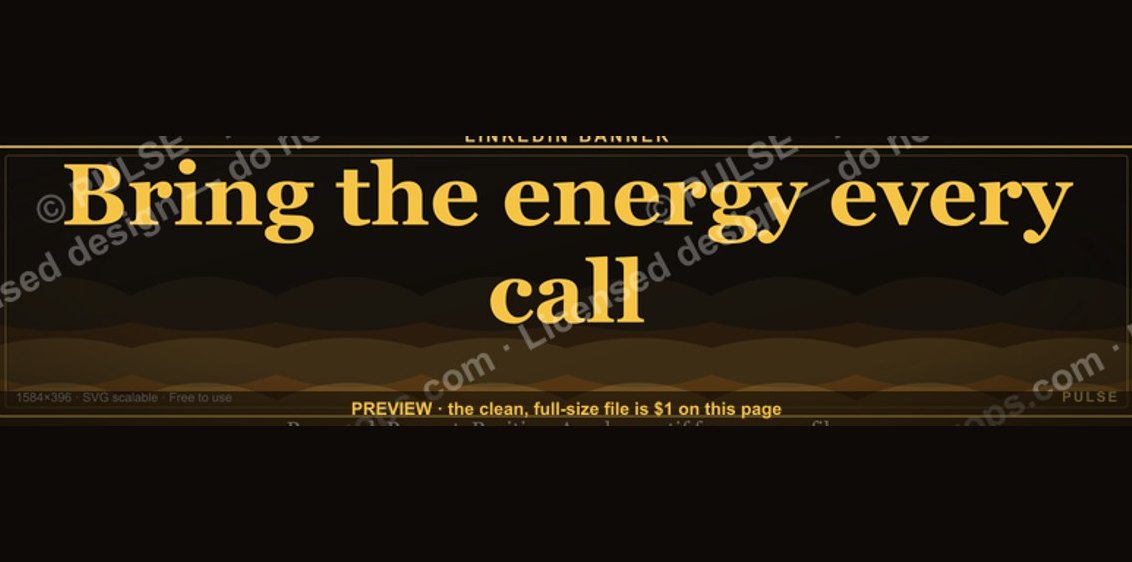 graphic“Bring the energy every call.” — LinkedIn Banner