
“Ask better questions.” — LinkedIn Banner
 Curated byKory White · Fractional CRO · Maryland
 PULSEKNOWLEDGE LIBRARY
A LinkedIn banner that simply reads “Ask better questions” is a positioning statement, not a credential. It tells anyone landing on your profile that you lead with curiosity and inquiry rather than self-promotion — that you’d rather frame the right problem than broadcast a quick answer. The phrase carries no claim of expertise on its own, so its value comes entirely from the profile and posts behind it. Used well, it sets an expectation (“this person asks sharp questions”) that your headline, About section, and content then have to deliver on. Used as decoration over generic self-promotion, it reads as hollow. In short: it works when it’s a promise you keep, and it falls flat when it isn’t.
“Ask better questions.” — LinkedIn Banner

A dark, on-brand LinkedIn banner — "Ask better questions." over a "Why What if How" line with a pulse motif. Put it on your profile to signal exactly what you do.
Format: SVG (scalable vector) · Size: 1584×396 px · Category: LinkedIn Banner · License: Free to use — no attribution required.
Recolor it to your brand
Use the color picker above to recolor this banner to your team or company colors, switch the background (including transparent), then download it as an SVG or PNG. No sign-up, no watermark.
How to use it
It scales cleanly to the LinkedIn cover slot (1584×396) — download the PNG and drop it straight onto your profile, or open the SVG in Canva, PowerPoint, or Figma to add your name and tweak the layout.
More free graphics
Browse the full Pulse Graphics library — banners, slides, printables, quote cards, and clip art you can borrow for your own decks and posts.
Related on PULSE
- “ASK BETTER QUESTIONS” — Sales Floor Print
- “Ask better questions.” — Quote Card
- Ask better questions. — LinkedIn Wallpaper
- The Ask — Section Divider Slide
- Better reps, every week. — LinkedIn Wallpaper
- “Selling better outcomes.” — LinkedIn Banner
Why “Ask Better Questions” Works as a Professional Signal
On LinkedIn, where most banners are either a company logo or a recycled motivational line, a banner that simply says “Ask better questions” stands out because it’s specific and slightly self-aware. It signals three things, and each one only lands if the rest of your profile backs it up.
It signals intellectual humility. In a feed full of people broadcasting answers, choosing to foreground questions suggests you’re comfortable saying “I don’t know yet — let’s find out.” That posture tends to read well for roles where framing the problem matters as much as solving it: product management, consulting, strategy, research, and leadership.
It positions you as a problem-framer, not just a problem-solver. The “Why / What if / How” line beneath the headline mirrors a familiar inquiry sequence — understand the root cause (Why), explore the options (What if), then plan execution (How). People who work in innovation, strategy, or product recognize that vocabulary instantly and read you as someone who thinks in sequences rather than one-off opinions.
It implies emotional intelligence, not just analysis. The pulse motif in the design hints that the questioning is driven by genuine curiosity and human connection rather than interrogation. That blend — analytical and warm — is what most modern leadership writing, from Edgar Schein’s *Humble Inquiry* onward, treats as the hallmark of a good question-asker.
The catch is coherence. If your headline says “Sales Director” and your history is fifteen years of closing, a banner emphasizing questions creates dissonance — the viewer wonders why a closer is leading with curiosity. If your headline says “Product Strategy Lead” or “Innovation Coach,” the same banner reinforces a single, consistent story. The banner is a promise; the rest of your profile is where you keep it.
How to Pair the Banner with Your LinkedIn Content
A banner is only as strong as the content around it. To make “Ask better questions” credible, show your questions in action.
Start with the headline. Instead of “Marketing Manager,” try “Asking better questions about customer behavior · Marketing Strategy Lead.” That ties the banner to your identity in one line.
Open your About section with a question. Something like: “What if your biggest growth opportunity is hiding in plain sight because no one’s asking the right question about it?” Now the profile itself demonstrates the philosophy instead of just asserting it.
Pick a weekly rhythm. One post a week that walks through a questioning framework goes a long way — for example, “The three questions I ask every client before I write a word of strategy,” then a short explanation of why each one matters. Posts that share a “dumb” question that uncovered a real insight tend to land well because they show vulnerability rather than polish.
Use the “Why / What if / How” structure as a content series. It maps cleanly onto a three-post arc:
- Why do so many product launches stall? — root-cause analysis
- What if you treated a launch like an experiment? — reframing the problem
- How to run a minimum viable launch in two weeks — practical execution
Keep the ratio honest. If every post is “here’s my opinion” or “look at my win,” the banner reads as hypocritical. Aim for mostly questions, frameworks, and invitations to discuss, with the occasional personal win mixed in. The point is to signal that you genuinely value inquiry over assertion — and then prove it.
A Quick Note on the Design Choices
A few of the banner’s visual decisions are deliberate. The short, context-free phrase creates a small curiosity gap — “better questions about *what*?” — that nudges people to click through to find out. The dark background reads as focused and considered rather than loud. And the “Why / What if / How” line gives the slogan a sense of method, so it feels like a framework rather than a throwaway phrase. None of this guarantees engagement on its own; it simply makes the banner easier to remember in a crowded feed, so that when someone sees your name again, they think, “that’s the person who asks better questions.”
Why “Ask Better Questions” Resonates on LinkedIn
The phrase works because it taps into a specific professional tension: the gap between surface-level networking and genuine value creation. On a platform flooded with “thought leadership” that often rehashes common knowledge, a banner that signals curiosity stands out. It implicitly rejects the culture of performative expertise—the endless posts claiming “the one trick to double your revenue” or “the framework that changed everything.” Instead, it aligns with a quieter but increasingly respected approach: the Socratic method applied to business. Professionals who use this banner effectively often work in fields where diagnosis matters more than prescription—consulting, product management, coaching, strategy, or research. The banner acts as a filter, attracting people who value inquiry over ego.
How to Make It Credible (Beyond the Banner)
A banner alone won’t do the work. To back it up, your profile needs to demonstrate that you actually ask better questions. This means your About section should include examples of the kinds of questions you ask—not generic ones like “What keeps you up at night?” but specific, context-rich questions that show depth. For instance: “When a client says they need more leads, I ask: ‘What’s your current lead-to-close ratio, and where in that funnel do you lose the most value?’” Your experience section should highlight roles where inquiry was central—research, discovery, problem definition. Your posts should model the behavior: share a question that led to an insight, not just a conclusion. Over time, the banner becomes a shorthand for a reputation you’ve built through content and conversations.
When It Backfires (and How to Avoid It)
The phrase can backfire if your profile reads as self-promotional or if your content is full of answers rather than questions. A banner that says “Ask better questions” followed by a headline like “Top 1% Sales Coach” and a feed of “here’s how I closed a deal” posts creates cognitive dissonance. It feels like a brand mismatch. To avoid this, audit your profile for consistency: does every section reinforce curiosity? If your About section is a list of achievements, rewrite it to include a question you’re currently exploring. If your posts are all advice, experiment with a post that starts with a question and invites discussion. The banner works best when it’s the first note in a chord that plays throughout your profile—not a solo act.
Why This Banner Works for Thought Leaders
This banner signals a specific intellectual posture—one that values depth over speed. For consultants, coaches, or strategists, “Ask better questions” immediately differentiates you from the “10x growth” crowd. It suggests you help clients uncover blind spots rather than just execute known solutions. The banner’s effectiveness depends on your industry: it resonates strongly in fields like product management, organizational design, or executive coaching, where framing the right problem is half the solution. In more execution-heavy roles (operations, sales), it may need supporting context in your headline to avoid seeming abstract.
How to Pair It With Your Profile Content
A banner is only as strong as the content beneath it. To make “Ask better questions” land credibly, your About section should include at least one concrete example of a question you asked that shifted a project or client’s direction. Your featured posts could highlight a “question of the week” series or a case study where better framing led to a breakthrough. Even your experience bullet points benefit—rewrite them to emphasize discovery and inquiry (e.g., “Led stakeholder interviews that reframed the product roadmap from feature-based to outcome-based”). When every section echoes the banner’s promise, visitors feel a coherent personal brand rather than a random quote.
When to Skip This Banner
Avoid this banner if your profile leans heavily on certifications, years of experience, or specific technical skills as your primary differentiator. It also falls flat if your content is mostly self-promotional or focused on quick wins—the banner sets an expectation of reflective thinking that those posts won’t meet. Similarly, if your target audience values speed and certainty (e.g., urgent operational roles), a more direct banner like “Turning complexity into clarity” might serve better. The banner is a filter: it attracts people who value inquiry and repels those who want instant answers. Make sure that’s the filter you want.
Sources
- LinkedIn Help — Add or edit your background photo — official guidance and dimensions for the profile cover image
- Harvard Business Review — “The Surprising Power of Questions” (Brooks & John, 2018) — research-backed overview of how questioning builds trust and uncovers information
- Edgar H. Schein, *Humble Inquiry: The Gentle Art of Asking Instead of Telling* (Berrett-Koehler) — foundational text on asking rather than telling
- Warren Berger, *A More Beautiful Question* (Bloomsbury) — on why better questions drive better thinking and innovation
- TED — Talks on curiosity and the art of asking questions — curated talks on inquiry and curiosity
- SHRM — Workplace communication and interviewing resources — professional guidance on questioning in hiring and management contexts
FAQ
What does “ask better questions” mean in a business context? It means trading surface-level prompts (“What’s your budget?”) for ones that surface real intent (“What outcome would make this an obvious yes for your team?”). Better questions expose actual needs, reduce guesswork, and build trust — which is why they matter as much in leadership and strategy as they do in sales.
How do I make this banner credible on my own profile? Match it to your headline and posts. If your headline names a question-driven role (strategy, product, coaching, research) and your recent posts show you working through real questions, the banner reinforces a coherent story. If your profile is otherwise all declarations and wins, the banner reads as decoration — so update the surrounding content first.
Does this only apply to sales, or more broadly? Broadly. The same principle drives good coaching, negotiation, hiring interviews, and even everyday relationships: the quality of your questions sets a ceiling on the quality of the answers you get. The banner happens to live on LinkedIn, but the skill it advertises is general.
Can asking better questions actually improve my LinkedIn engagement? Often, yes. Posts that pose a genuine, specific question — “What’s one question you wish prospects asked you more often?” — tend to invite replies and shares more than flat statements do. It positions you as collaborative rather than self-promoting. The banner just sets the expectation; your posts have to follow through.
How do I ask probing questions without sounding like an interrogation? Lead with genuine curiosity, not a checklist. Use a warm tone, pause after asking, and acknowledge the person’s answer before going deeper. Framing questions as invitations (“I’m curious how you’d…”) instead of demands keeps it a dialogue rather than an extraction.
Is there a point where asking too many questions backfires? Yes — if you never offer a view of your own, or if the questions feel intrusive or off-topic. Calibrate depth to the relationship: open with lighter, rapport-building questions and earn your way to the harder ones as trust grows. Balance inquiry with the occasional clear point of view so you read as a peer, not a pollster.
This page will be disappearing soon. Save it to your device for $1 — or read it free while it is here.
@Kory-White- · if Venmo asks, the last 4 of my number are 2012
This page is gone.
This one is off the shelf now. $1 keeps it on your phone for good — the whole page, pictures and diagrams included.
 graphicLLM Builder AI Engineer — LinkedIn Banner
 graphicHow do you build a Champions sell motion from scratch in 2027?
 graphic“Clarity closes.” — LinkedIn Banner
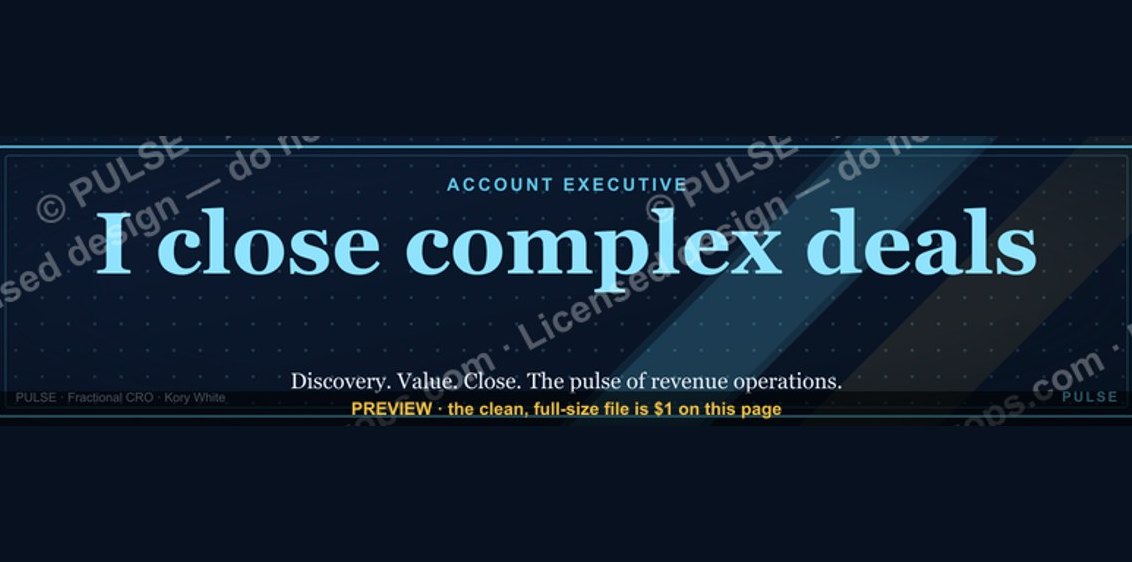 graphicAccount Executive — LinkedIn Banner
 graphicOffensive Security Pentest CRO — LinkedIn Banner
 graphicVector Database CTO — LinkedIn Banner
 graphic“Sell something people love.” — LinkedIn Banner
 graphic“Bring the energy every call.” — LinkedIn Banner
 graphicHow to build a champion seller playbook in 2027
 graphicPredictable revenue, by design. — LinkedIn Wallpaper