
“Earn every yes.” — LinkedIn Banner
 Curated byKory White · Fractional CRO · Maryland
 PULSEKNOWLEDGE LIBRARY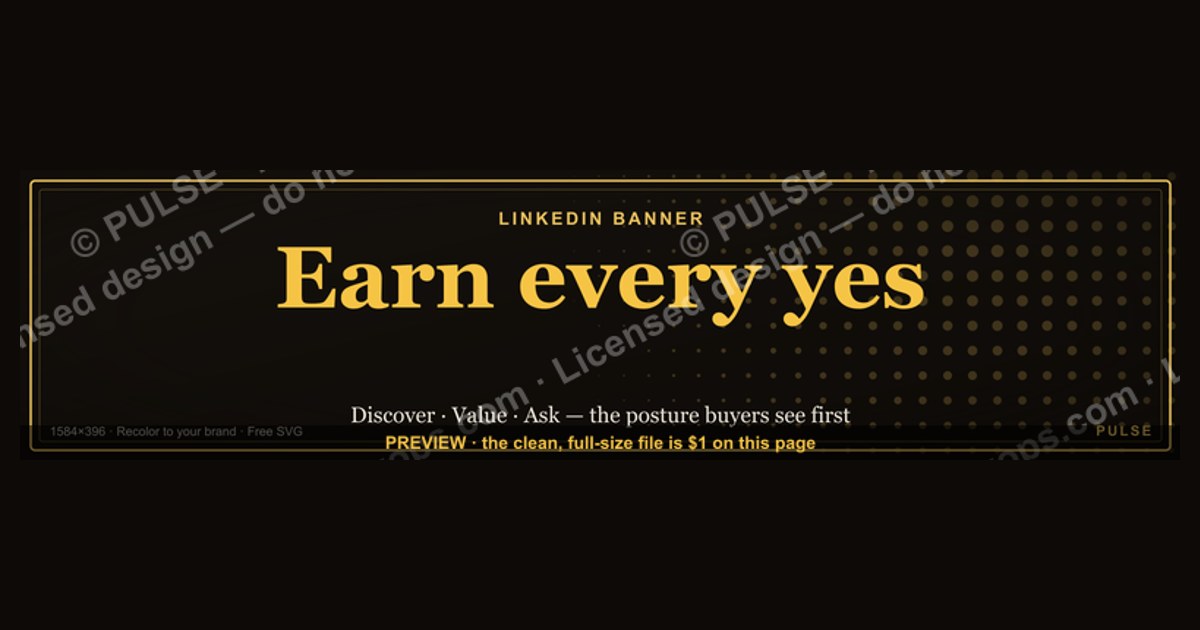
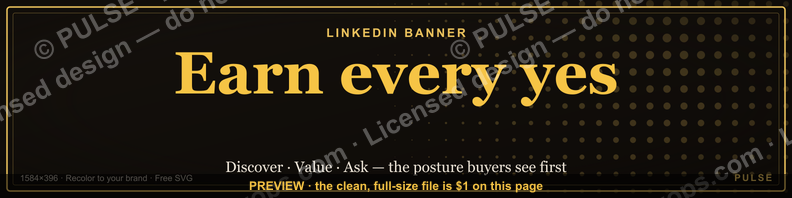
"Earn every yes" is a sales philosophy condensed into a LinkedIn banner phrase: treat every commitment a prospect gives you — a reply, a meeting, a demo, a signature — as something you have to earn through value and credibility, not extract through pressure. It is a posture, not a metric, and it is deliberately printed where buyers see it first: your profile header. The free banner below puts that posture on display at LinkedIn's exact cover dimensions (1584×396), and you can recolor it to your brand before downloading. There is no price and no fabricated statistic attached to it — just a positioning statement and a graphic you can use today.
“Earn every yes.” — LinkedIn Banner

A dark, on-brand LinkedIn banner — "Earn every yes." over a "Discover · Value · Ask" line with a pulse motif. Put it on your profile to signal exactly how you sell.
Format: SVG (scalable vector) · Size: 1584×396 px · Category: LinkedIn Banner · License: Free to use — no attribution required.
Recolor it to your brand
Use the color picker above to recolor this banner to your team or company colors, switch the background (including transparent), then download it as an SVG or PNG. No sign-up, no watermark.

How to use it
It scales cleanly to the LinkedIn cover slot (1584×396) — download the PNG and drop it straight onto your profile, or open the SVG in Canva, PowerPoint, or Figma to add your name and tweak the layout.
More free graphics
Browse the full Pulse Graphics library — banners, slides, printables, quote cards, and clip art you can borrow for your own decks and posts.
Related on PULSE
- “EARN EVERY YES” — Sales Floor Print
- Earn every yes. — LinkedIn Wallpaper
- “Every no is closer to a yes.” — Quote Card
- “EARN THE RIGHT” — Sales Floor Print
- “EVERY. SINGLE. MONTH.” — Sales Meme
- “PROGRESS EVERY DEAL” — Sales Floor Print
Why “Earn Every Yes” Resonates With Modern Buyers
The phrase works because it inverts the thing buyers dislike most about being sold to: the sense that a commitment is being pulled out of them before they're ready. Modern B2B buying behavior has moved decisively toward self-directed research — buyers spend the majority of their journey gathering information independently and only a small slice of it in live conversation with any one supplier's reps (Gartner's B2B buying research). That means the few interactions you do get are high-stakes, and a posture of "I'll ask when I've earned it" reads as respect for the buyer's time rather than a threat to it.
It also lowers the buyer's guard for a practical reason: it sets an expectation. When your header says "Earn every yes," the implicit promise is *I won't ask for your commitment until I've shown you why it's worth giving.* Buyers extend more attention to people who have signaled they won't waste it.
For the seller, the phrase functions as a discipline rather than a slogan. Before every outreach it forces one honest question — *have I actually earned the right to ask for this?* — which filters out the generic, copy-pasted messages that get ignored and replaces them with something specific enough to deserve a reply. The mechanism is simple and doesn't require a statistic to justify: relevant, value-first contact gets answered more often than spray-and-pray, and a "yes" the buyer feels they own churns less than one they feel they were talked into.
In practice, "earning every yes" means:
- Reach out only with a specific, relevant reason for *this* person — not a generic pitch you could send to anyone.
- Lead with value before the ask — a relevant teardown, a benchmark, a pointed observation about their funnel.
- Respect the timeline. "Not now" is information, not rejection. Follow up later with something genuinely useful.
- Judge yourself on conversation quality, not calls booked.
How to Design a Banner That Earns Its Slot
Your banner is the first thing a profile visitor sees, and a logo or stock photo says nothing about how you work. A few principles make the slot pull its weight:
- Make the text the hero. A bold sans-serif (Inter, Montserrat, Plus Jakarta Sans) carrying the phrase, with your name and title in a smaller secondary line. One message beats three.
- Pick a color that signals trust and contrast. Dark blues and charcoals read as professional and reliable; a restrained burgundy (like the
#C8112Bin the sponsored card) reads as confident — just keep the text white or near-white for legibility. - Design for the phone first. A large share of LinkedIn traffic is mobile, where the banner renders small and partially cropped behind the profile photo. Keep the phrase clear of the lower-left corner and test it at a thumbnail size before you commit.
- Skip the clutter. Stock handshakes and phone mockups undercut the authenticity the phrase is trying to convey. A subtle pattern or a faint logo watermark is plenty.
- Match your headline. If the banner says "Earn every yes" but your headline says "Top 1% Closer," the mixed message costs you more than either line gains.
How to Tell Whether It's Working
LinkedIn gives you no banner-specific analytics, so track proxies and watch direction, not vanity numbers:
- Quality of profile views, via "Who's Viewed Your Profile" — are viewers inside your ICP, or random?
- Quality of inbound messages — a shift from "I see you're in sales" toward specific, problem-shaped questions is the signal you want.
- Click-through on your profile CTA — if you keep a Calendly or featured link, use a UTM or Bitly link so you can see whether visitors act.
- Consistency over churn — keep one design live for at least 30 days before judging it. Swapping weekly makes any read impossible.
The point isn't a prettier header. The banner is a filter: people who resonate with "earn every yes" lean in, and people who want a transactional pitch self-select out — which is exactly the trade you want at the top of the funnel.
Sources
- Gartner — The B2B Buying Journey — research on how buyers split their time across independent research and supplier interactions.
- LinkedIn Help — Add or edit your profile background photo — official guidance and the 1584×396 px banner dimensions.
- Harvard Business Review — The End of Solution Sales (Dixon & Adamson) — how buyer behavior has shifted ahead of seller engagement.
- LinkedIn Official Blog — linkedin.com/blog — product updates and profile best practices.
- Edelman — Edelman Trust Barometer — research on the role of trust in business relationships and decision-making.
- The Muse — Personal branding and profile guidance — practical career and LinkedIn profile advice.
FAQ
What does “Earn every yes” mean in a sales context? It means every commitment a prospect gives you — a meeting, a demo, a signature — should be the result of value you've delivered, not pressure you've applied. It reframes selling as repeatedly proving worth so each "yes" feels earned rather than extracted.
Is this banner only for salespeople? No. It lands hardest for revenue roles — sales, marketing, customer success — but the underlying idea (earn trust before you ask for commitment) applies to founders, consultants, recruiters, and job seekers alike.
Does “earn every yes” mean you never ask for the sale? The opposite. You still ask — directly and specifically — but only after you've given the prospect enough insight or proof that they can say yes with confidence. It's about the quality of the ask, not avoiding it.
How is this different from “Always Be Closing” (ABC)? ABC pushes for a close regardless of fit or readiness, which can burn trust. "Earn every yes" front-loads understanding and value so the close becomes the natural next step instead of a forced one — better suited to long, multi-stakeholder B2B cycles.
Can it work under aggressive quotas? Yes, with discipline. The case to leadership is that trust earned early tends to reduce churn and grow deal size, which makes attainment more predictable. Many strong reps find that slowing down at the top of the funnel speeds up everything after it.
What's one step I can take today? Before your next outreach, answer one question: *what specific, useful thing can I give this person that they can't easily get elsewhere?* Lead with that, not with a request — even a small, relevant insight starts earning the next yes.
This page will be disappearing soon. Save it to your device for $1 — or read it free while it is here.
@Kory-White- · if Venmo asks, the last 4 of my number are 2012
This page is gone.
This one is off the shelf now. $1 keeps it on your phone for good — the whole page, pictures and diagrams included.
 graphic“A confused buyer never buys.” — LinkedIn Banner
 graphic“Ready to lead a sales team.” — LinkedIn Banner
 graphicHow do you build a Champions sell motion from scratch in 2027?
 graphicRenewals Manager — LinkedIn Banner
 graphicCustomer Success — LinkedIn Banner
 graphic“Great reps wanted.” — LinkedIn Banner
 graphicLead from the front. — LinkedIn Wallpaper
 graphicReady reps win. — LinkedIn Wallpaper
 graphicCommercial Director — LinkedIn Banner
 graphicCalm closers win. — LinkedIn Wallpaper