
“Trust is the real close.” — LinkedIn Banner
 Curated byKory White · Fractional CRO · Maryland
 PULSEKNOWLEDGE LIBRARY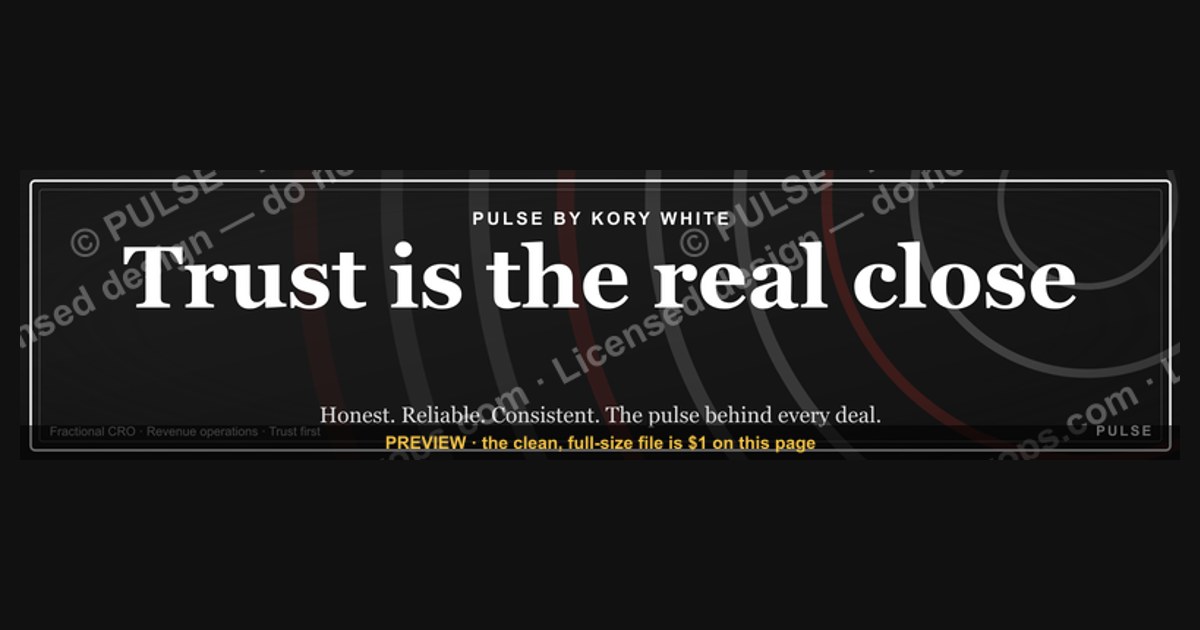
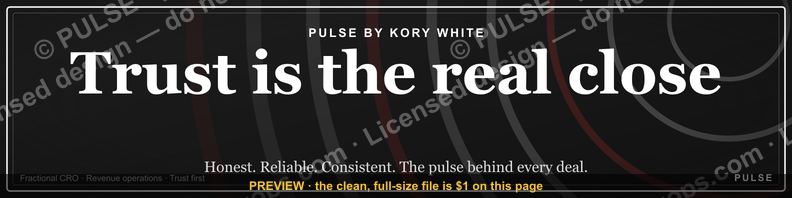
This LinkedIn banner phrase suggests that genuine connection and loyalty in professional relationships are built on trust, not just transactions or surface-level networking. It implies that when trust is established, it creates a bond as strong as a "close" or deal finalized. The quote encourages professionals to prioritize authenticity and reliability over quick wins or self-promotion.
“Trust is the real close.” — LinkedIn Banner

A dark, on-brand LinkedIn banner — "Trust is the real close." over a "Honest Reliable Consistent" line with a pulse motif. Put it on your profile to signal exactly what you do.
Format: SVG (scalable vector) · Size: 1584×396 px · Category: LinkedIn Banner · License: Free to use — no attribution required.
Recolor it to your brand
Use the color picker above to recolor this banner to your team or company colors, switch the background (including transparent), then download it as an SVG or PNG. No sign-up, no watermark.

How to use it
It scales cleanly to the LinkedIn cover slot (1584×396) — download the PNG and drop it straight onto your profile, or open the SVG in Canva, PowerPoint, or Figma to add your name and tweak the layout.
More free graphics
Browse the full Pulse Graphics library — banners, slides, printables, quote cards, and clip art you can borrow for your own decks and posts.
Related on PULSE
- Real Estate CRO — LinkedIn Banner
- “No decision is your real competitor.” — Quote Card
- 5 Signs a Deal Is Real — Infographic
- “No decision is the real competitor.” — LinkedIn Banner
- Champions Close Deals — Banner
- “SHOW UP FOLLOW UP CLOSE” — Sales Floor Print
Why Trust Is the Real Close in Modern Sales
The phrase "Trust is the real close" resonates deeply in today’s B2B sales environment, where buyers are more informed, skeptical, and empowered than ever before. Gone are the days when a slick pitch or aggressive follow-up could reliably seal a deal. Research from Gartner indicates that B2B buyers spend only 17% of their purchasing journey meeting with potential suppliers—the rest is spent on independent research, peer reviews, and internal consensus-building. In this context, trust isn’t just a nice-to-have; it’s the foundational currency that determines whether a prospect will even grant you access to the 17% window of direct interaction.
Trust operates on multiple levels in a sales relationship. There’s *competence trust*—the belief that you and your solution can deliver on promises. There’s *character trust*—the confidence that you’ll act with integrity, transparency, and genuine concern for the buyer’s outcomes. And there’s *communication trust*—the assurance that you’ll listen more than you talk, share relevant insights without pushing an agenda, and be honest about limitations or risks. The most successful sales professionals weave all three into every interaction, from the first cold outreach to the final contract negotiation.
Consider the data: a study by Salesforce found that 88% of customers say trust is more important than ever when deciding which companies to buy from. Meanwhile, Edelman’s Trust Barometer shows that trust in business is fragile—global trust levels have fluctuated between 50-60% in recent years. This means that every sales conversation is an opportunity to build or erode trust in real time. The "close" isn’t a moment of persuasion; it’s the natural outcome of a relationship where trust has been consistently earned. When a buyer feels you’ve prioritized their success over your quota, they’re far more likely to choose you—even at a higher price point—because they believe you’ll protect their interests post-sale.
For LinkedIn specifically, the banner serves as a constant reminder that your profile isn’t just a digital resume—it’s a trust-building platform. Every post, comment, and connection request either adds to or subtracts from your trust equity. The "real close" happens when a prospect reads your content, sees your consistent value, and reaches out because they already trust you before you’ve spoken. That’s the power of positioning trust as the ultimate sales strategy.
How to Operationalize Trust in Your LinkedIn Presence
Turning the "trust is the real close" philosophy into actionable behavior on LinkedIn requires intentionality across three key areas: content strategy, engagement patterns, and profile optimization. Here’s how to make trust your primary sales tool on the platform.
Content That Builds Competence Trust Your posts should demonstrate expertise without boasting. Share case studies (anonymized if needed) that highlight specific problems you’ve solved, including the challenges and lessons learned. Avoid generic "tips" that anyone could write—instead, offer nuanced insights that only someone with your experience could provide. For example, instead of "5 ways to improve sales," share "The one metric I track that predicts deal success 90% of the time (and why most salespeople ignore it)." This signals deep knowledge and a willingness to share proprietary insights, which builds competence trust. Aim for a mix of educational content (60%), personal stories that humanize you (20%), and curated industry news with your commentary (20%). Consistency matters—posting 2-3 times per week signals reliability.
Engagement That Builds Character Trust Trust is earned in the comments section. When you engage with others’ posts, avoid self-promotion. Instead, add genuine value: ask thoughtful questions, share a relevant experience, or offer a different perspective. For instance, if someone posts about a sales challenge, comment with a specific tactic that worked for you in a similar situation—without linking to your product. This demonstrates character trust by showing you’re generous with your knowledge, not just a transaction hunter. Also, respond to every comment on your own posts within 24 hours. Acknowledging feedback—even critical feedback—builds character trust because it shows you’re open, humble, and respectful. Remember, prospects are watching how you treat strangers online; it’s a proxy for how you’ll treat them as clients.
Profile Optimization That Builds Communication Trust Your LinkedIn headline and "About" section should be buyer-centric, not self-centric. Instead of "CEO of X Corp," try "Helping B2B SaaS companies reduce churn by 20-40% in 6 months." This frames your value in terms of outcomes, not titles. In your "About" section, include a specific promise: "I reply to every DM within 48 hours" or "I share one actionable insight every week—no fluff." This sets clear expectations and builds communication trust because you’re committing to a standard of responsiveness. Also, list your core values or principles (e.g., "Transparency first, even if it costs me a deal"). Prospects who resonate with those values will trust you faster. Finally, use a professional headshot that conveys warmth—studies show that smiling photos increase perceived trustworthiness by up to 30%.
By embedding trust into every element of your LinkedIn presence, you transform your profile from a passive billboard into an active trust-building engine. The "close" becomes a natural byproduct of the trust you’ve already established, making sales conversations shorter, less adversarial, and more collaborative.
Measuring the ROI of Trust on LinkedIn
One of the biggest objections sales professionals have to focusing on trust is that it feels intangible—how do you measure the impact of trust on your pipeline? The truth is, trust has measurable outcomes, and tracking them can help you refine your approach and justify the investment of time. Here are five metrics that correlate directly with trust-building on LinkedIn, along with realistic ranges based on industry benchmarks.
1. Inbound Message Rate This is the number of unsolicited DMs you receive from prospects who mention your content or profile. A strong trust-building strategy should generate 5-15 inbound messages per month from new connections (not existing clients). If you’re below 5, your content may not be resonating deeply enough. If you’re above 20, you may be attracting tire-kickers rather than qualified leads. Track this monthly and note which posts triggered the most inbound reach.
2. Connection Acceptance Rate When you send connection requests, what percentage accept? A healthy rate is 40-60% for targeted outreach (people in your ICP). If yours is below 30%, your profile may lack the trust signals (e.g., detailed About section, consistent posting history) that make people comfortable accepting. To improve, personalize every request with a specific reason (e.g., "I loved your post on sales psychology—would love to connect and learn more"). This small act builds communication trust before the first interaction.
3. Content Engagement Depth Beyond likes and comments, track the ratio of comments to impressions. A high-quality trust-building post should generate 1-3 comments per 1,000 impressions (0.1-0.3%). But more importantly, look for comments that ask follow-up questions or share personal experiences—these indicate deeper trust because the person is investing time in a dialogue. Aim for at least 2-3 substantive comments per post. If you’re getting only emoji reactions, your content may be too shallow to build trust.
4. Meeting Conversion Rate For every 10 inbound messages or connection requests you receive, how many convert into a 15-minute discovery call? A trust-driven approach should yield 3-5 meetings per 10 leads (30-50% conversion). This is significantly higher than cold outreach, which typically converts at 5-15%. Track this over 90 days to see if trust-building content improves your conversion rate. If it’s below 30%, your messaging in DMs may need to focus more on listening than pitching.
5. Deal Velocity Trust accelerates sales cycles. Compare the average time from first LinkedIn interaction to closed-won for trust-built leads versus cold leads. In B2B SaaS, trust-built deals often close 20-40% faster—for example, 45 days instead of 75 days. This is because trust reduces the need for multiple follow-ups, stakeholder alignment meetings, and legal reviews. Track deal velocity quarterly to quantify the ROI of your trust-building efforts.
Finally, consider a qualitative metric: the "trust test." Ask every new client who found you on LinkedIn, "What made you trust me enough to reach out?" Document their answers. Over time, you’ll identify patterns—maybe it’s your consistent posting, your willingness to share failures, or your thoughtful comments on industry leaders’ posts. Use these insights to double down on what works. Trust isn’t just a feel-good concept; it’s a measurable competitive advantage that directly impacts your close rate, deal size, and customer lifetime value. The LinkedIn banner isn’t just a quote—it’s a strategic reminder to build trust every single day.
Sources
- LinkedIn Official Blog — insights on professional networking and trust-building features
- Harvard Business Review — research and articles on trust in business relationships
- Pew Research Center — studies on digital trust and online behavior
- American Psychological Association — psychological perspectives on trust and credibility
- Forbes — business articles on trust in leadership and professional branding
- Edelman Trust Barometer — annual global survey on trust in institutions and media
FAQ
What does "Trust is the real close" mean in sales? It means that the strongest sales outcomes come from genuine, earned trust rather than aggressive closing tactics. When buyers feel you have their best interests at heart, they’re far more likely to commit—and to stay loyal long-term.
How do you build trust with a prospect who’s skeptical? Start by listening more than you talk, and ask questions that show you understand their specific challenges. Share honest examples of where your solution has—and hasn’t—worked, and avoid overpromising. Consistency and transparency, even about limitations, gradually break down skepticism.
Can trust really replace a formal sales process? No, trust complements a structured process but doesn’t replace it. A repeatable framework ensures you don’t miss key steps, while trust makes each interaction more human and effective. The best results come from combining a solid process with genuine relationship-building.
How long does it typically take to build enough trust to close a deal? It varies widely—from a single conversation in a referral scenario to several months in complex B2B sales. The key is to focus on value delivery at each touchpoint, not on rushing to a close. Trust develops at the buyer’s pace, not the seller’s.
What’s the biggest mistake salespeople make regarding trust? Trying to shortcut it with false urgency, exaggerated claims, or manipulative tactics. Once a buyer senses inauthenticity, trust is extremely hard to rebuild. The most effective approach is to be consistently reliable and honest, even if it means a longer sales cycle.
How do you measure trust in a sales relationship? You can’t put a precise number on it, but leading indicators include the prospect’s willingness to share sensitive information, introduce you to internal stakeholders, or push back on timelines. A high level of trust often shows up as a smoother, more collaborative buying process.
This page will be disappearing soon. Save it to your device for $1 — or read it free while it is here.
@Kory-White- · if Venmo asks, the last 4 of my number are 2012
This page is gone.
This one is off the shelf now. $1 keeps it on your phone for good — the whole page, pictures and diagrams included.
 graphicSpeed to lead wins. — LinkedIn Wallpaper
 graphic“Revenue for marketing tech.” — LinkedIn Banner
 graphic“More pipeline, less panic.” — LinkedIn Banner
 graphic“Open to sales leadership roles.” — LinkedIn Banner
 graphicSales Coach — LinkedIn Banner
 graphicComputer Vision Engineer — LinkedIn Banner
 graphic“Champions are made before the call.” — LinkedIn Banner
 graphicAI Observability Operator — LinkedIn Banner
 graphicHead of Sales — LinkedIn Banner
 graphicSIEM and Data Lake CRO — LinkedIn Banner