
“Selling security that scales.” — LinkedIn Banner
 Curated byKory White · Fractional CRO · Maryland
 PULSEKNOWLEDGE LIBRARY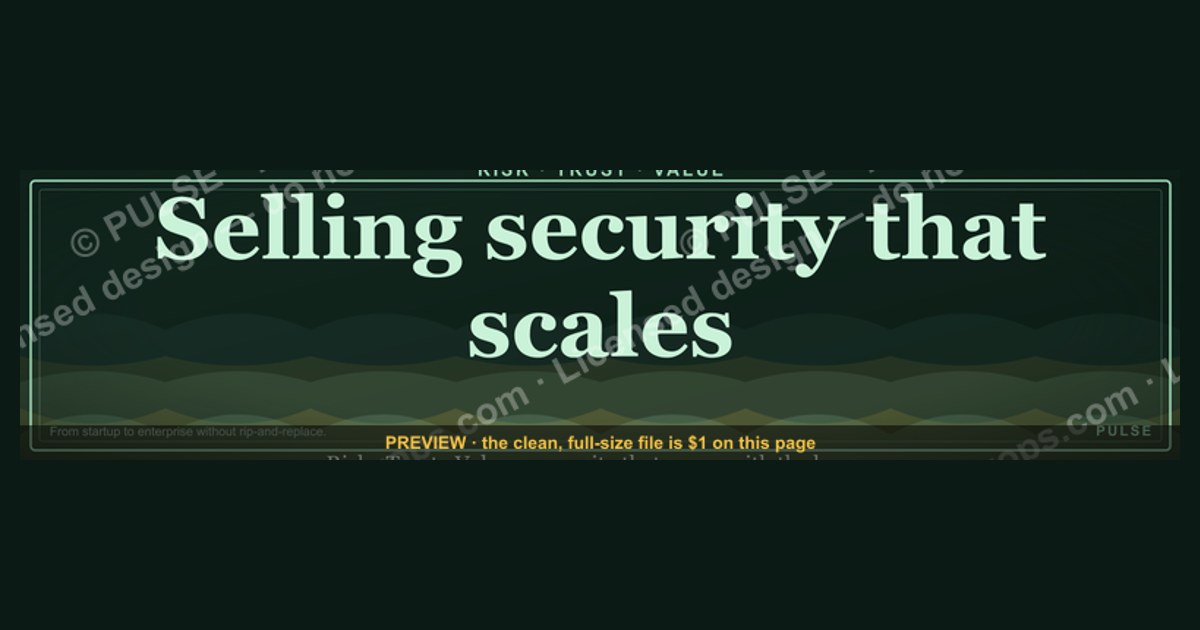

"Selling security that scales." is a positioning line for a cybersecurity seller, vendor, or revenue leader who wants their LinkedIn profile to say one thing clearly: the security they offer grows with the buyer instead of breaking at the next stage of growth. In practice it signals solutions — managed detection, identity and access, endpoint protection, surveillance — that expand from a small team to an enterprise footprint without a rip-and-replace. The banner pairs that headline with a "Risk · Trust · Value" line and a pulse motif, framing security as a long-term partnership measured in reduced risk, earned trust, and demonstrable value rather than a one-time purchase. Drop it on your profile to tell prospects, in one glance, exactly what problem you solve.
“Selling security that scales.” — LinkedIn Banner

A dark, on-brand LinkedIn banner — "Selling security that scales." over a "Risk · Trust · Value" line with a pulse motif. Put it on your profile to signal exactly what you do.
Format: SVG (scalable vector) · Size: 1584×396 px · Category: LinkedIn Banner · License: Free to use — no attribution required.
The first diagram below shows the "Risk · Trust · Value" framework the banner references; the second shows how a scalable security stack typically grows alongside the business.
Recolor it to your brand
Use the color picker above to recolor this banner to your team or company colors, switch the background (including transparent), then download it as an SVG or PNG. No sign-up, no watermark.

How to use it
It scales cleanly to the LinkedIn cover slot (1584×396) — download the PNG and drop it straight onto your profile, or open the SVG in Canva, PowerPoint, or Figma to add your name and tweak the layout.
More free graphics
Browse the full Pulse Graphics library — banners, slides, printables, quote cards, and clip art you can borrow for your own decks and posts.

Related on PULSE
- Offensive Security Pentest CRO — LinkedIn Banner
- “Process scales. Heroics don't.” — Quote Card
- Process scales. — LinkedIn Wallpaper
- “Process scales. Heroics don’t.” — LinkedIn Banner
- The Value Selling Ladder — Infographic
- SPIN Selling — Infographic
Why “Selling Security That Scales” Resonates
The line works because it names a real tension in the security market: most tools are built for either a small team or a large enterprise, leaving fast-growing companies stuck with software that either outgrows them or underdelivers. "Scales" speaks to buyers who have been burned by a tool that broke when their headcount doubled or their compliance scope shifted. It promises solutions that grow with the attack surface, the regulatory load, and the team — without a forklift upgrade every couple of years.
There is a practical reason buyers respond to consolidation language, too. Many mid-sized organizations run a sprawling collection of point security tools, and each new one adds integration work, alert noise, and a skills gap. So a vendor who leads with scalability is implicitly promising fewer rip-and-replace decisions and a platform that flexes with usage rather than forcing customers into rigid tiers. That is a credible differentiator in a market where a lot of churn comes from customers simply outgrowing their first choice.
For the seller using this banner, the headline opens the conversation — the selling happens when you can show a specific path. Pair the line with concrete examples of how your solution scales: elastic licensing, multi-tenant architecture, automated onboarding, or a roadmap that absorbs a new cloud region without re-architecture. Show the prospect how their posture holds up as the business expands, and the banner's promise becomes a story you can close on.
Designing a LinkedIn Banner That Converts
The dark background and minimal typography are deliberate. Security buyers see a lot of dashboards and vendor pitches, so a clean, high-contrast layout cuts through the noise, and the dark theme reads as serious and vigilant — on-brand for the category. The point is legibility first: a single clear focal point is easier to parse at a glance than a banner crowded with logos and competing elements.
The hierarchy is simple. The headline "Selling security that scales." anchors the top in a bold sans-serif; the "Risk · Trust · Value" subline gives a secondary hook that hints at a framework without over-explaining; and the pulse line adds a subtle sense of activity and monitoring. Because the LinkedIn cover slot is cropped differently on mobile and desktop, the important text stays centered and large enough to survive thumbnailing — design to the visible safe zone, not the full canvas.
For sellers building their own version, the takeaways are practical: keep the headline to a handful of words that state your value, use high contrast, add one subtle visual element for depth, and preview on both desktop and mobile before publishing. If you want to learn what works, run two variations — headline alone versus headline plus subhead — and watch which one moves your profile views and connection requests.
How to Leverage This Banner in Your LinkedIn Strategy
A banner is passive real estate; it earns its keep only when paired with active engagement. Treat "Selling security that scales." as the visual anchor of a consistent message across your profile, posts, and outreach.
Start with alignment. If the banner says you sell security that scales, your headline and About section should echo it — something like "Helping mid-market companies buy security that scales | Risk · Trust · Value | infosec sales" beats a generic "Cybersecurity Sales Executive." Visitors should understand what you do within seconds.
Then build content around the banner's three words. A post on what "scales" actually means in security sales, a breakdown of the Risk · Trust · Value framework with a real example, and a post on how scalability affects total cost of ownership all reinforce the same theme. Use the banner art (or a cropped version) as the visual so prospects see one consistent brand from feed to profile.
Use it in outreach, too. When someone views your profile, a contextual note works well: "Saw you stopped by — the 'selling security that scales' line on my banner sums up what I help teams avoid: tools that break when you grow. Open to a short chat on how we approach scalability?" Finally, measure indirectly. LinkedIn doesn't report banner impressions, so track profile views, connection acceptance, and inbound messages before and after the change. If nothing moves over a couple of weeks of active posting, revise the headline or add a light call-to-action cue to the design.
The Psychology Behind “Scales” in Security Sales
The word “scales” does heavy lifting in this banner. It directly addresses the single biggest fear in cybersecurity procurement: that today’s quick fix becomes tomorrow’s compliance nightmare. Buyers have been burned by point solutions that work for 50 employees but collapse during a SOC 2 audit or a Series B growth spurt. By leading with “scales,” you signal that you understand the full lifecycle of security maturity — from startup to regulated enterprise. This positions you not as a vendor, but as a strategic partner who maps solutions to the buyer’s actual growth trajectory, not just their current headcount. The banner’s pulse motif reinforces this: security isn’t static, it’s a living system that adapts as the business does.
How to Match Your Profile Content to the Banner
A banner this specific demands profile alignment to avoid looking like stock art. Your headline should echo the same growth narrative — something like “Scaling Security for High-Growth Companies” or “Identity & Endpoint Security That Grows With You.” Your “About” section needs to lead with a problem-solution structure that mirrors the banner’s “Risk · Trust · Value” framework. For example: “I help CTOs and CISOs reduce risk by deploying security that earns trust through measurable value — not by locking them into contracts that outgrow their needs.” In your experience section, highlight clients or projects where you expanded security coverage from a single office to multi-region operations. The banner promises scalability; your profile must prove you deliver it.
Where This Banner Works Best (and Where It Doesn’t)
This banner performs strongest for cybersecurity sellers targeting B2B SaaS, fintech, healthcare, or any vertical with rapid headcount growth and regulatory pressure. It resonates with Series A through pre-IPO companies where the CTO or CISO is actively worried about outgrowing their current stack. However, it can feel out of place for MSPs selling to SMBs under 20 employees, or for consultants focused solely on compliance audits — the “scale” promise implies a growth trajectory those buyers may not have. If you serve both segments, consider creating a second banner for smaller clients. Also avoid pairing this banner with a headline like “Cybersecurity Expert” — it’s too generic and dilutes the specific growth narrative the banner establishes.
Why This Banner Works for Cybersecurity Sellers
The banner's "Risk · Trust · Value" triad maps directly to the buyer's journey in security sales. Risk opens the conversation—every CISO knows their exposure. Trust builds when you demonstrate reliability through uptime, response times, or compliance certifications. Value closes the deal by showing measurable outcomes: reduced breach costs, faster mean-time-to-detect, or lower total cost of ownership. A banner that visually reinforces this sequence helps prospects self-qualify before they even message you.
How to Pair This Banner with Your Profile Content
To maximize the banner's impact, align your headline and summary with the same "scaling security" narrative. For example, a headline like "Helping growing companies build security that scales" creates instant coherence. In your summary, mention a specific growth stage you serve (seed-stage startups, Series B companies, or enterprises) and the common security pain point at that stage—such as "managing access across 50 employees" vs. "orchestrating SIEM across 10,000 endpoints." This consistency reduces friction for visitors deciding whether to connect.
When to Refresh or Rotate This Banner
While "selling security that scales" is versatile, consider swapping it out if your target segment shifts. For example, if you move from selling to mid-market companies to exclusively enterprise clients, a banner emphasizing "enterprise-grade security" or "compliance at scale" might resonate better. Similarly, if your company launches a new product line (e.g., AI-driven threat detection), update the banner to reflect that focus. A good rule of thumb: refresh your banner every 6–12 months or whenever your core value proposition changes materially.
Sources
- LinkedIn Help Center — official documentation on profile features, cover image dimensions, and banner guidelines.
- LinkedIn Marketing Solutions Blog — published guidance on profile branding and content best practices.
- Federal Trade Commission (FTC) — consumer-protection guidance on truthful, non-deceptive advertising and security claims.
- American Marketing Association (AMA) — standards and best practices for ethical marketing language.
- International Association of Privacy Professionals (IAPP) — resources on data security, privacy compliance, and related claims.
- Cybersecurity and Infrastructure Security Agency (CISA) — public guidance on layered, scalable security practices.
FAQ
What does “security that scales” actually mean for my business? It means your security grows with your company instead of breaking at the next stage. Rather than bolting on disconnected point tools as you expand, you invest in a flexible foundation — elastic licensing, consolidated platforms, automation — that absorbs more users, more data, and new threats without a rebuild.
Is this banner just a generic stock image, or does it reflect real cybersecurity work? The art is a reusable design, but the message maps to real practice: good security should feel unobtrusive yet hold up under load. Sellers and vendors use visuals like this to signal that their services are professional and adaptable across company sizes — the substance comes from what you say next on your profile.
How do I know if my current security setup actually scales? A useful test: could it absorb a 2x or 3x jump in users without a major overhaul or a sharp cost spike? If you're adding new tools every quarter, or your team spends more time triaging alerts than preventing incidents, that's a sign your stack is sprawling rather than scaling.
Will “security that scales” work for a small startup with a limited budget? Yes. Scalable security usually starts modular — cloud-based endpoint protection or a zero-trust approach you can extend later. Many vendors price by headcount or data volume, so you pay for what you use now and expand as you grow, without committing to enterprise tooling on day one.
Can I achieve scalable security without hiring a full in-house team? Often, yes. Managed security service providers (MSSPs) and fractional or virtual CISO arrangements give you expert oversight without the full headcount, and you can dial that expertise up or down as your needs shift. The trade-off to weigh is response time, scope, and how the provider integrates with your existing tools.
How quickly can I expect results from a more scalable security approach? Early wins — less alert noise, faster incident response — tend to show within the first weeks of deploying the right tools and process. Reaching the point where security genuinely flexes with growth usually takes several months, depending on where you start and how much you can invest up front.
This page will be disappearing soon. Save it to your device for $1 — or read it free while it is here.
@Kory-White- · if Venmo asks, the last 4 of my number are 2012
This page is gone.
This one is off the shelf now. $1 keeps it on your phone for good — the whole page, pictures and diagrams included.
 graphic“More pipeline, less panic.” — LinkedIn Banner
 graphic“Open to sales leadership roles.” — LinkedIn Banner
 graphic“Motion creates momentum.” — LinkedIn Banner
 graphicVector Database CTO — LinkedIn Banner
 graphic“Looking for my next quota.” — LinkedIn Banner
 graphic“Stay in the deal.” — LinkedIn Banner
 graphic“Hire slow. Ramp fast.” — LinkedIn Banner
 graphicComputer Vision Engineer — LinkedIn Banner
 graphicStartup Founder — LinkedIn Banner
 graphicOffensive Security Pentest CRO — LinkedIn Banner