
“Process scales. Heroics don’t.” — LinkedIn Banner
 Curated byKory White · Fractional CRO · Maryland
 PULSEKNOWLEDGE LIBRARY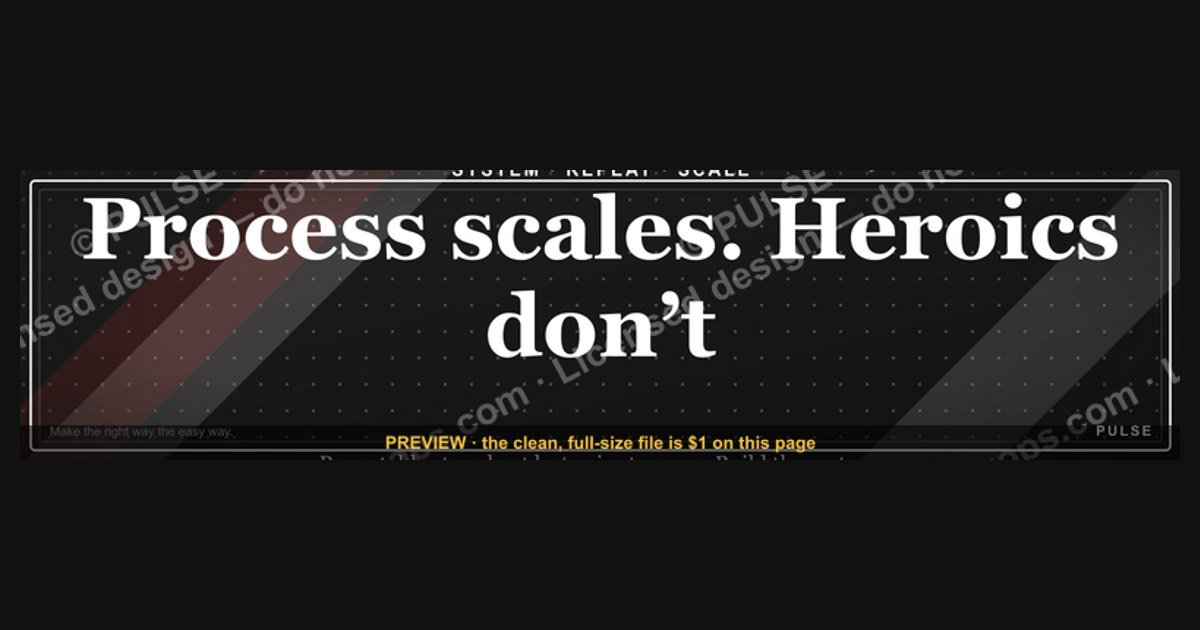

This quote emphasizes that reliable, repeatable systems (processes) are the foundation for sustainable growth, while individual acts of heroism—like last-minute fixes or overworking—are not scalable. It suggests that building strong processes allows a team to handle increasing demands without relying on burnout or exceptional effort. The message is common in engineering and operations, where the goal is to make the right way the easy way.
“Process scales. Heroics don’t.” — LinkedIn Banner

A dark, on-brand LinkedIn banner — "Process scales. Heroics don’t." over a "System Repeat Scale" line with a pulse motif. Put it on your profile to signal exactly what you do.
Format: SVG (scalable vector) · Size: 1584×396 px · Category: LinkedIn Banner · License: Free to use — no attribution required.
Recolor it to your brand
Use the color picker above to recolor this banner to your team or company colors, switch the background (including transparent), then download it as an SVG or PNG. No sign-up, no watermark.

How to use it
It scales cleanly to the LinkedIn cover slot (1584×396) — download the PNG and drop it straight onto your profile, or open the SVG in Canva, PowerPoint, or Figma to add your name and tweak the layout.
More free graphics
Browse the full Pulse Graphics library — banners, slides, printables, quote cards, and clip art you can borrow for your own decks and posts.

Related on PULSE
- “Process scales. Heroics don't.” — Quote Card
- Process scales. — LinkedIn Wallpaper
- “Selling security that scales.” — LinkedIn Banner
- “Don't pitch. Diagnose.” — Quote Card
- "Build, don't chase." — LinkedIn Banner
- “Don’t pitch. Diagnose.” — LinkedIn Banner
The Psychology Behind the Quote: Why We Default to Heroics
The phrase "Process scales. Heroics don’t." resonates so deeply because it exposes a fundamental tension in how most organizations operate. At its core, this isn't just about operational efficiency—it's about human psychology and the stories we tell ourselves about success.
Most leaders and teams fall into the heroics trap for several deeply ingrained reasons. First, there's the romance of the rescue narrative. We've been conditioned by movies, books, and workplace folklore to celebrate the person who pulls an all-nighter to save a deal, the engineer who single-handedly fixes a production outage at 3 AM, or the sales rep who closes a massive account through sheer force of will. These stories are compelling because they're dramatic and personal. But they're also dangerously misleading. The hero's journey makes for a great movie, but it makes for terrible business operations.
Second, there's ego and identity attachment. Many high-performers build their professional identity around being the person who can be counted on in a crisis. The adrenaline of last-minute saves, the recognition from leadership, the feeling of indispensability—these become addictive. When someone's self-worth is tied to being a hero, they unconsciously resist process improvements that would make heroics unnecessary. They may even subconsciously create conditions where crises emerge, just to reaffirm their role as the savior.
Third, there's short-term reward bias. Organizations consistently reward heroic behavior more generously than process improvements. The salesperson who closes a quarter-end deal with heroic effort gets a bonus and public recognition. The operations person who builds a system that prevents future quarter-end scrambles gets... a nod in a team meeting, if they're lucky. This misalignment of incentives means that even well-intentioned people gravitate toward heroics because that's where the visible rewards are.
The psychological cost of this heroism culture is staggering. Teams operating in constant firefighting mode experience burnout rates 3–5 times higher than those with stable processes. Decision quality degrades as fatigue sets in. Innovation stalls because all energy goes to putting out fires rather than building for the future. And perhaps most critically, the organization becomes fragile—if the hero leaves, gets sick, or simply burns out, the entire system can collapse.
The shift from heroics to process requires a fundamental mindset change. It means finding satisfaction in the invisible work of building systems that prevent problems from occurring in the first place. It means celebrating the person who makes the crisis impossible, not just the person who handles it well. This is harder than it sounds because it requires delayed gratification and a willingness to work on things that may not yield visible results for months.
For leaders looking to make this shift, the first step is often the hardest: honestly assess whether your organization's reward systems actually incentivize process over heroics. Do your performance reviews celebrate prevention or only reaction? Do your promotions go to system-builders or crisis-handlers? The answers might be uncomfortable, but they're essential for real change.
Building Processes That Actually Scale: A Practical Framework
"Process scales" sounds simple, but building processes that genuinely scale across teams, geographies, and growth stages is one of the hardest things an organization can do. Many companies fall into the trap of creating rigid, bureaucratic processes that kill speed and autonomy in the name of consistency. The goal isn't process for process's sake—it's process that enables better outcomes with less heroic effort.
The most effective scalable processes share several key characteristics. First, they are documented but not dogmatic. A good process provides clear guidelines, checklists, and decision frameworks while leaving room for judgment and adaptation. For example, a sales qualification process shouldn't be a rigid script that every rep must follow word-for-word. Instead, it should be a set of criteria and questions that guide the conversation, with clear decision points where the rep can use their judgment.
Second, scalable processes are designed for the weakest link, not the strongest. Too many processes are built around what the most talented person can do, assuming everyone else will rise to that level. In reality, processes need to work when your newest hire, your most tired team member, or your least experienced person is executing them. This means building in guardrails, validation steps, and clear failure modes. A good process makes it hard to do the wrong thing and easy to do the right thing.
Third, they incorporate feedback loops and continuous improvement. A process that never changes is a process that's becoming obsolete. The best organizations treat processes as living documents, with regular reviews, metrics tracking, and mechanisms for frontline workers to suggest improvements. This doesn't mean endless process redesign meetings—it means having a simple, regular cadence of review and adjustment.
Here's a practical framework for building processes that scale:
Step 1: Identify the heroics hotspots. Look at where your team consistently has to do extraordinary things to meet normal expectations. These are the areas where process is most needed. Common hotspots include: onboarding new customers, handling support escalations, quarterly closing cycles, and cross-team handoffs.
Step 2: Document the current "heroic" way. Before you can improve a process, you need to understand what's actually happening. Have your best performers document exactly what they do when they're being heroic. What steps do they take? What knowledge do they rely on? What shortcuts do they use? This documentation becomes the raw material for your process.
Step 3: Extract the essential, eliminate the accidental. Not everything in the heroic approach needs to be in the process. Separate the critical steps that ensure quality and consistency from the personal preferences and workarounds that worked for that individual but may not work for others. Focus on the 20% of steps that produce 80% of the value.
Step 4: Build in decision points and escalation paths. No process can cover every situation. Design clear decision points where the process says "if X happens, do Y" or "if you're unsure, escalate to Z." This prevents the process from becoming a straitjacket while still providing structure.
Step 5: Test with your weakest link. Have your newest or least experienced team member try to execute the process. Watch where they get confused, where they make mistakes, and where they need help. Revise the process based on their experience, not just the experts' opinions.
Step 6: Measure what matters. Track both process adherence and outcomes. If the process is being followed but outcomes are poor, the process needs to change. If outcomes are good but adherence is low, you may have a training or culture issue. Use metrics like time to completion, error rates, and customer satisfaction to gauge effectiveness.
Step 7: Institutionalize the review cycle. Set a regular cadence (quarterly works well for most processes) to review and update your key processes. Include frontline workers in these reviews—they'll have the best insights on what's working and what isn't.
A common mistake is trying to build perfect processes from the start. This leads to analysis paralysis and resistance. Instead, aim for "good enough to start" and iterate rapidly. A 70% solution that's actually being used is infinitely better than a 100% solution that exists only in a document.
When Heroics Are Actually Necessary (And How to Make Them Rare)
Let's be honest: no amount of process will eliminate the need for heroics entirely. There will always be unexpected events, unprecedented situations, and genuine emergencies that require extraordinary effort. The goal isn't to create a world without heroics—it's to make heroics the exception rather than the rule, and to ensure they're deployed strategically rather than habitually.
The key distinction is between reactive heroics (responding to predictable, recurring problems that should have been prevented) and emergency heroics (responding to genuinely unexpected, high-impact events). The former is a sign of process failure; the latter is an inevitable part of operating in a complex world.
Here's how to think about when heroics are justified:
When the stakes are genuinely high and time is critical. If a production outage is costing $100,000 per hour, it may be worth pulling out all the stops to resolve it quickly. If a key customer is about to churn and the quarterly revenue target is at risk, heroic efforts might be appropriate. The key is to define "genuinely high stakes" clearly in advance, so you're not constantly redefining normal situations as emergencies.
When the situation is truly novel. If you're entering a new market, launching a completely new product, or dealing with a once-in-a-decade event, there may not be a process to follow. In these cases, heroics can be a form of exploration—learning what works so you can build a process for next time. The important thing is to document what you learn so the heroics don't need to be repeated.
When the organization is in a transition phase. During rapid growth, acquisitions, or major pivots, existing processes may not keep up. Heroics can serve as a bridge until new processes are built. But this should be a temporary state with a clear timeline for building scalable solutions.
The real danger isn't in occasional heroics—it's in heroics becoming the default operating mode. To prevent this, organizations need to:
Create a "heroics tax." Every time someone has to be heroic, require them to document what happened and what process could have prevented it. This documentation becomes the raw material for process improvement. Without this step, heroics just repeat.
Track heroics frequency. Measure how often your team has to work outside normal hours, escalate to senior leadership, or deploy extraordinary resources to meet normal expectations. If this frequency is increasing, you have a process problem, not a people problem.
Celebrate the process-builders, not just the crisis-handlers. In your next all-hands meeting, recognize the person who built the system that prevented a crisis, not just the person who handled the crisis well. This sends a powerful signal about what you truly value.
Build redundancy into critical systems. The most dangerous heroics are the ones that are required because only one person knows how to do something. Cross-train team members, document key knowledge, and ensure that no single person's departure would cause a crisis.
Have an explicit "heroics budget." Just as you budget for R&D or marketing, budget for a certain amount of heroic effort per quarter. This acknowledges that some heroics are inevitable while setting a limit that forces prioritization. When the budget is used up, you have to make hard choices about what doesn't get done
Sources
- Harvard Business Review — covers organizational scaling, process management, and leadership challenges.
- McKinsey & Company — provides insights on scaling operations and avoiding reliance on individual heroics.
- Forbes — features articles on business growth, process optimization, and entrepreneurial lessons.
- MIT Sloan Management Review — explores how processes scale effectively in technology and management contexts.
- Stanford Graduate School of Business — offers research on scaling strategies and organizational behavior.
- The Lean Enterprise Institute — focuses on process improvement, lean methodologies, and scaling without heroics.
FAQ
What does "process scales, heroics don't" mean in practice? It means that relying on individual effort or last-minute saves can work short-term but breaks as a company grows. Sustainable growth comes from repeatable systems, playbooks, and workflows that any team member can follow.
How do you transition from a heroics-driven culture to a process-driven one? Start by documenting the most frequent or critical tasks—like lead routing or deal reviews—into simple checklists or templates. Then gradually automate or delegate those steps, measuring consistency and output rather than individual effort.
Does process stifle creativity or flexibility in sales? Not if designed well. Good process sets guardrails and best practices but leaves room for judgment—for example, a structured discovery framework that still lets reps adapt questions to each prospect. The goal is repeatable success, not robotic behavior.
How long does it take to see results from implementing sales process? Honest ranges vary widely—some teams see improved consistency within a few weeks, while full adoption and measurable lift often take 3–6 months. The key is sticking with it through the initial friction.
What's the biggest mistake companies make when trying to scale with process? Over-engineering before understanding what actually works. Many teams build complex systems based on assumptions, then wonder why no one uses them. A better approach is to start with a simple process that mirrors your best reps' natural workflow.
Can a small team (under 10 people) benefit from process, or is it only for larger orgs? Even small teams benefit—process helps avoid rework, speeds onboarding, and frees founders from being the bottleneck. The difference is scale: a 5-person team might need just a few core playbooks, while a 50-person team needs full systems.
This page will be disappearing soon. Save it to your device for $1 — or read it free while it is here.
@Kory-White- · if Venmo asks, the last 4 of my number are 2012
This page is gone.
This one is off the shelf now. $1 keeps it on your phone for good — the whole page, pictures and diagrams included.
 graphicSpeed to lead wins. — LinkedIn Wallpaper
 graphic“Trusted advisor, never a vendor.” — LinkedIn Banner
 graphic“Ready to lead a sales team.” — LinkedIn Banner
 graphicReady reps win. — LinkedIn Wallpaper
 graphic“Process over pressure.” — LinkedIn Banner
 graphic“Champions are made before the call.” — LinkedIn Banner
 graphicRenewals Manager — LinkedIn Banner
 graphic“Revenue for marketing tech.” — LinkedIn Banner
 graphic“A confused buyer never buys.” — LinkedIn Banner
 graphicHow to build a champion seller playbook in 2027