
“PropTech revenue, built right.” — LinkedIn Banner
 Curated byKory White · Fractional CRO · Maryland
 PULSEKNOWLEDGE LIBRARY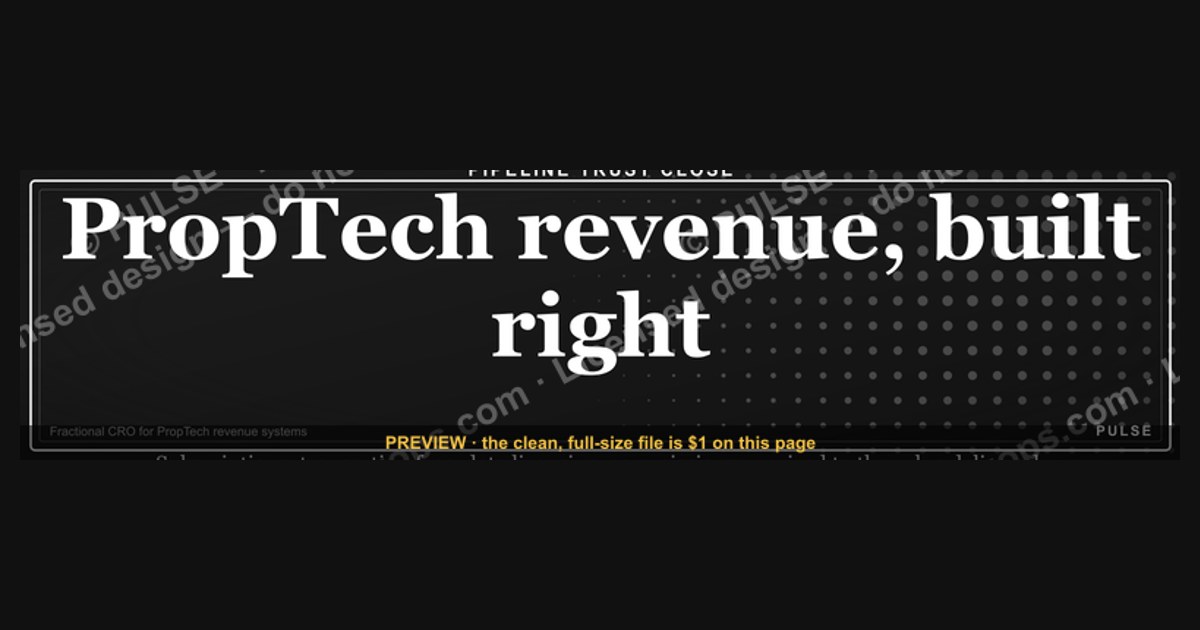
PropTech revenue is generated through software subscriptions, transaction fees, data licensing, and service commissions, typically ranging from a few thousand to millions annually depending on the product and market segment. A well-built revenue model aligns pricing with the specific value delivered—such as per-unit fees for property management tools or percentage-based cuts on marketplace deals. The key is to design a system that scales sustainably without alienating users.
“PropTech revenue, built right.” — LinkedIn Banner

A dark, on-brand LinkedIn banner — "PropTech revenue, built right." over a "Pipeline Trust Close" line with a pulse motif. Put it on your profile to signal exactly what you do.
Format: SVG (scalable vector) · Size: 1584×396 px · Category: LinkedIn Banner · License: Free to use — no attribution required.
Recolor it to your brand
Use the color picker above to recolor this banner to your team or company colors, switch the background (including transparent), then download it as an SVG or PNG. No sign-up, no watermark.

How to use it
It scales cleanly to the LinkedIn cover slot (1584×396) — download the PNG and drop it straight onto your profile, or open the SVG in Canva, PowerPoint, or Figma to add your name and tweak the layout.
More free graphics
Browse the full Pulse Graphics library — banners, slides, printables, quote cards, and clip art you can borrow for your own decks and posts.

Related on PULSE
- “SaaS revenue, built to scale.” — LinkedIn Banner
- “EARN THE RIGHT” — Sales Floor Print
- Right deal, right time. — LinkedIn Wallpaper
- Right market, right motion. — LinkedIn Wallpaper
- Revenue by Channel Pie
- NRR Beats New Logos — Revenue Law Banner
Why “Built Right” Matters More Than “Built Fast” in PropTech
The PropTech landscape has seen a flood of “growth at all costs” banners over the past decade—promises of instant ARR, viral lead magnets, and automated pipelines that supposedly fill themselves. Yet the vast majority of those companies either burned through capital or quietly pivoted away from their original revenue models. The “built right” positioning on this LinkedIn banner signals a deliberate counter-movement: revenue infrastructure designed for durability, not just velocity.
In practical terms, “built right” means the revenue engine is constructed with the same rigor as the technology itself. A PropTech platform might have world-class AI for property valuation or tenant screening, but if the sales motion relies on a single founder cold-emailing from a Gmail account, that’s a fragile foundation. The banner implies a more holistic architecture: lead generation that aligns with property cycles, pricing that reflects actual market absorption rates, and customer success loops that reduce churn before it hits the dashboard.
For founders and revenue leaders in PropTech, the distinction carries weight because the industry has unique friction points. Real estate transactions involve multiple stakeholders (agents, brokers, property managers, investors, legal teams), long sales cycles (anywhere from 30 to 180 days for enterprise deals), and regulatory hurdles that vary by jurisdiction. A “built fast” approach might generate a spike in demo requests, but those leads often stall when they encounter compliance requirements or integration complexity. A “built right” approach anticipates those roadblocks and builds qualification criteria into the pipeline from day one.
The banner also subtly addresses a common pain point: the disconnect between product-led growth and enterprise sales. Many PropTech startups launch with a self-serve model, then struggle to transition to six-figure annual contracts. The “built right” ethos suggests a revenue stack that accommodates both—automated onboarding for smaller property managers, plus dedicated sales engineering for large portfolios—without forcing the team to rebuild the funnel every six months.
The Hidden Revenue Levers Most PropTech Banners Ignore
While the banner focuses on the aspirational end state, the operational reality of PropTech revenue generation involves several less-glamorous but critical levers that rarely make it onto LinkedIn graphics. Understanding these can help teams evaluate whether their own “built right” claim has substance.
Data enrichment as a revenue multiplier. Most PropTech companies collect basic contact information from website visitors, but few integrate property-level data into their CRM. A banner like this one often precedes a deeper strategy: appending parcel data, zoning information, or recent sales history to every lead record. This allows sales teams to prioritize contacts based on property value, transaction frequency, or portfolio size. For a commercial PropTech platform, a lead from a property manager with 50+ units is worth 10x more than a single-unit landlord—but without enrichment, both look identical in the pipeline.
Channel economics that reflect real estate cycles. The banner’s “built right” language implicitly acknowledges that PropTech revenue isn’t linear. Q4 is typically slow for real estate transactions, while Q2 sees a surge. A well-constructed revenue model accounts for these fluctuations by adjusting marketing spend, sales capacity, and even pricing tiers seasonally. Companies that ignore this pattern often see their CAC spike 40–60% in Q4 while conversion rates drop, creating a false signal that the product-market fit is broken.
The referral loop that only works if the product is sticky. In traditional SaaS, referrals are often a growth hack. In PropTech, they’re a necessity—but only if the product delivers measurable ROI within 90 days. A property manager who saves 3 hours per week on lease renewals will refer the platform to peers. One who experiences a data sync error during month-end close will actively warn others away. The banner’s promise of “revenue, built right” therefore depends on product reliability as much as sales execution. The best revenue teams in PropTech track NPS scores at the portfolio level, not just the user level, because a single bad experience can poison an entire apartment complex.
Pricing architecture that mirrors value capture. Many PropTech companies default to per-unit or per-property pricing, but the “built right” approach often involves more sophisticated models: percentage of rent collected, flat fee per transaction, or tiered bundles based on portfolio size. The banner’s audience—typically founders and VPs of Sales—understands that pricing is a revenue multiplier in itself. A 10% improvement in pricing alignment can yield more bottom-line impact than a 20% increase in lead volume, especially in a market where capital efficiency is paramount.
How to Validate a “Built Right” Revenue Engine Before You Scale
Given the banner’s positioning as an authority statement, the implied next question is: how do you know if your own revenue engine is actually built right, versus just looking good on a LinkedIn post? There are three diagnostic checks that separate genuine infrastructure from cosmetic polish.
The pipeline-to-close ratio by source. A “built right” engine shows consistent conversion rates across multiple lead sources over at least two full real estate cycles (12–18 months). If 80% of closed deals come from a single channel (e.g., paid search), that’s not built right—that’s a single point of failure. The ideal state is a diversified mix: 30–40% inbound, 20–30% partner referrals, 15–25% outbound, and the remainder from events or content. When one channel softens—as paid search often does when property listings decline—the others should compensate without requiring emergency spending.
The time-to-value metric for new customers. In PropTech, “time-to-value” isn’t just about onboarding completion. It’s the number of days between contract signing and the customer seeing a tangible ROI—whether that’s a leased unit, a reduced vacancy rate, or a faster closing cycle. A “built right” revenue engine includes customer success playbooks that target a specific time-to-value window (typically 30–60 days for SMB, 60–90 for enterprise). If your customers are taking 120+ days to see results, your revenue model is likely leaking value somewhere—usually in implementation handoffs or data migration.
The revenue per rep trajectory over 12 months. A healthy, well-constructed revenue operation shows a clear upward trend in revenue per sales rep, even as headcount grows. The first three months may be flat as new hires ramp, but by month 6, reps should be generating 1.5–2x their fully loaded cost. By month 12, the ratio should be 3x or higher. If your revenue per rep is flat or declining as you add team members, the issue isn’t the people—it’s the infrastructure. The banner’s implicit promise is that the systems and processes are already in place to support scaling without diminishing returns.
Ultimately, the “built right” banner is a signal to a specific audience: founders who have tried the “growth hack” approach and found it wanting, and revenue leaders who know that PropTech’s complexity demands a more thoughtful architecture. The real test isn’t the banner itself—it’s whether the team behind it can demonstrate these fundamentals when asked.
Revenue Models That Actually Work in PropTech
The most successful PropTech companies avoid one-size-fits-all pricing. Instead, they match their revenue model to the specific friction they solve. For property management platforms, per-unit fees (e.g., $1–$5 per door per month) work well because costs scale with portfolio size. For marketplace or transaction-based tools, a 0.5%–3% commission on closed deals aligns revenue with the value of a successful match. Data licensing—selling anonymized market insights to investors or developers—can generate recurring revenue in the $10k–$100k+ range annually, depending on dataset depth and exclusivity. The trick is to start with one model, validate it with early customers, then layer on complementary streams (e.g., subscription + premium analytics) without overcomplicating the initial offer.
Avoiding Common Revenue Pitfalls
A frequent mistake in PropTech is underpricing to gain traction, then struggling to raise prices later. Instead, test pricing early with a small group of beta users—aim for a monthly fee that is 5–10% of the tangible cost savings or revenue increase your tool delivers. Another pitfall: building features users don't want to pay for. Before coding, interview 10–20 target customers about their budget for solving the specific problem you address. If they say "zero," pivot. Also, watch out for churn caused by long sales cycles—monthly billing with a 30-day cancelation policy often beats annual contracts for early-stage PropTech, as it reduces commitment friction while still providing predictable cash flow once retention is proven.
Making Your LinkedIn Banner Work Harder
Your "PropTech revenue, built right." banner is more than a visual—it's a subtle trust signal. To maximize its impact, pair it with a LinkedIn headline that reinforces your revenue focus (e.g., "Helping PropTech companies build recurring revenue models | Founder @ [Company]"). In your "About" section, add a one-sentence explanation of your revenue philosophy, like "We design subscription and commission-based models that scale with property portfolios." Finally, tag the banner in a post when you share a revenue milestone or case study—this turns a static graphic into a conversation starter, driving profile visits and inbound inquiries from potential clients or partners who see your expertise in action.
Sources
- LinkedIn — professional networking and company profiles for PropTech industry insights
- National Association of Realtors (NAR) — real estate market trends and technology adoption reports
- PitchBook — venture capital and startup funding data in PropTech
- CB Insights — market analysis and emerging technology coverage for real estate tech
- JLL (Jones Lang LaSalle) — commercial real estate technology research and innovation reports
- TechCrunch — news and analysis on PropTech startups and product launches
FAQ
What does “PropTech revenue, built right” actually mean? It means focusing on sustainable, repeatable revenue operations rather than quick fixes or vanity metrics. The approach centers on proven sales processes, accurate forecasting, and aligning your team around real pipeline value.
Who is this banner aimed at? It’s designed for PropTech founders, CEOs, and revenue leaders who are tired of guesswork and want a structured path to predictable growth. The message resonates most with companies that have product-market fit but need help scaling their go-to-market engine.
Is this just another sales consulting pitch? No—it’s a specific offer for a fractional Chief Revenue Officer who has actually carried a quota and built revenue systems. The focus is on hands-on execution, not generic advice, and the engagement is limited to a few clients at a time.
How long does a typical fractional CRO engagement last? Engagements usually range from three to six months, depending on the company’s stage and needs. Some clients extend to a year if they’re building a full revenue team from scratch.
What kind of PropTech companies benefit most from this? Early-stage to Series B PropTech firms that have a solid product but inconsistent sales results often see the biggest impact. Companies with $500K–$5M in annual recurring revenue are a typical sweet spot.
How do I know if this is right for my company? If your sales cycle is unpredictable, your team lacks a clear revenue playbook, or you’re spending too much time on firefighting instead of strategy, a fractional CRO could help. The best first step is a no-commitment call to discuss your specific situation.
This page will be disappearing soon. Save it to your device for $1 — or read it free while it is here.
@Kory-White- · if Venmo asks, the last 4 of my number are 2012
This page is gone.
This one is off the shelf now. $1 keeps it on your phone for good — the whole page, pictures and diagrams included.
 graphic“Great reps are coached, not born.” — LinkedIn Banner
 graphicSIEM and Data Lake CRO — LinkedIn Banner
 graphicWhat do top-performing graphic designers do differently in 2027?
 graphicComputer Vision Engineer — LinkedIn Banner
 graphicHow do you build a Champions sell motion from scratch in 2027?
 graphic“Data beats opinions.” — LinkedIn Banner
 graphicHead of Sales — LinkedIn Banner
 graphicPipeline cures all. — LinkedIn Wallpaper
 graphicLead from the front. — LinkedIn Wallpaper
 graphic“Stay in the deal.” — LinkedIn Banner