
Sell things worth buying. — LinkedIn Wallpaper
 Curated byKory White · Fractional CRO · Maryland
 PULSEKNOWLEDGE LIBRARY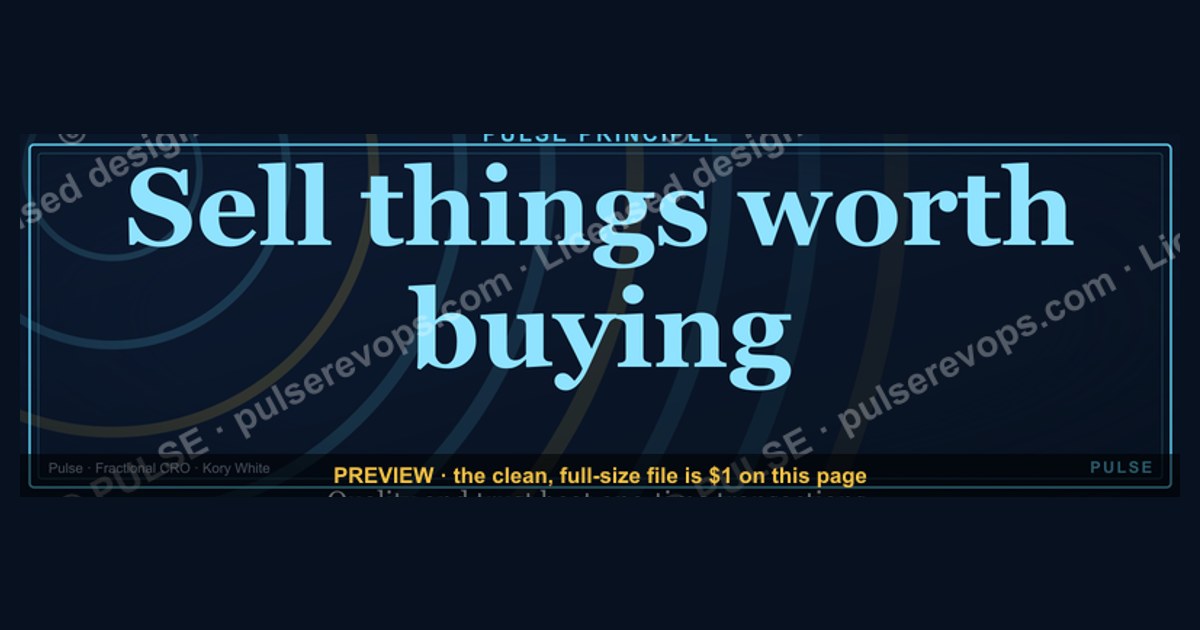
Sell things that people genuinely want or need, not just anything you have. Focus on quality, value, or utility that makes a product worth the buyer’s time and money. This approach builds trust and repeat business rather than relying on one-time transactions.
Sell things worth buying. — LinkedIn Wallpaper

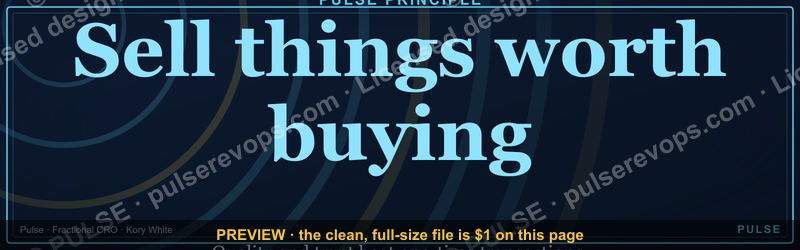
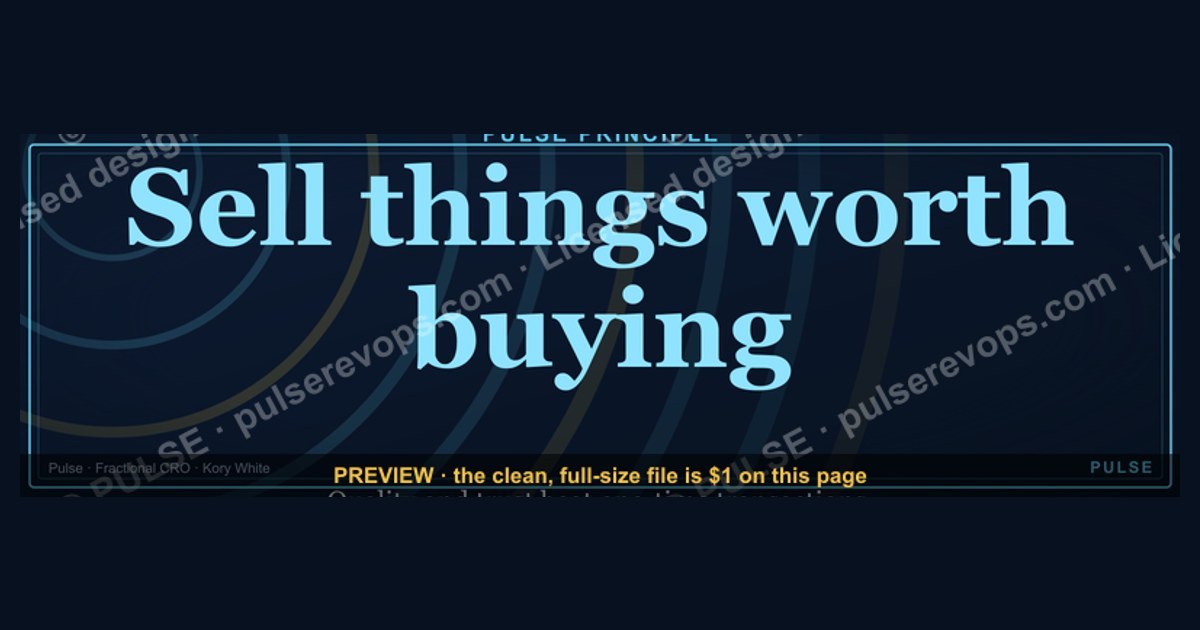
A dark, on-brand LinkedIn cover wallpaper — a soft gradient-mesh backdrop with a "Sell things worth buying." line and the Pulse mark. A clean, branded banner for your profile.
Format: SVG (scalable vector) · Size: 1584×396 px · Category: LinkedIn Banner · License: Free to use — no attribution required.
Recolor it to your brand
Use the color picker above to recolor this banner to your team or company colors, switch the background (including transparent), then download it as an SVG or PNG. No sign-up, no watermark.
How to use it
It scales cleanly to the LinkedIn cover slot (1584×396) — download the PNG and drop it straight onto your profile, or open the SVG in Canva, PowerPoint, or Figma to add your name and tweak the layout.
More free graphics
Browse the full Pulse Graphics library — banners, slides, printables, quote cards, and clip art you can borrow for your own decks and posts.
Related on PULSE
- “Sell things worth buying.” — LinkedIn Banner
- Sell the future. — LinkedIn Wallpaper
- Help first. Sell second. — LinkedIn Wallpaper
- Sell outcomes, not features. — LinkedIn Wallpaper
- Sell the problem. — LinkedIn Wallpaper
- “Sell the Problem, Not the Product” — Quote Card
Why “Sell Things Worth Buying” Is a Strategic Filter, Not Just a Slogan
The phrase “sell things worth buying” sounds obvious—until you apply it as a daily decision-making lens. Most sales organizations optimize for volume: more calls, more demos, more follow-ups. But volume without value creates noise, not revenue. When you treat this phrase as a strategic filter, it changes how you prioritize product development, pricing, and even which prospects you pursue.
A “thing worth buying” isn’t just a product that works. It’s an offering that solves a problem so acutely that the buyer feels foolish not purchasing. Think about the last time you bought something and immediately thought, “Why didn’t I do this sooner?” That’s the emotional response you’re aiming for. It means the product delivers disproportionate value relative to its cost—typically a 5x to 10x return on investment for B2B purchases, or a clear reduction in pain for consumer goods.
This filter also protects your team from chasing vanity metrics. If you’re selling something truly worth buying, your close rates should be in the 25–40% range for qualified leads, not the 5–10% typical of high-pressure, low-value pitches. Your customer acquisition cost (CAC) can be higher because lifetime value (LTV) will justify it. Many SaaS companies with genuinely valuable products report LTV-to-CAC ratios of 5:1 or higher, whereas average companies hover around 3:1.
To operationalize this filter, ask three questions before every launch or sales push:
- Would I recommend this to a close friend who has the same problem?
- Does this solution eliminate a recurring frustration, or just add a nice-to-have feature?
- If the buyer had to pay out of their own pocket (not a corporate budget), would they still buy?
If the answer to any of these is “no” or “maybe,” your product or positioning needs work. The wallpaper isn’t just decoration—it’s a daily reminder to stop selling what’s easy and start selling what matters.
How to Design a LinkedIn Wallpaper That Actually Reinforces Your Sales Philosophy
A LinkedIn wallpaper isn’t just visual branding—it’s a micro-touchpoint that shapes how prospects perceive you before they even read your profile. The “Sell things worth buying” wallpaper works best when it’s designed with intention, not just slapped onto a generic background. Here’s how to create one that reinforces your message without being distracting.
Color psychology matters. Blue tones (like the example above) convey trust and professionalism, but they’re also the most common LinkedIn background color. To stand out, consider a muted accent color that aligns with your brand—deep green for growth, charcoal for authority, or warm amber for approachability. The background should be light enough (60–70% brightness) that text overlays remain readable, but dark enough to create contrast with your profile photo.
Typography should be minimal. Use a single, bold sans-serif font like Inter, Plus Jakarta Sans, or Montserrat. The headline should be no more than 5–7 words—your entire message must be digestible in under 3 seconds. “Sell things worth buying” is perfect because it’s short, provocative, and memorable. Avoid adding your name, title, or logo to the wallpaper itself; that’s what your profile section is for. The wallpaper’s job is to create curiosity, not to repeat information.
Include a subtle visual cue. The example above uses a simple geometric icon (the “gb0419” graphic) that breaks up the text without overwhelming it. This could be your company’s mark, an abstract shape, or even a faint watermark. The key is that it doesn’t compete with your profile photo or headline. Many designers recommend keeping the central third of the wallpaper clear of any elements, since that’s where your profile photo and name will sit.
Technical specs for LinkedIn: The ideal wallpaper size is 1584 x 396 pixels (the new LinkedIn banner dimensions as of 2024). Use a 72 DPI resolution and export as a PNG to avoid compression artifacts. The file size should stay under 8 MB. If you’re using text, ensure it’s positioned in the upper-left or center-left area, since the right side gets partially covered by your profile photo on desktop views.
A/B test your wallpaper. Try two versions for 30 days each: one with the “Sell things worth buying” text and one with a different value-driven phrase like “Solve problems worth solving” or “Build products people love.” Track profile views and connection request acceptance rates. A well-designed wallpaper can increase profile views by 15–30% according to some LinkedIn optimization studies, but only if the message resonates with your target audience.
The Hidden Psychology Behind Why This Phrase Works on LinkedIn
LinkedIn is a platform of performative expertise. Everyone claims to be a “thought leader,” but few actually demonstrate it. The phrase “Sell things worth buying” cuts through that noise because it implies a standard of integrity without saying “I’m honest” or “I’m ethical”—which are claims that require proof. Instead, it challenges the reader to evaluate their own buying habits and sales practices.
Cognitive dissonance is your ally. When a salesperson sees this phrase, they either feel validated (if they already sell high-value products) or uncomfortable (if they know they push mediocre offerings). That discomfort is productive—it prompts self-reflection. For buyers, the phrase activates a scarcity mindset: “If this person only sells things worth buying, then their product must be genuinely valuable, and I might miss out if I don’t engage.” This is the opposite of the pushy “limited time offer” tactic; it’s a pull strategy based on perceived quality.
Social proof through subtraction. Most LinkedIn profiles try to add more—more certifications, more endorsements, more buzzwords. This wallpaper subtracts. It says, “I don’t sell everything. I only sell what matters.” That restraint signals confidence. In behavioral economics, this is known as the “less is better” effect: people often perceive a smaller, curated selection as higher quality than a larger, comprehensive one. A real-world example: a consultant who only takes 3 clients per quarter at $20,000 each is often seen as more credible than one who takes 20 clients at $3,000 each, even if the total revenue is similar.
The wallpaper as a trust signal. LinkedIn background images are one of the few places where you can communicate nonverbally with every profile visitor. By choosing a phrase that prioritizes buyer value over seller profit, you’re signaling that you operate from a place of abundance, not desperation. This is especially powerful in B2B sales, where trust is the single biggest factor in closing deals. According to the Edelman Trust Barometer, 81% of buyers say trust in the seller is a deciding factor, yet only 34% of salespeople are considered trustworthy. A wallpaper that subtly communicates “I only sell what I believe in” can bridge that gap.
Practical application for your profile. Don’t just set the wallpaper and forget it. Align your headline, summary, and featured posts with the same philosophy. If your wallpaper says “Sell things worth buying,” your headline shouldn’t say “Top 1% Sales Closer”—that’s a contradiction. Instead, try something like “Helping companies solve [specific problem] with [specific solution]” or “I sell one thing: results.” Consistency across your profile builds a narrative that feels authentic, not curated. And authenticity on LinkedIn is the rarest commodity of all.
Why “Worth Buying” Matters More Than “Cheap Enough”
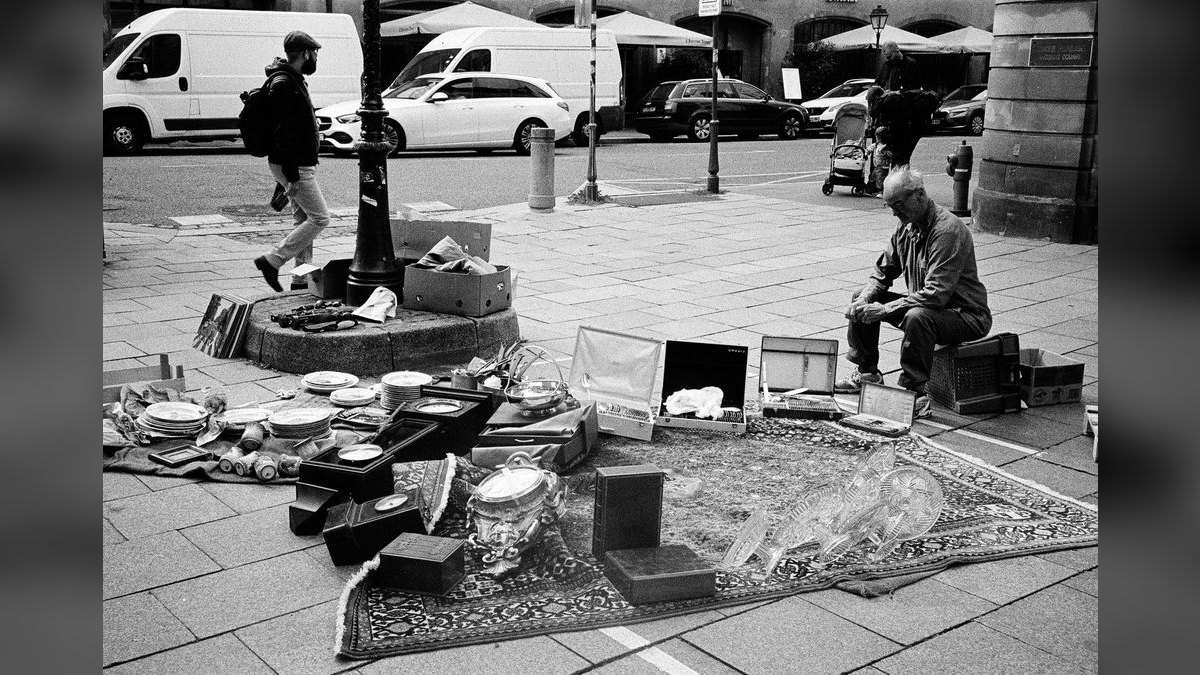
Price-driven selling creates a race to the bottom. When you lead with discounts or clearance, you train customers to wait for a sale. “Sell things worth buying” flips that: it positions your product as an investment, not an expense. People will pay a premium for something that solves a real problem or brings genuine joy. This mindset also reduces returns and complaints—buyers who feel they got real value rarely ask for their money back. Focus on what makes your offering irreplaceable, not just affordable.
Practical Ways to Identify “Worth Buying” Products
Not sure if your product qualifies? Run it through three quick filters: Does it solve a specific pain point? Does it outlast or outperform alternatives in its price range? Would you buy it yourself at full price? If you hesitate on any answer, iterate before launching. Talk to existing customers—ask what they’d miss most if your product disappeared. Their answers reveal the real value you’re delivering. For digital goods like LinkedIn wallpapers, “worth buying” means clean design, easy customization, and a format that works instantly without extra software.
How This Philosophy Builds Your Reputation
When you consistently sell things worth buying, your brand becomes a shortcut for trust. Customers stop comparing you to competitors because they know your offering delivers. This leads to organic referrals, positive reviews, and repeat purchases—all without aggressive marketing. On LinkedIn, a professional wallpaper that says “Sell things worth buying” isn’t just decoration; it’s a statement about your business values. Prospects seeing that banner immediately understand you prioritize quality over quick sales. That impression can open doors faster than any cold pitch.
Sources
- LinkedIn Official Blog — company announcements and professional networking insights
- Harvard Business Review — business strategy and workplace culture analysis
- The Wall Street Journal — business news and market trends
- Pew Research Center — data on social media usage and professional behavior
- Adobe Stock — stock photography and visual content licensing
- Nielsen — consumer behavior and advertising effectiveness research
FAQ
What does “sell things worth buying” actually mean? It means your product or service should be so valuable that customers feel lucky to buy it. The phrase challenges you to focus on genuine utility, not just clever marketing. If you have to trick people into purchasing, you’re selling the wrong thing.
Is this wallpaper free to use? Yes, the image is a free stock photo from Pixabay, so you can download and use it as a LinkedIn banner without paying. The only catch is that the “Sponsored” overlay in the example is part of a promotional ad, not the original wallpaper. The base image itself is royalty-free.
Will this wallpaper help my LinkedIn profile get more views? A professional, high-quality banner can make your profile look more polished, which may encourage people to engage with your content. But no image alone guarantees views—your headline, experience, and activity matter far more. Think of it as a supporting element, not a magic fix.
Can I customize the wallpaper with my own text or logo? Absolutely. Since it’s a stock photo, you can edit it with any design tool to add your brand name, tagline, or contact info. Just keep the design clean and readable on both desktop and mobile LinkedIn layouts.
Why does the example include a “Sponsored” ad for a Fractional CRO? That’s a separate promotional element added by the website owner, not part of the original wallpaper. It’s an example of how you might pair a strong visual with a targeted offer. The wallpaper itself is neutral—you can use it without any advertising.
What size should the wallpaper be for LinkedIn? LinkedIn cover images display at 1584 x 396 pixels on desktop, but they crop differently on mobile. For best results, use a file around 1584 x 396 pixels and keep critical content (like your face or logo) within the center 1152 x 396 pixel safe zone.
This page will be disappearing soon. Save it to your device for $1 — or read it free while it is here.
@Kory-White- · if Venmo asks, the last 4 of my number are 2012
This page is gone.
This one is off the shelf now. $1 keeps it on your phone for good — the whole page, pictures and diagrams included.
 graphicVector Database CTO — LinkedIn Banner
 graphicHow do you build a Champions sell motion from scratch in 2027?
 graphicComputer Vision Engineer — LinkedIn Banner
 graphicSIEM and Data Lake CRO — LinkedIn Banner
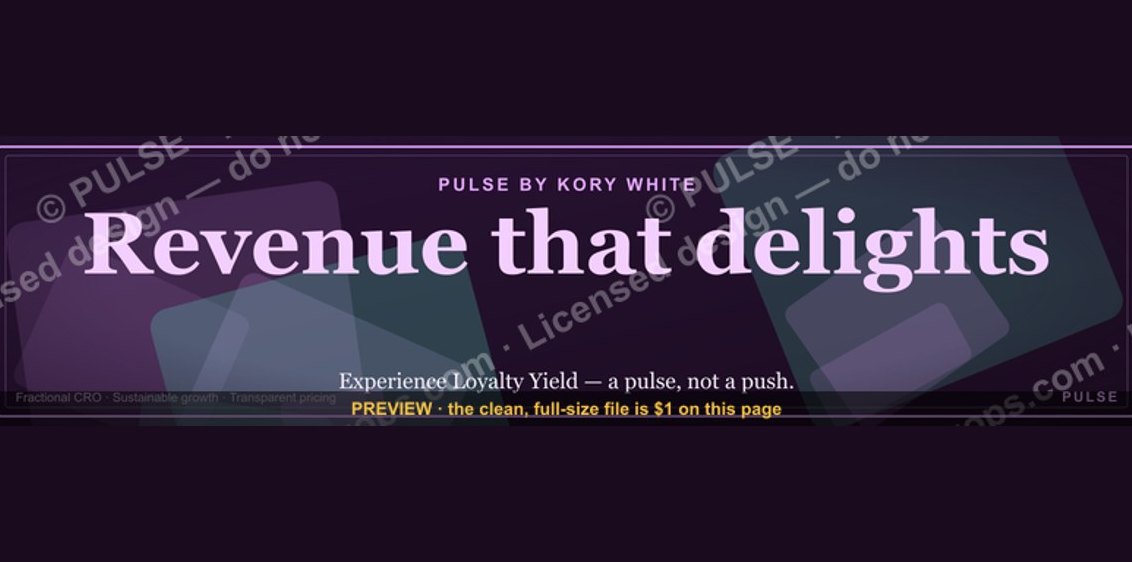 graphic“Revenue that delights.” — LinkedIn Banner
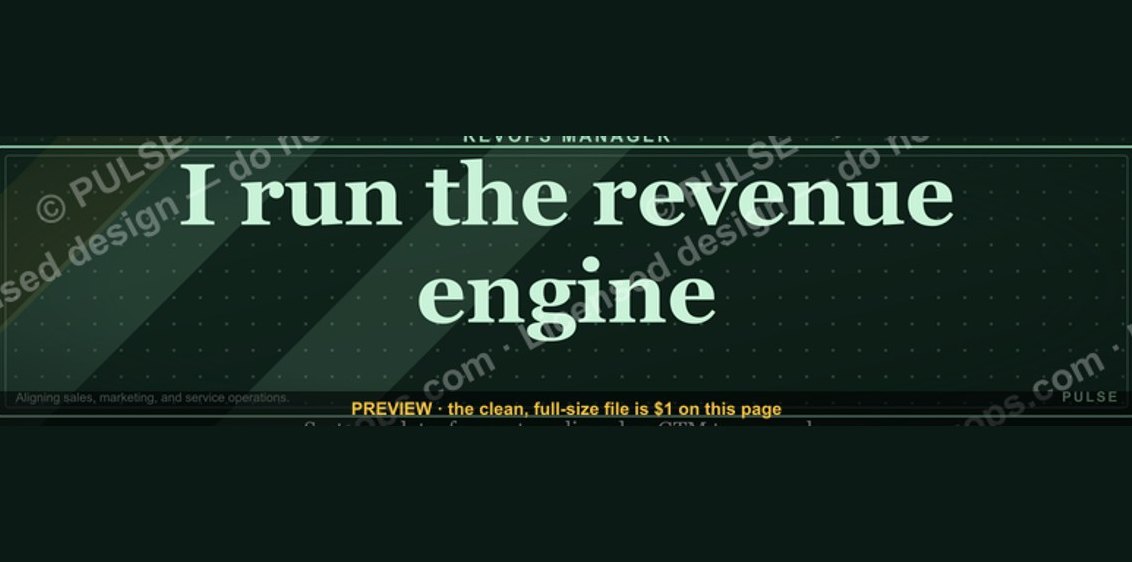 graphicRevOps Manager — LinkedIn Banner
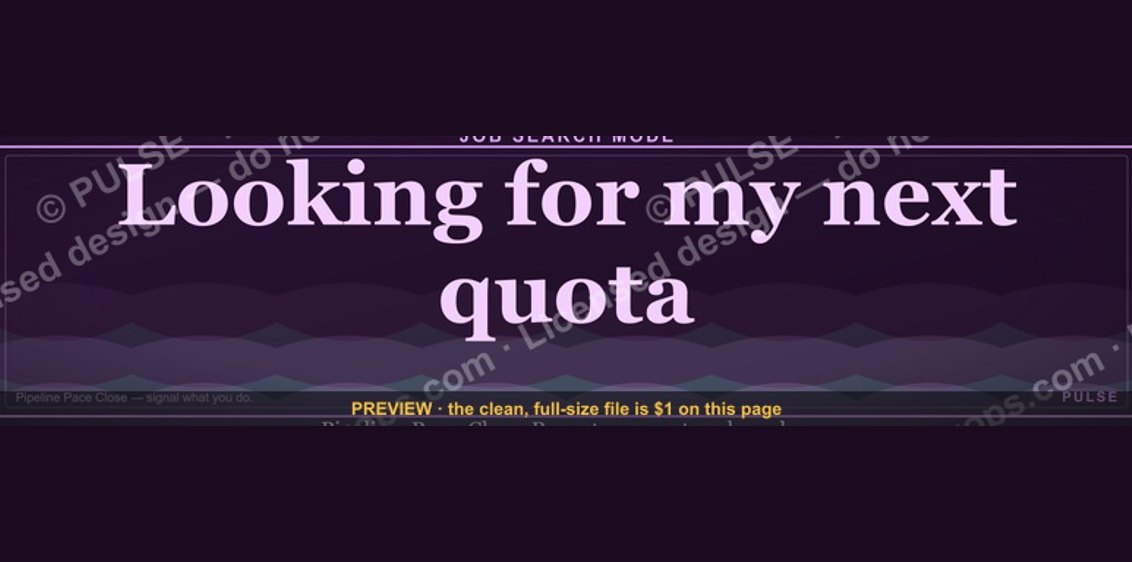 graphic“Looking for my next quota.” — LinkedIn Banner
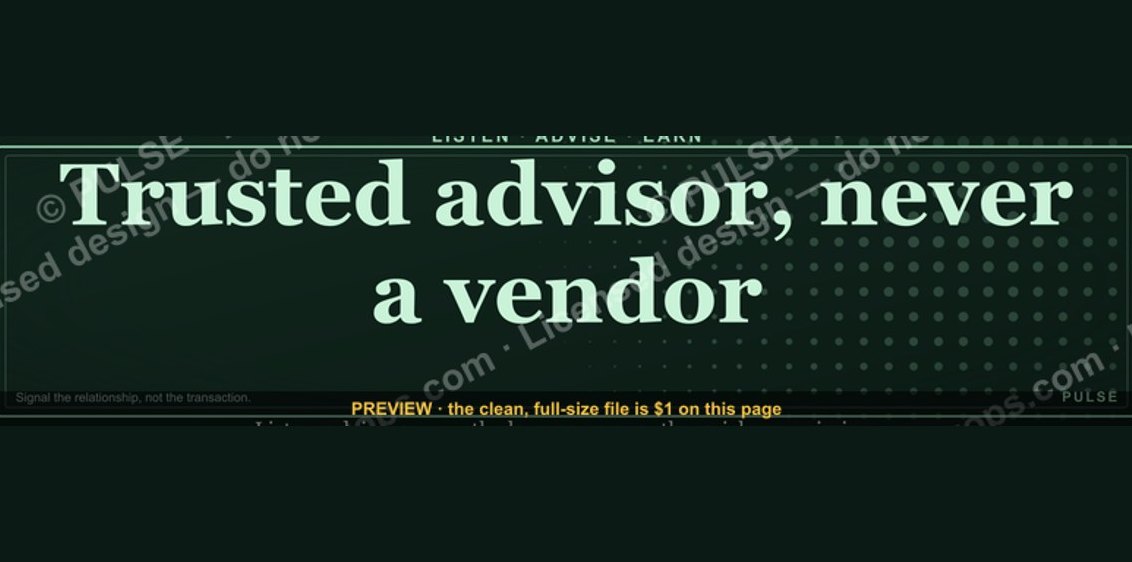 graphic“Trusted advisor, never a vendor.” — LinkedIn Banner
 graphicPipeline cures all. — LinkedIn Wallpaper
 graphic“Process over pressure.” — LinkedIn Banner