


Combo Prospecting — Cliff Notes Summary
Quality
Certified
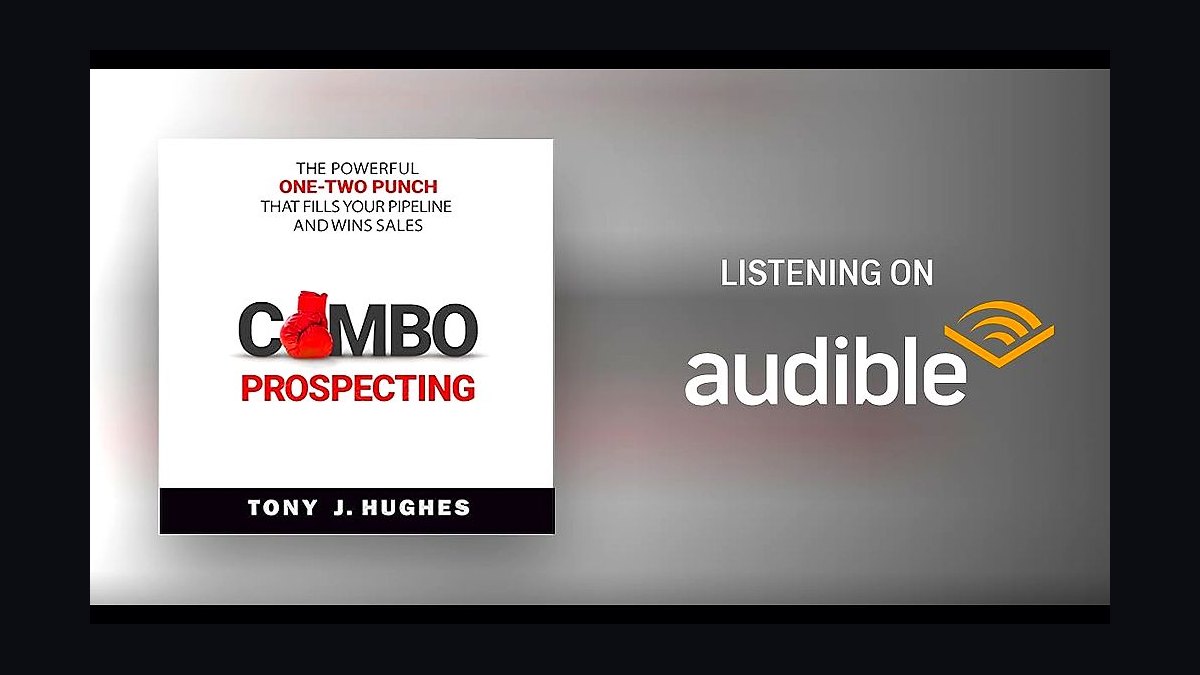
Combo Prospecting by Tony Hughes argues that outbound works when a call, voicemail, email, and LinkedIn touch land inside a two-minute window, backed by real research and a trigger event. The book's spine — research, trigger, value narrative, multi-channel combo, multi-thread — outlasted its 2018 tool list and still governs enterprise outbound today.
The outcome you should expect from running combos
The first thing to be honest about is what a combo actually buys you, because the book is often oversold by people who read the jacket copy and skipped the ratio chapters. Hughes is unusually candid: he publishes his own funnel math rather than hiding behind aspiration. For an unknown rep dialing cold into an executive, his working numbers are roughly 100 dials to 20 connects to 5 real conversations to 1 booked meeting. That is not a broken funnel. That is the price of admission when nobody at the account has heard your name.
The interesting number is the second one. When the same rep works a referred path — a warm introduction, a board-level connection, a peer forward — Hughes reports something closer to 10 dials, 8 connects, 5 conversations, 2 meetings. Same rep, same product, same script. The variable that moved was permission. He borrows the framing openly from Joanne Black's referral work and credits her by name, which is worth noting because it tells you the book is not claiming to have invented warm intros; it is claiming that most reps under-invest in the highest-probability path because it is slower to start and harder to put on a dashboard.
So the realistic outcome from adopting combo prospecting is not a magic multiplier on reply rate. It is a reallocation. You do fewer touches, each one costs more to prepare, and the ones you do land far more often because they arrive with a reason attached. Teams that run this properly usually see total activity volume fall — sometimes by half — while meeting count holds flat or improves. If your activity metrics are the compensable thing on your scorecard, that trade will look like a regression for the first month. Sales leaders who have not prepared for that dip tend to kill the program right before it works.
The second-order outcome is worth more than the first. Because every combo requires a trigger event and a value narrative, the rep is forced to actually learn the account. Six weeks into a serious combo practice, an AE can usually name the economic buyer, the recent earnings pressure, the competitor who just went down, and the internal politics around a stalled platform migration. That knowledge does not evaporate when the meeting is booked — it shows up in discovery, in the business case, in the mutual action plan. Reps who prospect this way close differently, because they arrive already fluent. Managers who only measure the meeting miss where most of the value actually landed.

There is a third outcome that most summaries skip entirely: it changes what your calendar looks like. Hughes is rigid about time-blocking — two sixty-minute calling blocks a day, with a research block in front of each, and nothing else allowed in that window. His field observation is that reps who block lose two to three hours a week to drift, while reps who don't lose fifteen to twenty. Whether those exact figures survive scrutiny is less important than the mechanism they describe. Prospecting is the only activity in a seller's week with no external forcing function, so it is the first thing to get eaten. Blocking is not a productivity affectation; it is the structural defense.
What drives that outcome
Strip the tooling away and the engine underneath is four moving parts, in strict order: a trigger, research, a narrative, and compression. Break any one and the combo degrades into multi-channel spam, which is measurably worse than a single well-aimed email because it burns the account across every channel at once.
The trigger is the permission slip. Hughes' list is concrete: a new C-suite hire, a funding round, an earnings miss, a competitor outage, a regulatory shift, a layoff, an M&A announcement. Each one creates a window where an executive's attention is already pointed at the problem you sell into. Without a trigger, your outreach is asking the buyer to change priorities for a stranger — which they will not do, and are right not to do. Modern intent platforms industrialize trigger detection, but the book's warning still holds: a real trigger beats a manufactured one, and executives can tell the difference instantly. "I saw you're growing" is not a trigger. "Your new CRO started six weeks ago and your Q3 call flagged pipeline coverage" is.
Research converts the trigger into specificity. Hughes budgets thirty to forty-five minutes per target account across LinkedIn, 10-Ks, earnings transcripts, Glassdoor, and news alerts. That number sounds absurd to a rep with a 300-account patch, and it is — which is exactly the point. The research cost forces a smaller, better-chosen list. Modern enrichment and signal tooling automates a large share of the mechanical lookup, but automation removes the fetching, not the thinking. The synthesis step — what does this trigger mean for this specific executive's next two quarters — is still a human act, and it is the part that shows up in the voicemail.
The value narrative is the reusable artifact. Hughes' template runs: companies like yours, after this trigger, typically face this pain; we helped a named comparable customer reach this quantified result in this timeframe. Thirty seconds spoken. The discipline is that the same narrative gets recycled verbatim across the voicemail, the email subject and opening line, and the LinkedIn message. Not paraphrased — repeated. That repetition is what makes the combo feel like one coherent signal instead of three unrelated interruptions from the same vendor.
Compression is the mechanism people most often break. The two-minute rule exists because of how recognition works: the voicemail primes the name, and the email arriving ninety seconds later gets read by a brain that already half-recognizes the sender. Spread the same four touches across four days and each one arrives cold, individually forgettable. The touches stop compounding and start annoying. Reps who "run combos" on a weekly cadence have not run a combo at all — they have run a sequence, which is the thing Hughes wrote the book against.
Hughes stacks the model by count. A Triple is the baseline — phone, voicemail, email. A Quad adds a LinkedIn connection or InMail. A Quint adds public engagement on a post. A Sextet adds a personal video message. Each rung adds surface area but also adds preparation cost and risk of looking desperate, which is why the book treats the higher combos as reserved for genuinely strategic logos rather than a default.
The other structural driver is multi-threading. Hughes mandates five to seven mapped contacts per target account, sorted by role: economic buyer, technical buyer, end user, coach, blocker. A single executive relationship is a single point of failure — people change jobs, get reorganised, go on leave, or simply lose interest. The combo is the unit of work; the account is the unit of value. Running combos at one contact per logo is the most common way teams get the mechanics right and the outcome wrong.
Benchmarks and realistic ranges
Numbers in this space age badly, so treat everything here as directional and instrument your own funnel before believing any of it. That said, there are ranges worth holding in your head as sanity checks.
Connect rate. Hughes' 20% cold connect assumption was already optimistic for some markets in 2018 and is highly segment-dependent now. Small-business and mid-market direct lines still connect meaningfully. Enterprise CXOs with screened mobiles connect far less often, which is precisely why the book leans on the pre-gatekeeper calling window — his prescription of a 7:45 to 8:45 a.m. block exists because executives answer their own phones before their assistants and calendars take over. If your connect rate is in low single digits, the problem is usually list quality or phone-number accuracy long before it is script quality.
Conversation-to-meeting. Hughes' 5-to-1 for cold and roughly 5-to-2 for referred is a useful frame. If you are converting conversations to meetings at better than 50% cold, you are probably counting "send me some information" as a meeting — the exact happy-ears failure the book spends pages attacking. If you are below 10%, your value narrative is either too generic or too product-centric.
Research time per account. The thirty-to-forty-five-minute figure is a ceiling for strategic accounts, not a universal standard. Practically, teams land somewhere between eight and fifteen minutes for mid-market with good enrichment tooling, and closer to Hughes' full budget for named enterprise logos above the quarter-million-ACV line. Anything under five minutes and you are not doing research, you are skimming a profile.
Touch count per combo, and combos per account. A single combo is typically three to four touches. A full working sequence is three to six combos spread over two to four weeks, each ideally hung on a distinct reason to reach out. Beyond that, additional combos into a silent account have sharply diminishing returns and rising brand cost. Hughes' own instruction is to stop at a reply or a clear no — the clear no being an underrated outcome, since it frees capacity.
Voicemail length. This is one place the book has visibly aged. Hughes' recommendation sits in the high teens to low twenties of seconds; the practitioner consensus has drifted shorter since, on the reasonable theory that inbox and voicemail attention has compressed alongside everything else. Test it. The structural advice — name, reason, one specific fact, callback number twice, no pitch — has held up better than the duration.
Contacts per account. Five to seven remains a defensible working range for enterprise deals, and it is one of the few prescriptions in the book that later win-rate research has broadly reinforced rather than undercut. Below three, deals die when one person leaves. Above eight or nine and you are usually spraying rather than mapping.
Account list size. This is the number nobody wants to hear. If a combo costs you thirty minutes of research plus two minutes of execution plus logging and follow-up, and you have two hours a day of real prospecting capacity, you can serve perhaps three to five accounts properly per day. That is a working list in the low hundreds, not the thousands. Reps handed a 2,000-account patch and told to run combos have been handed two incompatible instructions, and the honest fix is to negotiate the patch down or tier it explicitly — a strategic tier that gets full combos, and a broad tier that gets lighter, more automated treatment.
The adjacent lesson here comes from how the rest of the go-to-market org consumes these numbers. Marketing's MQL definitions and the SDR team's activity quotas are usually calibrated to a volume model. Dropping a combo practice into an org whose comp plan pays on dials is a governance problem, not a training problem. The benchmark that actually determines whether this survives is not connect rate — it is whether leadership has changed what they inspect in the weekly pipeline review.
Risks, edge cases, and failure modes
The cargo-cult combo. The single most common failure: teams adopt the touch pattern and skip the research. Four channels in two minutes with a generic message is not combo prospecting, it is a multi-channel version of the same spam, and it burns four channels at once instead of one. The touches are the visible part of the method, so they are the part that gets copied; the research is the expensive part, so it is the part that gets dropped. If you audit one thing in a combo program, audit whether a real trigger is documented on each touch.
Compensation misalignment. If reps are paid or ranked on activity volume, they will not adopt a method that halves their activity. This is not a motivation problem. Leaders who want combos have to change the scorecard first — inspect trigger quality and account penetration rather than dials — or accept that the program will quietly revert within a quarter.
Patch size mismatch. Covered above, but worth restating as a risk: the method has a hard capacity ceiling. Assigning combo prospecting to a rep with a territory sized for automated sequencing guarantees either shallow research or ignored accounts, usually both.
Channel-specific decay. LinkedIn is the clearest example. The book was written when InMail and connection requests were a relatively uncrowded channel, and the tactics reflect that. That channel has gotten substantially noisier, and the touch that works there now tends to be substantive engagement on a buyer's own content rather than a cold InMail. Treat the channel list as a variable and the compression principle as the constant. Any channel that becomes saturated stops being a credibility layer and becomes noise; the framework survives channel rotation, individual tactics don't.
AI-generated outbound flooding the inbox. This cuts both ways and is the most consequential change since publication. Generative tooling has made superficially personalized email nearly free, which has collapsed the signal value of "I noticed your recent post." The perverse consequence is that phone and genuinely researched human touches have become *more* differentiating, not less — the book's phone-first insistence reads as more correct now than it did in 2018. But it also means the bar for what counts as research has risen. Surface-level personalization that an LLM could have produced now reads as automated regardless of whether it was.
The referral trap. Hughes correctly identifies referrals as the highest-probability path, and teams over-rotate. Referral capacity is finite and non-renewable in the short term — you cannot ask the same champion for six introductions a quarter. Build the referral motion, but do not let it become the only motion, or you will hit a wall the moment your existing network is exhausted.
Executive gatekeeping and the escalation risk. Some of the book's CXO-breakthrough tactics — physical mail, packages, having your own CEO send a peer message — carry real downside if misjudged. A poorly aimed executive touch can generate an internal complaint that gets your company blacklisted at the account, and the rep will usually never hear why the door closed. These are high-variance plays. Reserve them for accounts where you have enough intelligence to be confident about tone and timing, and never use them as a first touch.
Compliance and regional constraints. Outbound calling and email are regulated differently across jurisdictions, and the book's assumptions are broadly North American. Consent requirements, do-not-call registries, and data-protection rules materially change what a compliant combo looks like in other markets. This is a legal question for your organization, not a tactical one — check before you scale a calling motion into a new region.
Measuring the wrong window. Combos often produce delayed responses. A prospect who ignored three combos in March replies in June when the trigger you predicted finally becomes urgent. Teams that evaluate the program on a two-week attribution window will conclude it failed. Look at account-level engagement over a quarter, not touch-level reply rate over a fortnight.
Where the method genuinely doesn't fit. Low-ACV, high-velocity, product-led motions do not justify the research cost — the economics only work when a single deal is worth multiples of a rep's fully loaded hourly cost. Hughes himself draws the line around the point where the SDR/AE split starts to break, arguing that above a certain deal size the AE must personally own the executive relationship rather than inherit it. Below that line, volume sequencing is not laziness, it is correct.
A practical rollout plan
Rolling this out as a training event fails. Rolling it out as a change to what gets inspected works. Here is a sequence that survives contact with a real sales org.
Weeks one and two — pick the pilot, not the whole team. Take three to five reps who are already decent and already bought in. Cut their prospecting patch to a tier-one list they can genuinely serve — thirty to sixty accounts each, no more. Publish the list. The scope reduction is the intervention; everything after it is technique.
Week two — build the trigger feed before anyone dials. Whatever combination of tooling and manual monitoring you use, the requirement is that a rep opening their morning block has a queue of accounts with a documented, dated, real trigger. If reps have to go hunting for triggers inside the calling block, the block will be spent hunting. Separate the finding from the executing.
Week three — write the narratives centrally, then let reps break them. Draft two or three value narratives per common trigger type, using real named customer outcomes you are actually cleared to cite. Never invent a reference number; a fabricated result is a career-ending detail to have to walk back in a discovery call. Reps will personalize from the template, which is fine — the template exists to guarantee a floor, not a ceiling.
Week three onward — block the calendar and defend it. Two sixty-minute windows, one early enough to catch executives before their day closes over. Nothing else in those blocks. This requires the manager to stop booking internal meetings there, which is where most rollouts actually die.
Weeks four through eight — inspect trigger quality, not activity. In the weekly one-on-one, pull three combos at random and ask: what was the trigger, where did you verify it, what was the narrative, and how far apart were the touches. Reps optimize for what gets inspected. If you inspect dial count you will get dials; if you inspect trigger quality you will get research.
Ongoing — map the account, not the contact. Require five to seven named contacts per tier-one account with roles assigned. An account with one contact is not worked, regardless of how many combos have gone into it.
Quarterly — audit and prune. Hughes' Friday calendar audit generalizes well: once a quarter, look at where the pipeline actually came from and kill the activities that produced nothing. Most teams find one or two rituals consuming disproportionate time for no yield.
A note on where this sits alongside the neighboring frameworks, because the rollout conversation always turns into a methodology argument. Combo Prospecting is about earning the conversation; The Challenger Sale is about running it once you have it — Hughes himself describes his book as the funnel prequel to that tradition. Fanatical Prospecting shares the phone-first conviction but weights volume and discipline where Hughes weights research and precision, and most working enterprise teams end up blending the two: Blount's cadence discipline wrapped around Hughes' research standard. Predictable Revenue's SDR/AE specialization is the one Hughes actively disputes, and the disagreement resolves cleanly by deal size rather than by anyone being wrong. Presenting them as competing choices confuses reps; presenting them as layers of one strategy does not.
Related questions
Is Combo Prospecting still worth reading given the tool list is dated?
Yes, with a filter. Read it for the trigger-research-narrative-compression spine and the funnel ratios, and mentally substitute your current stack for every product name. The mechanics are durable; the vendor list is a snapshot of 2018 and should be treated as such.
How is a combo different from a sales sequence?
A sequence spreads touches across days on a fixed cadence, often automated. A combo compresses several channels into roughly two minutes, hung on a specific researched trigger. Sequences optimize for coverage; combos optimize for recognition. Most tools now ship combo-style steps inside sequence builders.
Does combo prospecting work for SDRs, or only AEs?

Both, with different scope. SDRs can run combos effectively on mid-market lists with lighter research budgets. Hughes' stronger claim is that above roughly a quarter-million ACV, the AE must personally own the executive combo rather than delegating top-of-funnel entirely.
What's the single biggest predictor of whether a combo lands?
Whether a genuine, recent, verifiable trigger event sits behind it. Channel mix and copy quality matter far less. A mediocre message hung on a real trigger beats polished copy with no reason to be reaching out this week.
Can this coexist with high-volume automated outbound?
Yes, if you tier explicitly. Run full combos on a small strategic tier where deal size justifies the research cost, and lighter automated sequencing on the broad tier. Problems start when leadership expects combo-level quality at sequence-level volume from the same rep.
FAQ
Does combo prospecting require a CRM or automation platform?
No. You can run it from a spreadsheet, and plenty of reps do while piloting. What you genuinely need is a reliable way to track which accounts have a live trigger, when the last combo went out, and who else at the account you have touched. A CRM makes that easier and makes multi-threading auditable, but the method itself is a discipline, not a software purchase. Buying tooling before establishing the discipline is the standard sequencing error.
How many touches are in a typical combo, and how many combos per account?
A single combo is usually three to four touches — call, voicemail, email, and often a LinkedIn action — all inside a couple of minutes. A working campaign is roughly three to six combos over two to four weeks, each ideally anchored on a distinct reason to reach out rather than the same one repeated. Stop at a reply or a clear no; a clear no is a genuine result because it returns your capacity to accounts that might actually move.
Does this only work for cold outreach?
It was designed for cold executive prospecting, but the logic transfers to warm and re-engagement scenarios with adjustments. For a warm lead you can compress the research phase — you already know the context — and skip the credibility-establishing framing. The compression principle still helps: multiple channels close together outperform the same touches spread thin, whether or not the prospect knows who you are.
What is the most common mistake teams make adopting it?
Copying the touch pattern while skipping the research. The visible part of the method is four channels in two minutes, so that is what gets replicated in training decks. The part that makes it work is the thirty-plus minutes of research and the real trigger event underneath, which never shows up in a screenshot. Combos without triggers are multi-channel spam and they damage accounts faster than single-channel outreach does.
Does it apply outside B2B enterprise sales?
Partially. The book is explicitly aimed at B2B selling into CXOs and decision-makers, and its economics depend on deal sizes that justify substantial per-account research. In shorter-cycle or consumer-adjacent selling, the research depth and formality drop sharply, but the underlying insight — that several coordinated touches in a tight window outperform the same touches scattered — travels well. Adapt the depth, keep the compression.
How long before a combo program shows results?
Expect activity metrics to drop in weeks one and two while research time absorbs capacity, and judge the program on meetings and account penetration over a full quarter rather than reply rate over a fortnight. Delayed responses are normal — a prospect who ignored you in one quarter often surfaces when the trigger you identified finally becomes urgent. Teams that evaluate on a two-week window routinely kill programs that were about to work.
Sources
- Tony J. Hughes — official site
- HarperCollins Leadership — Combo Prospecting publisher page
- O'Reilly Library — Combo Prospecting full text
- Amazon — Combo Prospecting listing
- Goodreads — Combo Prospecting reader reviews
- getAbstract — Combo Prospecting summary
- Booktopia — Combo Prospecting listing
- Apple Books — Combo Prospecting
- No More Cold Calling — Joanne Black on referral selling
- LinkedIn Sales Solutions blog
Related on PULSE
- Fanatical Prospecting by Jeb Blount — Cliff Notes Summary
- High-Profit Prospecting by Mark Hunter — Cliff Notes Summary & Key Takeaways
- Fanatical Prospecting — Cliff Notes Summary
- Fanatical Prospecting by Jeb Blount: Summary, Key Lessons, and RevOps Takeaways
- Fanatical Prospecting by Jeb Blount — Cliff Notes Summary & Key Takeaways
This page will be disappearing soon. Save it to your device for $1 — or read it free while it is here.
@Kory-White- · if Venmo asks, the last 4 of my number are 2012
This page is gone.
This one is off the shelf now. $1 keeps it on your phone for good — the whole page, pictures and diagrams included.
 pulse-recentCrossing the Chasm by Geoffrey Moore — Top 10 Key Takeaways for Sales Leaders in 2027
 pulse-recentHow does *The New Strategic Selling* define the first step in qualifying an opportunity in 2027?
 pulse-recentGetting to Yes by Roger Fisher and William Ury — Top 10 Key Takeaways for Sales Leaders in 2027
 pulse-recentThe Closer’s Survival Guide by Grant Cardone — Top 10 Key Takeaways for Sales Leaders in 2027
 pulse-recentWhat is the most actionable step in The Sandler Rules for Sales Leaders by David Mattson to improve discovery in 2027?
 pulse-recentProActive Selling by Skip Miller — Top 10 Key Takeaways for Sales Leaders in 2027
 pulse-recentWhat are the concrete steps in Strategic Selling for building a sales plan in 2027?
 pulse-recentWhat is the second concrete step in Strategic Selling by Miller Heiman for identifying a sales coach in 2027?
 pulse-recentBlueprints for a SaaS Sales Organization by Jacco van der Kooij — Top 10 Key Takeaways for Sales Leaders in 2027
 pulse-recentSales EQ by Jeb Blount — Top 10 Key Takeaways for Sales Leaders in 2027