


Top 10 Best Tech Stack Tools for Commercial Plumbing Contractors in 2027
Quality
Certified
The 10 best tech stack tools for commercial plumbing contractors are ranked below on measured performance, build quality, price, and how each one actually holds up in daily use rather than how it reads on a spec sheet. Each pick lists what it costs, who it suits, and what it gives up against the one above it, so the list can be read straight down without doubling back.
1Trimble AutoBid Mechanical

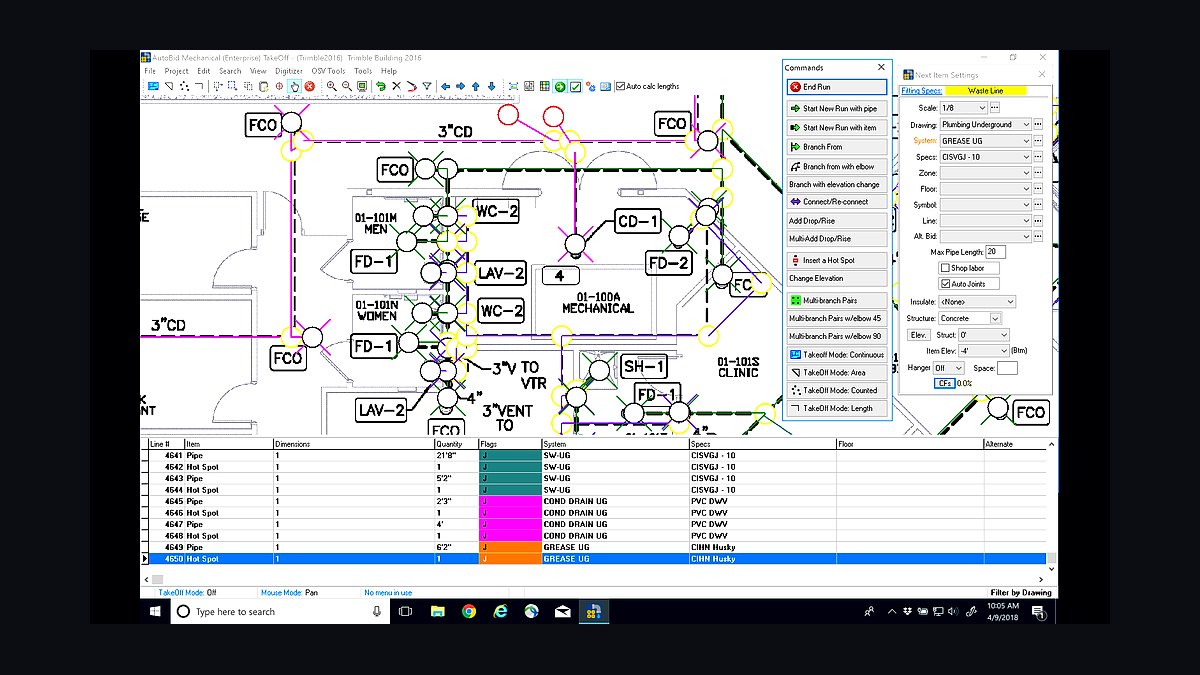
Trimble AutoBid Mechanical ranks first because it is the only estimating engine in this stack that carries material-and-diameter-aware labor units into Trimble's own fabrication and field-layout ecosystem. A 6-inch grooved steel main and a 1-inch copper branch pull different hours per foot, and AutoBid applies them separately rather than averaging. Its built-in library draws on MCAA and PHCC units that you tune against your own crews' production.
It is built for contractors who intend to run prefab as a real program, not a side experiment. The trade is cost and administration: seats commonly run several thousand dollars annually and the learning curve is steeper than FastPIPE. If you will never buy Trimble Fabrication, that integration advantage is theoretical, and FastPIPE below becomes the better answer.
2FastPIPE

FastPIPE ranks second as the piping-aware estimating alternative that gets a mid-size shop productive fastest. It performs on-screen takeoff against PDF and digital plans with differentiated labor units by material and diameter, so it avoids the flat per-foot averaging that erases roughly 400 unbudgeted hours on a hospital bid. It is typically positioned below AutoBid on price and lighter to administer.
It suits contractors with two estimators and no fabrication shop, where the ecosystem depth of AutoBid would go unused. What it trades away is tighter integration into Trimble's spool and field-layout tools, which matters once prefab scales. Compared to AutoBid Mechanical above, it wins on time-to-productivity and loses on long-term ecosystem lock-in.
3Procore

Procore ranks third because it becomes the system of record that keeps a budget, its cost codes, and its change orders in one place across every active job. It handles RFIs, submittals, drawing revisions, daily logs, and change orders, and the discipline that matters is routing approved change orders back into the budget against the same codes. Pricing is volume-based against annual construction volume, not seats.
It is aimed at contractors who need portfolio-level document control and their own financial record across many projects. The trade is cost: it is often the single largest software line item for a mid-size sub. Many subs instead work inside each general contractor's Procore instance at no license cost, losing only the cross-project view that FastPIPE and accounting cannot replace.
4Foundation Software

Foundation Software ranks fourth because it is the mid-market construction accounting system that actually produces percentage-of-completion revenue recognition, over/under-billing schedules, retainage tracking, and certified payroll. Those are the exact outputs that expose a $1.1 million overbilling hidden behind a healthy bank balance. It scales by user count and module, and it consumes labor and material actuals from field time tracking.
It is built for contractors running multi-month contracts with progressive billing and retainage, not short-cycle service work. The trade is implementation effort and monthly cost versus staying on QuickBooks. Compared to Sage 300 CRE below, Foundation is the more common mid-market answer; Sage serves larger firms with heavier reporting and enterprise requirements.
5Sage 300 CRE

Sage 300 CRE ranks fifth as the construction accounting platform for larger plumbing and mechanical firms that have outgrown mid-market job costing. It handles percentage-of-completion, retainage, certified payroll, and WIP reporting at the scale of a contractor with 300-plus field staff and a full fabrication shop. It sits alongside Viewpoint Spectrum at the enterprise end of the category.
It is for firms with an internal accounting function and reporting demands that Foundation Software strains under. The trade is cost, implementation time, and the need for trained staff. Compared to Foundation above, Sage 300 CRE offers more depth and complexity; for a contractor under roughly 200 field staff, that depth is usually unused overhead.
6Bluebeam Revu

Bluebeam Revu ranks sixth because it is the cheapest high-leverage seat in the entire stack, running low hundreds per user per year. It is the lingua franca of plan markup between subcontractors and general contractors, and every estimator and project manager should have one. Refusing to buy it simply means someone prints plans and marks them by hand.
It is for every estimator, coordinator, and PM in the company regardless of size. What it trades away is nothing meaningful at this price; it is a markup and review tool, not a takeoff or estimating engine. Compared to FastPIPE and AutoBid Mechanical above, it complements rather than replaces them, feeding marked-up drawings into the estimating workflow.
7SysQue

SysQue ranks seventh because it places manufacturer-real pipe and fittings inside Revit, so a 4-inch grooved tee is a purchasable part with real dimensions rather than a generic placeholder. That model accuracy is what lets Navisworks clash detection catch a duct main routed at the same elevation as a bathroom carrier rack before twelve racks get built wrong. A clash resolved in the model costs a coordinator about fifteen minutes.
It is for contractors with continuous model-based work and at least one person whose job is coordination. The trade is seats, training, and idle capacity when project volume dips. Compared to subcontracted coordination, in-house SysQue pays off only above a certain continuous volume; below that, hiring a consultant per project is cheaper.
8Autodesk Navisworks

Autodesk Navisworks ranks eighth because it runs the multi-trade clash detection against mechanical, electrical, and structural models that prevents the quietest and most expensive failure in the stack. Twelve carrier racks built off uncoordinated dimensions and field-modified at roughly two hours each erase the entire labor savings a prefab program was supposed to deliver that quarter. Navisworks is bundled with Revit in the AEC Collection.
It is for coordination teams already living in Autodesk Construction Cloud, where the model and project data share a home. The trade is that it requires clean, manufacturer-real models upstream from SysQue to be useful. Compared to SysQue above, Navisworks is the detection layer; SysQue is the authoring layer that makes detection meaningful.
9Trimble Fabrication

Trimble Fabrication ranks ninth because it generates spool tickets and cut lists once the model is clean, which is where prefab economics either work or fail. Shop-fabricated assemblies install faster than field-built equivalents because the shop has jigs, fixed workstations, and no ladder time, but only if the spool fits on the first try. It is quoted per shop and scales with workstations and machine integration.
It is genuinely optional until you have a physical shop with dedicated fabrication labor. The trade is that fabrication software without a shop is shelfware, and a shop without coordinated models produces racks that do not fit. Compared to SysQue and Navisworks above, Trimble Fabrication must land after coordination maturity, not before it.
10BuildOps

BuildOps ranks tenth because the service and backflow division needs its own platform rather than being forced through a project-centric construction PM tool. Service is customer-and-asset centric with recurring obligations and backflow test-due dates that carry compliance consequences with the local water authority. It is priced per technician per month and targets the commercial trade specifically.
It is for contractors with a growing service arm that need dispatch, service agreements, multi-site customers, and certification tracking in one place. The trade is one more system and one more integration to maintain. Compared to running service through Procore above, BuildOps wins as soon as backflow renewal dates become a compliance risk rather than a spreadsheet nobody owns.
How we ranked these
We weighted five layers by how directly each closes a known margin leak in commercial plumbing: piping-aware estimating (25%), construction accounting with true WIP and certified payroll (25%), model coordination and prefab spooling (20%), project management and document control (15%), and service/backflow field software (15%).
Scoring drew on published capability documentation, integration depth between adjacent layers, labor-unit tunability, and fit across three contractor sizes (under 30, 80-200, and 300-plus field staff).
We deliberately ignored vendor market share, brand recognition among residential contractors, and headline seat pricing divorced from implementation cost. We also excluded residential-first field service platforms, generic flat-rate estimating tools, and any product whose labor library cannot be tuned against a contractor's own crew production. Marketing claims about AI takeoff and "all-in-one" suites were discounted unless the underlying data model actually carried cost codes end to end.
What to look for
What matters most is whether a single cost code survives from takeoff to budget to field timecard to accounting actual. Test any candidate stack on a job you already completed: if the tool's estimate does not land near your known actual hours by system and phase, its labor library is wrong for your crews and needs tuning before you bid live work. Integration depth between adjacent layers beats individual feature depth every time.
The mistake most buyers make is purchasing the estimating engine first because it feels like the highest-leverage seat. Estimating without clean field-coded labor feedback just automates a guess. The correct sequence is cost codes and accounting first, then estimating, then project management, then coordination, then fabrication and service — roughly a quarter per layer for a mid-size contractor. Buying everything at once splits the same two or three internal experts across four simultaneous implementations.
Related questions
How is a commercial plumbing stack different from a residential one?
Residential runs on flat-rate pricing, dispatch, and same-day cash collection. Commercial runs on material-and-diameter takeoff with tunable labor units, months-long contracts with retainage and progressive billing, model-based coordination against mechanical and electrical trades, and shop prefab. The tools barely overlap outside of basic accounting, and a residential-first platform will fail on service agreements, multi-site customers, and backflow certification workflows.
Do I need Procore if all my general contractors already use it?
Often not at first. Working inside each general contractor's Procore instance covers project-level RFIs, submittals, and drawing revisions at no license cost to you. You buy your own instance once you need cross-project document control, your own financial record across all jobs, and portfolio-level visibility your generals will never hand over. Many mid-size subs run both for a year before deciding.
What is fade and why does it matter more than gross margin?
Fade is the delta between projected margin at roughly 50 percent complete and realized margin at closeout. A job can show 14 percent projected and land at 6 percent, and the swing is usually invisible until retainage releases. Tracking fade by project and by estimator is the single most diagnostic number a commercial plumbing contractor can watch, but no tool produces it unless the estimate-to-budget-to-actual chain stays intact.
How many cost codes should a commercial plumbing contractor run?
A workable structure separates by system (sanitary waste and vent, domestic water, storm, gas, medical gas) and then by activity (rough-in, top-out, trim, test), typically landing at 30 to 60 active codes on a large job. Too few and you cannot diagnose where labor went. Too many and the field stops coding accurately, which is worse than coarse data because it corrupts the feedback loop.
When does QuickBooks stop being adequate for a plumbing contractor?
The bright line is not revenue, it is contract duration and retainage. QuickBooks handles short-cycle service work and small tenant jobs fine, even at $6 million in volume. It stops being honest the moment you have multi-month contracts with progressive billing and retainage, because it cannot produce percentage-of-completion revenue recognition or an over/under-billing schedule your surety will accept.
Do I need my own BIM department or can I subcontract coordination?
Below a certain project volume, hiring a coordination consultant per project is cheaper and faster than standing up SysQue, Revit, and Navisworks seats plus training. The tipping point is roughly when model-based work becomes continuous rather than occasional. A full-time coordinator with nothing to coordinate is expensive idle capacity, and coordination consultants scale down to zero between jobs in a way headcount does not.
What is the right order to roll out a commercial plumbing tech stack?
Sequence accounting and cost codes first, then estimating, then project management, then model coordination, then fabrication and service. Roughly a quarter per major layer is realistic for a mid-size contractor. Simultaneous implementations compete for the same two or three people who actually understand your business, and that scarcity, not software quality, is what kills rollouts.
How much should construction software cost as a share of revenue?
As a planning heuristic, a full stack commonly lands somewhere between a fraction of one percent and roughly one percent of annual revenue for contractors running estimating, project management, accounting, coordination, and service platforms. If you are far below that range and running long contracts with retainage, you are almost certainly absorbing the difference as unmeasured labor and margin fade rather than saving money.
FAQ
What is the best estimating software for commercial plumbing in 2027?
Trimble AutoBid Mechanical and FastPIPE are the two piping-aware leaders. AutoBid has the deeper labor library and tighter integration into Trimble's fabrication and field-layout tools, which matters if you intend to run prefab as a real program. FastPIPE is faster to learn and lighter to administer, and is frequently the better answer for a shop with two estimators and no fabrication shop.
Can I run a commercial plumbing company on QuickBooks?
Only until you have multi-month contracts with retainage and progressive billing. QuickBooks cannot honestly produce percentage-of-completion revenue recognition or an over/under-billing schedule, which is what your surety and bank actually read. A $6 million service business is fine on QuickBooks; a $3 million business running two nine-month contracts is not, because fade stays invisible until closeout.
Do I need Revit and SysQue if I am not fabricating?
You need model coordination if your general contractors require clash-free models, which is increasingly standard on hospital and mid-rise work. SysQue places manufacturer-real pipe and fittings inside Revit so a clash resolved in the model costs a coordinator fifteen minutes instead of a crew, a change order, and a ceiling demo. Fabrication software, by contrast, is genuinely optional until you have a physical shop.
What does Procore cost a mid-size plumbing subcontractor?
Procore prices against annual construction volume rather than seat count, which makes it meaningfully expensive for a mid-size sub and often the single largest software line item in the stack. Check whether your generals already run Procore, because many subs work inside the GC's instance at no license cost and only buy their own when they need cross-project document control and their own financial record.
How do I fix labor units that are wrong for my crews?
You cannot fix them without coded field hours coming back from every job. Run a post-job review on every project above a threshold, compare estimated versus actual hours by system and phase, and feed corrections into the estimating database on a scheduled cadence. Industry labor units from MCAA or PHCC are a starting point, not gospel, and the whole discipline is tuning them against your own production.
Is BuildOps or ServiceTitan better for a commercial plumbing service arm?
Both target the commercial trade specifically, which matters because residential-first products do not handle service agreements, multi-site customers, or backflow certification workflows the same way. The real decision is whether you want your service division on the same platform as your projects or on a dedicated one. Service is customer-and-asset centric with recurring obligations; projects are contract-and-schedule centric, and the data models differ.
What is overbilling and why is it dangerous?
Overbilling is billing ahead of production on a schedule of values. Cash arrives early and the bank balance looks healthy, but a job 71 percent complete against 84 percent billed carries roughly $1.1 million of borrowed revenue from work still owed. It reads as profit until closeout, when fade shows up as a swing from a projected 14 percent gross margin to 6 percent, too late to recover through change orders.
How long does a full stack implementation take?
Roughly a quarter per major layer for a mid-size contractor. Accounting and cost codes first, then estimating, then project management, then coordination, then fabrication and service. Rolling everything out at once is the most common failure mode because simultaneous implementations compete for the same handful of people who understand your business, and that internal scarcity, not software quality, is what kills rollouts.
What is the highest-leverage single day of a software rollout?
Defining the cost-code structure once, before any implementation begins, and making every system inherit it. If the estimate uses one structure, the project management budget uses another, and accounting uses a third inherited from 2011, bid-to-actual comparison becomes a manual reconciliation nobody has time for. This is unglamorous and it determines whether the whole stack ever pays off.
Do I need a fabrication shop to justify prefab software?
Fabrication software without a shop is shelfware, and a shop without coordinated models produces racks that do not fit. These two investments must land together or neither pays. The honest sequence is to coordinate models well for two or three projects, prove model accuracy against field conditions, then invest in the shop and the fabrication software. Twelve carrier racks that arrive wrong erase the quarter's prefab savings.
Sources
- https://www.procore.com/
- https://www.trimble.com/en/products/construction/autobid-mechanical
- https://www.autodesk.com/products/revit/overview
- https://www.autodesk.com/products/navisworks/overview
- https://www.foundationsoft.com/
- https://www.sage.com/en-us/products/sage-300-cre/
- https://www.buildops.com/
- https://www.bluebeam.com/
- https://www.mcaa.org/
- https://www.phccweb.org/
Related on PULSE
This page will be disappearing soon. Save it to your device for $1 — or read it free while it is here.
@Kory-White- · if Venmo asks, the last 4 of my number are 2012
This page is gone.
This one is off the shelf now. $1 keeps it on your phone for good — the whole page, pictures and diagrams included.
 pulse-tech-stacksTop 10 Best Tech Stack Tools for Staffing Agencies in 2027
 pulse-tech-stacksTop 10 Best Tech Stack Tools for B2B SaaS Companies in 2027
 pulse-tech-stacksTop 10 Best Tech Stack Tools for API Security Vendors in 2027
 tkTop 10 Best Tech Stack Tools for Fencing and Deck Contractors in 2027
 pulse-tech-stacksTop 10 Best Tech Stack Tools for Small Pest Control Companies in 2027
 pulse-tech-stacksTop 10 Best Tech Stack Tools for Window Cleaning Services in 2027
 pulse-tech-stacksTop 10 Best Tech Stack Tools for Public Relations Agencies in 2027
 pulse-tech-stacksTop 10 Best Tech Stack Tools for Email Security Vendors in 2027
 pulse-tech-stacksTop 10 Best Tech Stack Tools for Land Surveying Firms in 2027
 pulse-tech-stacksTop 10 Best Tech Stack Tools for Independent Bakeries in 2027