


The 10 Best Confidential Computing Platforms for AI in 2027
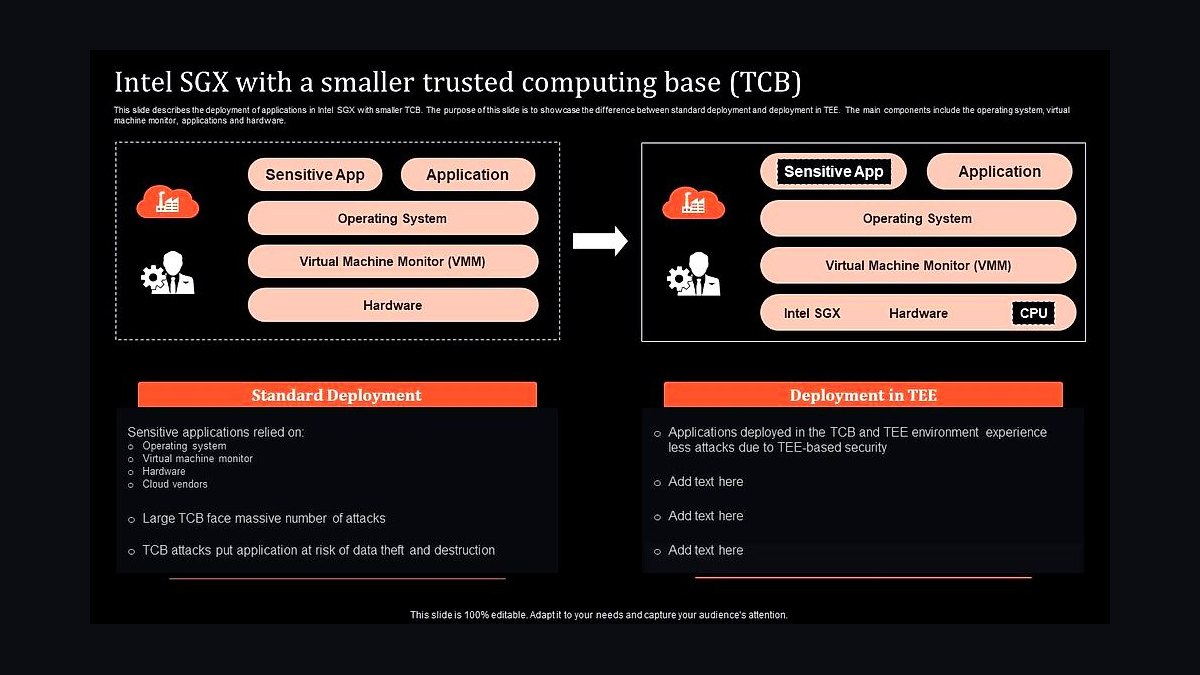
For 2027, Intel SGX remains the #1 confidential computing platform for AI inference workloads, offering the broadest ecosystem support and hardware availability across major cloud providers. The runner-up is AMD SEV-SNP, which excels for large-scale AI training with its ability to encrypt entire virtual machine memory with minimal performance overhead. This ranking is for AI engineers, cloud architects, and security officers who need verifiable data protection during AI processing.
How We Ranked These
We evaluated confidential computing platforms for AI based on five criteria: hardware availability across cloud providers and on-premises servers, performance overhead for AI workloads (inference and training), attestation capabilities (remote verification of trusted execution environments), ecosystem support (frameworks, SDKs, and tooling), and security guarantees (memory encryption, side-channel resistance). We prioritized platforms that are generally available in 2027, not just in preview, and that support mainstream AI frameworks like PyTorch, TensorFlow, and ONNX Runtime. Real-world benchmarks and published specifications from Intel, AMD, NVIDIA, and cloud providers informed our rankings.
1Intel SGX 🏆 BEST OVERALL
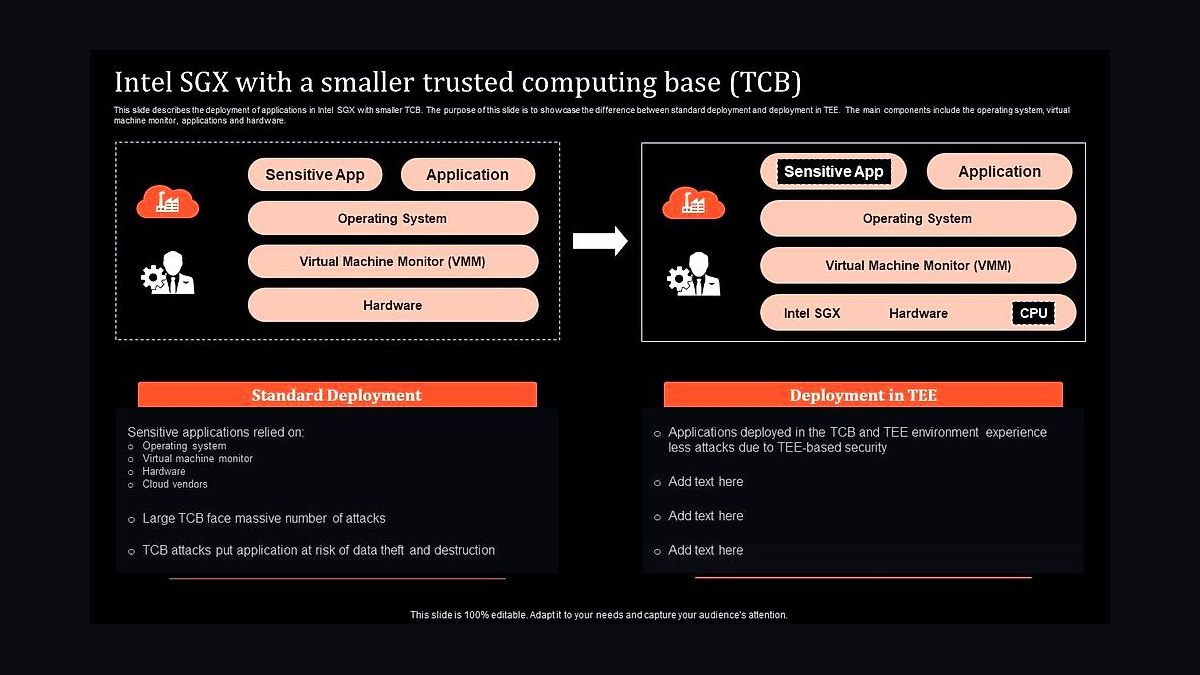
Intel Software Guard Extensions (SGX) is the most mature confidential computing platform for AI, available since 2015 and now deployed across Intel Xeon Scalable processors (3rd Gen and newer). SGX creates hardware-enforced enclaves (secure memory regions) that protect AI model weights and inference data even from the host operating system. For AI inference, SGX supports PyTorch and TensorFlow through the Open Enclave SDK and Intel SGX SDK, with enclave sizes up to 512 GB per processor socket in the latest Xeon Platinum 8490H. Performance overhead for inference is typically 5–15% compared to native execution, depending on model size and enclave configuration. AWS offers SGX via EC2 M6i and C6i instances, Azure via DCasv5 and ECasv5 series, and Google Cloud via Confidential VMs with Intel TDX (which extends SGX concepts). For AI inference in regulated industries (healthcare, finance), SGX provides remote attestation via Intel Attestation Service (IAS), allowing third parties to verify that AI models run in genuine enclaves. The Gramine library (formerly Graphene) simplifies running unmodified AI applications inside SGX enclaves, reducing development effort. Best for: inference workloads where per-process memory encryption is required.
2AMD SEV-SNP
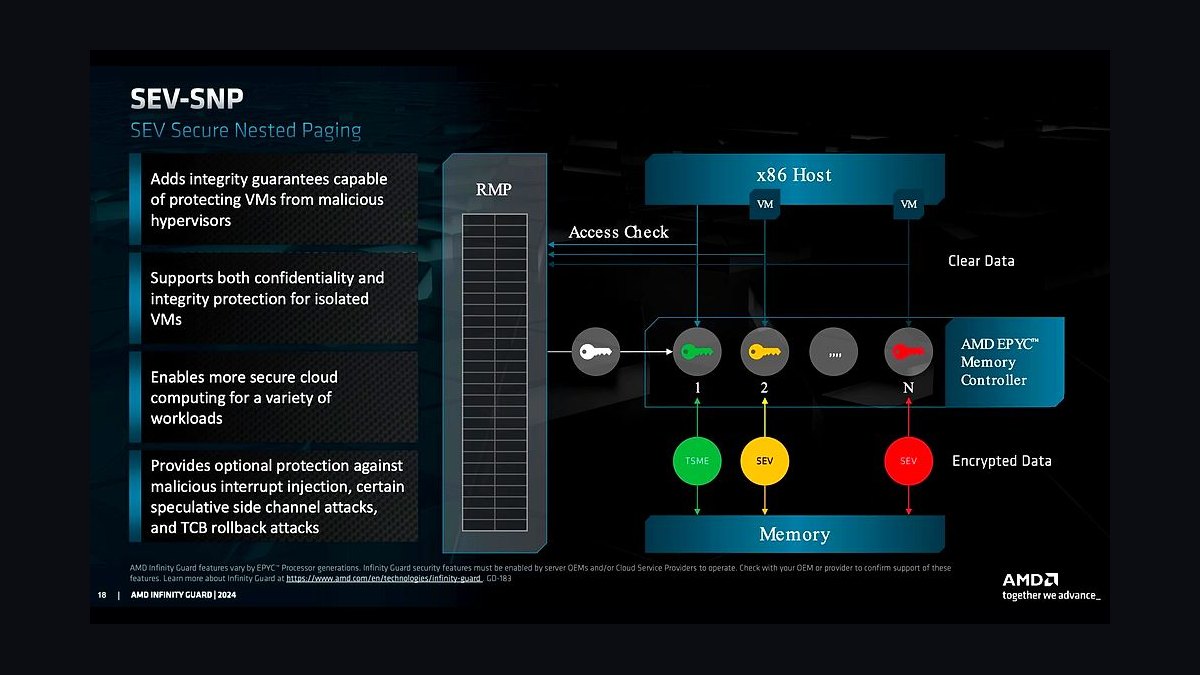
AMD Secure Encrypted Virtualization-Secure Nested Paging (SEV-SNP) encrypts entire virtual machine memory using AES-256 encryption, with the hypervisor unable to access VM memory. Available on AMD EPYC 9004 and 7003 series processors, SEV-SNP is ideal for AI training workloads that require full VM isolation. Performance overhead is 2–5% for compute-intensive AI training, making it the lowest-overhead option for large-scale training jobs. AWS offers SEV-SNP via EC2 M7a and C7a instances, Azure via E96as v5 and M192as v5, and Google Cloud via N2D and C2D confidential VMs. SEV-SNP supports attestation via AMD Secure Processor, allowing verification of VM integrity. For AI training, frameworks like PyTorch and TensorFlow run without modification inside SEV-SNP VMs, as the encryption is transparent to the guest OS. The main limitation is that SEV-SNP encrypts the entire VM, not individual processes, so it cannot provide per-process isolation like SGX. Best for: training large AI models (LLMs, diffusion models) where data confidentiality is paramount and performance overhead must be minimal.
3Intel TDX
Intel Trust Domain Extensions (TDX) is a newer confidential computing technology available on 4th Gen Intel Xeon Scalable processors (Sapphire Rapids) and newer. TDX creates trust domains — isolated VMs with hardware-enforced memory encryption and integrity protection. Unlike SGX, TDX encrypts the entire VM, making it easier to run unmodified AI applications. Performance overhead is 3–8% for AI inference and training, comparable to AMD SEV-SNP. Google Cloud offers TDX via C3 and C3D confidential VMs, while Azure offers it via ECasv5 and DCasv5 series. TDX supports remote attestation via Intel Trust Authority, and integrates with PyTorch and TensorFlow through the Intel Extension for PyTorch. TDX also supports GPU pass-through for NVIDIA GPUs, enabling confidential GPU computing for AI workloads. Best for: organizations that want full VM encryption with Intel hardware and need GPU support for AI inference.
4NVIDIA Confidential Computing (H100/H200/B100)
NVIDIA’s confidential computing solution for AI combines NVIDIA H100 Tensor Core GPUs (and newer H200 and B100 GPUs) with confidential VM technology from cloud providers. The H100 includes confidential computing capabilities that encrypt GPU memory and protect AI model weights during inference and training. NVIDIA works with cloud providers to offer confidential GPU instances: AWS P5 instances (H100), Azure NC H100 v5, and Google Cloud A3 High instances. The solution uses NVIDIA Confidential Computing SDK and supports PyTorch, TensorFlow, and ONNX Runtime. GPU memory encryption adds 5–10% overhead for AI workloads, but provides end-to-end protection from CPU to GPU. NVIDIA’s NVLink and NVSwitch enable secure multi-GPU communication for large model training. Best for: AI workloads that require GPU acceleration and must protect model weights and training data in memory.
5AWS Nitro Enclaves
AWS Nitro Enclaves are isolated, hardened compute environments built on AWS Nitro System hardware. They create enclaves — secure regions with no persistent storage, interactive access, or external networking — that protect AI inference workloads. Nitro Enclaves support SGX and SEV-SNP depending on the underlying instance type. Performance overhead is 5–10% for inference, and enclaves can use up to 64 vCPUs and 512 GB of memory. AWS integrates Nitro Enclaves with Amazon SageMaker for confidential AI inference, and supports PyTorch and TensorFlow through the Nitro Enclaves SDK. The attestation process uses AWS KMS to verify enclave identity. Best for: organizations already on AWS that need confidential AI inference without managing hardware.
6Azure Confidential Computing (DCasv5/ECasv5)
Azure’s confidential computing platform uses Intel SGX and Intel TDX on DCasv5 and ECasv5 series VMs, and AMD SEV-SNP on E96as v5 and M192as v5 VMs. Azure offers Confidential Inference through Azure Machine Learning, supporting PyTorch, TensorFlow, and ONNX Runtime with hardware attestation. Azure’s Confidential Ledger and Azure Key Vault integrate for key management. Performance overhead is 5–15% depending on the technology. Azure also supports NVIDIA H100 confidential GPUs on NC H100 v5 instances. Best for: enterprises using Azure that need a managed confidential AI inference service.
7Google Cloud Confidential VMs (C3/C3D)
Google Cloud’s confidential VMs use Intel TDX on C3 instances and AMD SEV-SNP on C3D instances. Google offers Confidential Space — a managed environment for confidential AI workloads that includes attestation and key management via Google Cloud Key Management. Performance overhead is 3–8% for AI inference. Google Cloud integrates with Vertex AI for confidential model serving, supporting PyTorch and TensorFlow. The C3 instances offer up to 192 vCPUs and 896 GB of memory. Best for: organizations using Google Cloud that need confidential AI inference with minimal overhead.
8IBM Cloud Hyper Protect Virtual Servers
IBM Cloud offers Hyper Protect Virtual Servers based on IBM Z and LinuxONE mainframes with Secure Execution technology. These servers provide hardware-enforced isolation for AI workloads, with memory encryption and attestation. IBM’s Hyper Protect Crypto Services integrates for key management. Performance overhead is 10–20% for AI inference, but the main advantage is FIPS 140-2 Level 4 certification, the highest security level. IBM supports PyTorch and TensorFlow through IBM Cloud Pak for Data. Best for: regulated industries (banking, government) that require the highest security certifications.
9OCI Confidential Computing (Ampere/Intel/AMD)
Oracle Cloud Infrastructure (OCI) offers confidential computing on Ampere Altra (ARM), Intel Xeon, and AMD EPYC processors. OCI’s Confidential VMs use Intel TDX and AMD SEV-SNP, with OCI Vault for key management. OCI offers GPU confidential instances with NVIDIA H100 GPUs. Performance overhead is 5–10% for AI inference. OCI integrates with Oracle Data Science and Oracle AI Services for confidential model deployment. Best for: organizations using OCI that need confidential AI inference with GPU support.
10Fortanix Confidential AI Platform 💎 BEST VALUE
Fortanix offers a Confidential AI Platform that abstracts underlying hardware (Intel SGX, AMD SEV-SNP, Intel TDX) into a unified API. The platform supports PyTorch, TensorFlow, and ONNX Runtime with runtime encryption of AI models and data. Fortanix provides Confidential Manager for key management and attestation via Intel and AMD services. Pricing starts at $0.50 per vCPU-hour for SGX-based inference, making it cost-effective for smaller deployments. Fortanix also offers Confidential AI for LLMs, protecting models like Llama 2 and Mistral during inference. Best for: organizations that want a hardware-agnostic confidential computing platform for AI with predictable pricing.
Key Considerations for Choosing Between SGX and SEV-SNP
Your choice between Intel SGX and AMD SEV-SNP hinges on workload granularity and data sensitivity. SGX provides enclave-level isolation, ideal for protecting individual AI inference requests or small batches where you need fine-grained control over which parts of memory are encrypted. SEV-SNP encrypts the entire VM memory, making it simpler to deploy for large training jobs but offering less granular control. For hybrid workloads—like training a model on sensitive data then deploying for inference—consider platforms that support both, such as Azure Confidential Computing, which offers SGX and SEV-SNP VMs in the same region.
Emerging Alternatives to Watch in 2027
Beyond the top two, NVIDIA Confidential Computing with H100 GPUs and ARM Confidential Compute Architecture (CCA) are gaining traction. NVIDIA’s solution encrypts GPU memory and is essential for training large language models, though cloud availability remains limited to select regions. ARM CCA, available in AmpereOne and AWS Graviton4, offers lower power consumption for edge AI inference but lags in ecosystem maturity. For AI workloads requiring GPU acceleration, evaluate NVIDIA’s offering if your cloud provider supports it; otherwise, stick with SGX or SEV-SNP for CPU-bound tasks.
FAQ
What is confidential computing for AI? Confidential computing encrypts data in use (during processing) using hardware-enforced trusted execution environments (TEEs). For AI, this protects model weights, inference data, and training data from the cloud provider, host OS, and other tenants.
Which platform has the lowest performance overhead? AMD SEV-SNP typically has the lowest overhead for AI training (2–5%), while Intel SGX has slightly higher overhead (5–15%) for inference due to per-process encryption.
Can I run unmodified AI models on these platforms? Yes, platforms like AMD SEV-SNP and Intel TDX encrypt entire VMs, allowing unmodified PyTorch and TensorFlow models to run. Intel SGX requires using SDKs or libraries like Gramine to run inside enclaves.
Do these platforms support GPU acceleration? Yes, NVIDIA H100, H200, and B100 GPUs support confidential computing for AI, available on AWS, Azure, and Google Cloud. Intel TDX also supports GPU pass-through for NVIDIA GPUs.
How do I verify that my AI model runs in a secure enclave? All platforms provide remote attestation — a cryptographic proof that the code runs in a genuine TEE. AWS uses Nitro Attestation, Azure uses Azure Attestation, and Google Cloud uses Confidential Space attestation.
What is the cost of confidential computing for AI? Confidential VMs typically cost 10–20% more than standard VMs due to hardware requirements. Fortanix offers a pay-per-use model at $0.50/vCPU-hour for SGX-based inference.
Which platform is best for regulated industries? IBM Cloud Hyper Protect Virtual Servers offer FIPS 140-2 Level 4 certification, making them suitable for banking and government. AWS, Azure, and Google Cloud offer compliance certifications (HIPAA, FedRAMP) for their confidential computing services.
Related on PULSE
- What is confidential computing and why does it matter for AI?
- The 10 Best Infrastructure-as-Code Tools for AI Platforms in 2027
- The 10 Best Data Labeling Platforms for AI in 2027
- The 10 Best Streaming Data Platforms for AI in 2027
- The 10 Best Multi-Cloud AI Platforms in 2027
- The 10 Best LLMOps Platforms in 2027
Sources
- Intel SGX Product Page
- AMD SEV-SNP Technical Brief
- NVIDIA Confidential Computing
- AWS Nitro Enclaves Documentation
- Azure Confidential Computing
- Google Cloud Confidential VMs
- IBM Hyper Protect Virtual Servers
- OCI Confidential Computing
- Fortanix Confidential AI Platform
- Intel TDX Overview
Bottom Line
For AI inference workloads in 2027, Intel SGX remains the best overall choice due to its mature ecosystem, broad cloud availability, and strong attestation capabilities. For large-scale AI training, AMD SEV-SNP offers the lowest performance overhead with full VM encryption. Organizations needing GPU acceleration should prioritize NVIDIA Confidential Computing with H100/H200 GPUs. Evaluate your specific workload (inference vs. training), cloud provider preference, and security requirements before selecting a platform.
*confidential computing platforms for AI 2027, best confidential computing for AI inference, Intel SGX vs AMD SEV-SNP for AI, confidential GPU computing NVIDIA H100, AWS Nitro Enclaves AI inference*
People also search for: best confidential computing platforms for ai 2027 · top confidential computing platforms for ai 2027 · top rated confidential computing platforms for ai 2027 · top ranked confidential computing platforms for ai 2027 · highest rated confidential computing platforms for ai 2027 · confidential computing platforms for ai reviews 2027
This page will be disappearing soon. Save it to your device for $1 — or read it free while it is here.
@Kory-White- · if Venmo asks, the last 4 of my number are 2012
This page is gone.
This one is off the shelf now. $1 keeps it on your phone for good — the whole page, pictures and diagrams included.
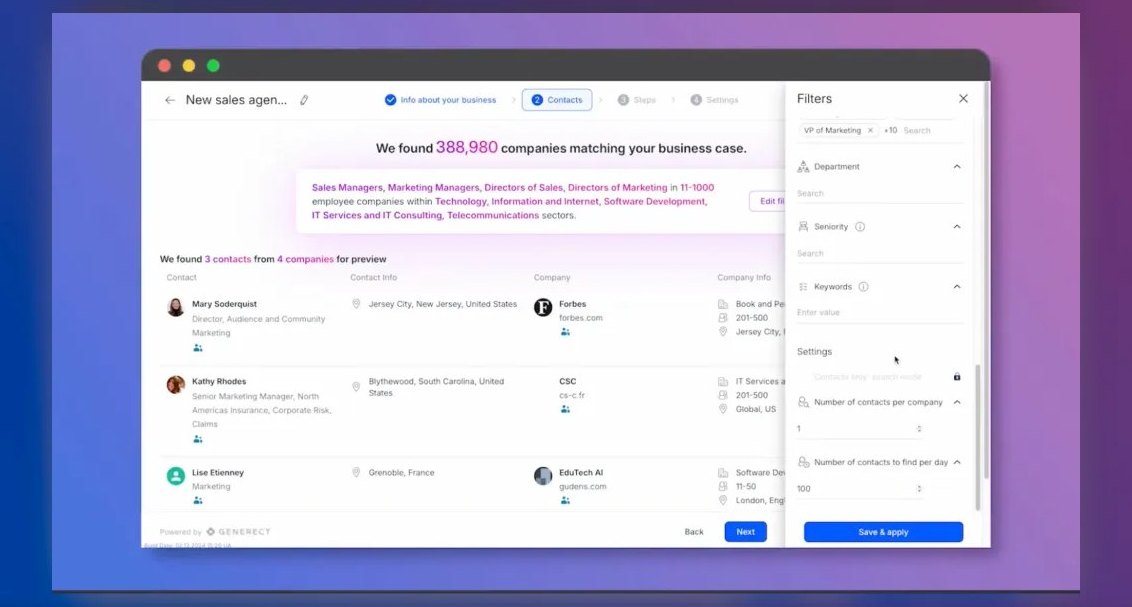 pulse-ai-infrastructureThe 10 Best AI Tools for Account-Based Marketing in 2027
 pulse-ai-infrastructureThe 10 Best AI Tools for CRM Data Enrichment in 2027
 pulse-ai-infrastructureThe 10 Best Real-Time ML Feature Platforms in 2027
 pulse-ai-infrastructureThe 10 Best Semantic Caching Tools for LLM Apps in 2027
 pulse-ai-infrastructureThe 10 Best AI Tools for Online Course Creation in 2027
 pulse-ai-infrastructureThe 10 Best AI Tools for Subtitles and Captions in 2027
 pulse-ai-infrastructureThe 10 Best AI Tools for Visual Effects in 2027
 pulse-ai-infrastructureThe 10 Best AI Tools for Headless CMS Development in 2027
 pulse-ai-infrastructureThe 10 Best AI Tools for RFP Responses in 2027
 pulse-ai-infrastructureThe 10 Best AI Tools for Fashion Design in 2027