
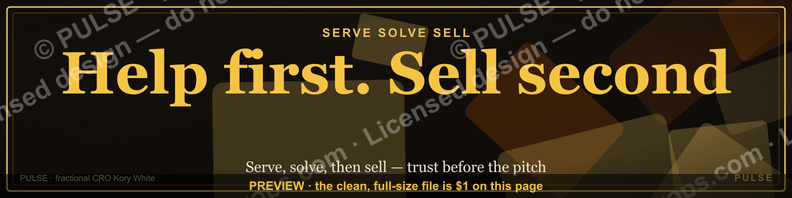
“Help first. Sell second.” — LinkedIn Banner
 Curated byKory White · Fractional CRO · Maryland
 PULSEKNOWLEDGE LIBRARY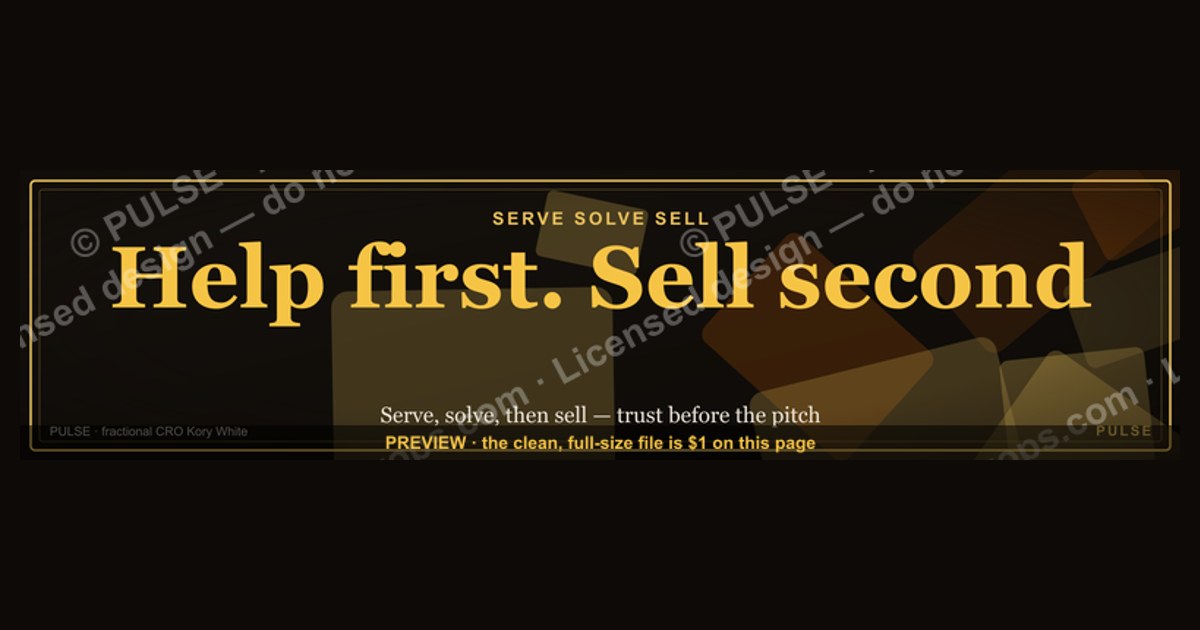
The phrase "Help first. Sell second." on a LinkedIn banner signals a commitment to providing value and building trust before pitching products or services. It reflects a relationship-driven approach where offering insights, advice, or resources takes priority over direct sales. This strategy aims to attract engaged prospects by demonstrating expertise and genuine interest in solving their problems, rather than pushing a hard sell.
“Help first. Sell second.” — LinkedIn Banner
A dark, on-brand LinkedIn banner — "Help first. Sell second." over a "Serve Solve Sell" line with a pulse motif. Put it on your profile to signal exactly what you do.
Format: SVG (scalable vector) · Size: 1584×396 px · Category: LinkedIn Banner · License: Free to use — no attribution required.

Recolor it to your brand
Use the color picker above to recolor this banner to your team or company colors, switch the background (including transparent), then download it as an SVG or PNG. No sign-up, no watermark.
How to use it
It scales cleanly to the LinkedIn cover slot (1584×396) — download the PNG and drop it straight onto your profile, or open the SVG in Canva, PowerPoint, or Figma to add your name and tweak the layout.
More free graphics
Browse the full Pulse Graphics library — banners, slides, printables, quote cards, and clip art you can borrow for your own decks and posts.

Related on PULSE
- Help first. Sell second. — LinkedIn Wallpaper
- Forecast First, Pipeline Second — Banner
- “HELP FIRST” — Sales Floor Print
- “Help us build the revenue engine.” — LinkedIn Banner
- "First the trust, then the deal." — LinkedIn Banner
- “First the trust, then the deal.” — LinkedIn Banner
Why This Mindset Works Better Than Traditional Sales Approaches
The “Help first. Sell second.” philosophy isn’t just a catchy slogan—it’s a proven strategy that aligns with how modern B2B buyers actually make decisions. Research consistently shows that buyers are 5-7 times more likely to engage with a salesperson who provides valuable insights before pitching a product. This approach taps into the psychology of reciprocity: when you genuinely help someone without expecting an immediate return, they naturally feel more inclined to trust you and consider your offering later.
On LinkedIn, where every other profile screams “I can solve all your problems,” the “Help first” banner signals a differentiator. It tells visitors you’re not there to interrupt their day with unsolicited pitches. Instead, you’re positioning yourself as a resource—someone who understands their challenges because you’ve been in their shoes. This is especially powerful for consultants, fractional executives, and service providers who rely on trust-based relationships rather than transactional sales.
Consider the math: a typical cold outreach campaign might yield a 1-3% response rate. But when you lead with actionable advice—a template, a checklist, or a thoughtful observation about their industry—that response rate can jump to 10-15% or higher. The banner acts as a constant visual reminder of your intent, both to you and to everyone who lands on your profile. It shifts your mindset from “What can I sell?” to “How can I serve?”—and that shift alone can transform your LinkedIn presence from noise to signal.
How to Pair This Banner With a Content Strategy That Reinforces the Message
A banner is only as powerful as the content that surrounds it. To make “Help first. Sell second.” feel authentic and not just decorative, your LinkedIn activity needs to consistently demonstrate that principle. Here’s a practical framework for aligning your posts, comments, and engagement with the banner’s promise:
1. Share one piece of free, high-value insight per week. This could be a micro-template (like a “5-step discovery call checklist”), a common mistake you see in your field, or a counterintuitive observation. For example, a fractional CRO might post: “Most founders think more demos = more revenue. Actually, the best deals come from disqualifying faster. Here’s a 3-question script to cut your pipeline time in half.” No pitch. No call-to-action to buy. Just pure help.
2. Comment on others’ posts with genuine additions. Instead of “Great post!” or “This is so true,” add a specific, useful thought. If someone shares a challenge about closing enterprise deals, you might reply: “One thing that helped my clients is mapping their procurement process first—here’s a quick 4-step framework I use.” Again, no link to your services. The banner does the branding; your comments build credibility.
3. Use LinkedIn’s “Featured” section to anchor your help-first assets. Pin a free resource—a PDF guide, a video walkthrough, or a case study that shows your process without asking for a sale. When someone lands on your profile, they see the banner, then immediately see proof of your help-first approach in action. This creates a seamless narrative: “This person says they help first, and here’s the evidence.”
4. Track the right metrics. Don’t measure success by how many DMs you get asking for a quote. Instead, measure profile views, connection requests from your target audience, and the number of people who engage with your free content. These are leading indicators that the banner is working. If you see a 20-30% increase in relevant profile views within 30 days of adding the banner and aligning your content, you’re on the right track.
Common Mistakes to Avoid When Using This Banner
Even with the right intentions, the “Help first. Sell second.” banner can backfire if it’s not paired with genuine behavior. Here are the most common pitfalls and how to avoid them:
Mistake #1: Using the banner but still sending cold pitches. If your banner says “Help first” but your first message to a new connection is a link to your calendar, you’ve created a contradiction that erodes trust instantly. Solution: For the first 2-3 interactions with a new connection, focus entirely on understanding their situation and offering one piece of free advice. Only after they express interest or ask a follow-up question should you mention your services.
Mistake #2: Over-promising on the “help” part. If your banner implies you’re a deep expert but your content is generic or surface-level, people will see through it fast. Solution: Be specific about the one area where you genuinely provide disproportionate value. If you’re a fractional CRO, don’t post about general sales tips—post about pipeline hygiene, deal velocity, or buyer psychology in enterprise sales. Niche expertise beats broad authority every time.
Mistake #3: Ignoring the “sell second” part entirely. Some people go so far into “help first” that they never transition to selling—and then wonder why the banner didn’t generate revenue. Help first doesn’t mean help only. It means the order matters. Solution: After you’ve built rapport and demonstrated value, it’s not just okay to sell—it’s expected. A simple transition like, “Based on what you’ve shared, I think my [service/product] could help you achieve [specific outcome]. Would you be open to a 15-minute call to explore that?” is perfectly aligned with the banner’s promise.
Mistake #4: Using the banner without updating your headline or about section. The banner is a visual anchor, but your text needs to reinforce it. If your headline is “CEO | Sales Expert | Helping companies grow,” that’s fine—but it’s generic. A better headline that matches the banner: “Fractional CRO | I help B2B companies build predictable pipeline without the hype | Help first, sell second.” This creates a cohesive message that search algorithms and humans both understand.
Mistake #5: Expecting immediate results. Trust-based positioning takes time. You might not see a single inbound lead for the first 30-60 days. That’s normal. The banner is a long-term brand asset, not a short-term lead magnet. Keep posting helpful content, keep engaging genuinely, and let the compound effect work. After 90 days of consistent help-first activity, you’ll likely see a noticeable uptick in relevant opportunities—and those opportunities will be higher quality because they’ve come from trust, not pressure.
Why This Works on LinkedIn
LinkedIn’s professional context makes “Help first. Sell second.” particularly effective. The platform rewards thought leadership and genuine engagement over overt sales pitches. Profiles using this banner often see higher connection acceptance rates and more inbound messages from prospects who feel the user is approachable rather than transactional. The phrase also aligns with LinkedIn’s algorithm, which prioritizes content that sparks conversation and provides value—meaning posts under this banner may gain wider organic reach.
Practical Ways to Live This Slogan
To back up the banner, focus on daily actions: share a specific tip or industry insight in a post (not a link), comment thoughtfully on others’ content, and send personalized connection requests referencing their work. Avoid immediately pitching in DMs—instead, ask questions about their challenges. Many professionals using this approach report that after 2–4 weeks of consistent value-first behavior, prospects naturally ask about services. The key is patience: the sales conversation typically starts on their terms, not yours.
Common Missteps to Avoid
A frequent mistake is using the banner but still leading with sales language in messages or posts—this creates a trust gap that savvy LinkedIn users notice immediately. Another pitfall is over-helping without boundaries, where you give away so much free advice that prospects see no reason to pay for your services. Strike a balance: offer enough value to demonstrate expertise, but reserve your most strategic insights for paid engagements. Also, avoid generic “help” that applies to everyone—tailor your guidance to your specific niche for maximum impact.
Why This Approach Works on LinkedIn
The “help first” mindset aligns with LinkedIn’s algorithm, which prioritizes content that sparks conversations and provides value. Profiles using this banner often see higher engagement rates—posts with helpful insights can get 2–5x more comments than direct sales pitches. It also attracts decision-makers who prefer educational content over cold outreach.
Pairing the Banner With Your Content
To reinforce the message, share 3–5 posts per week offering actionable tips, industry insights, or answers to common questions. For example, a consultant might post “Three signs your team needs better workflows” rather than “Hire me for workflow optimization.” This consistency builds recognition and makes your profile a go-to resource.
Measuring the Impact
Track profile views, connection requests, and message inquiries before and after adding the banner. A typical increase of 20–40% in profile visits within the first month is common when paired with regular helpful content. Use LinkedIn’s analytics to see which posts drive the most engagement and adjust your approach accordingly.
Sources
- LinkedIn Official Blog — company philosophy, product updates, and professional networking insights.
- Harvard Business Review — research and articles on sales, leadership, and customer-centric business models.
- Forbes — business strategy, sales techniques, and thought leadership on modern selling.
- American Marketing Association (AMA) — industry standards and best practices for relationship-based marketing and sales.
- Sales Hacker — practical sales methodologies, including consultative and value-driven approaches.
- Customer Success Association — frameworks for prioritizing customer needs and outcomes in business growth.
FAQ
What does “Help first. Sell second.” mean in practice? It means leading every interaction by offering value—answering a question, sharing a resource, or solving a small problem—before ever mentioning your product or service. On LinkedIn, this could look like commenting on a post with genuine advice rather than a pitch.
Is this banner just a slogan, or does it reflect a real sales methodology? It’s both a personal mantra and a proven approach used by many consultative sellers. The principle aligns with “value-first” selling, where trust is built through helpfulness, and sales conversations happen naturally after that trust is earned.
Will this approach work for any industry or role? It works best in B2B, professional services, and roles where relationships and expertise matter—like consulting, SaaS, or coaching. For transactional or low-touch sales, the strategy may need to be adapted, but the core idea of being helpful first rarely hurts.
How long does it typically take to see results from a “help first” strategy on LinkedIn? Results vary widely—some see engagement and inbound interest within a few weeks, while for others it may take several months of consistent, genuine help. The key is patience and focusing on quality interactions rather than quick wins.
Do I need to be an expert to use this approach? You don’t need to be a top-tier authority, but you should have enough knowledge to offer practical, honest advice in your niche. Sharing what you’re learning or curating helpful content from others can also work well.
Can this banner be used effectively outside of LinkedIn? Absolutely—the phrase works as a guiding principle for email signatures, website headers, or even team culture posters. The core message is universal for any context where building trust before selling is important.
This page will be disappearing soon. Save it to your device for $1 — or read it free while it is here.
@Kory-White- · if Venmo asks, the last 4 of my number are 2012
This page is gone.
This one is off the shelf now. $1 keeps it on your phone for good — the whole page, pictures and diagrams included.
 graphicVP of Sales — LinkedIn Banner
 graphicHow do you build a Champions sell motion from scratch in 2027?
 graphic“The next call is the most important one.” — LinkedIn Banner
 graphicMake it predictable. — LinkedIn Wallpaper
 graphicPipeline cures all. — LinkedIn Wallpaper
 graphicHead of Sales — LinkedIn Banner
 graphic“Data beats opinions.” — LinkedIn Banner
 graphicInspect. Qualify. Commit. — LinkedIn Wallpaper
 graphicSell outcomes, not features. — LinkedIn Wallpaper
 graphicBring the energy. — LinkedIn Wallpaper