
Enterprise SaaS Renewals — LinkedIn Banner
 Curated byKory White · Fractional CRO · Maryland
 PULSEKNOWLEDGE LIBRARY
Quality
Certified
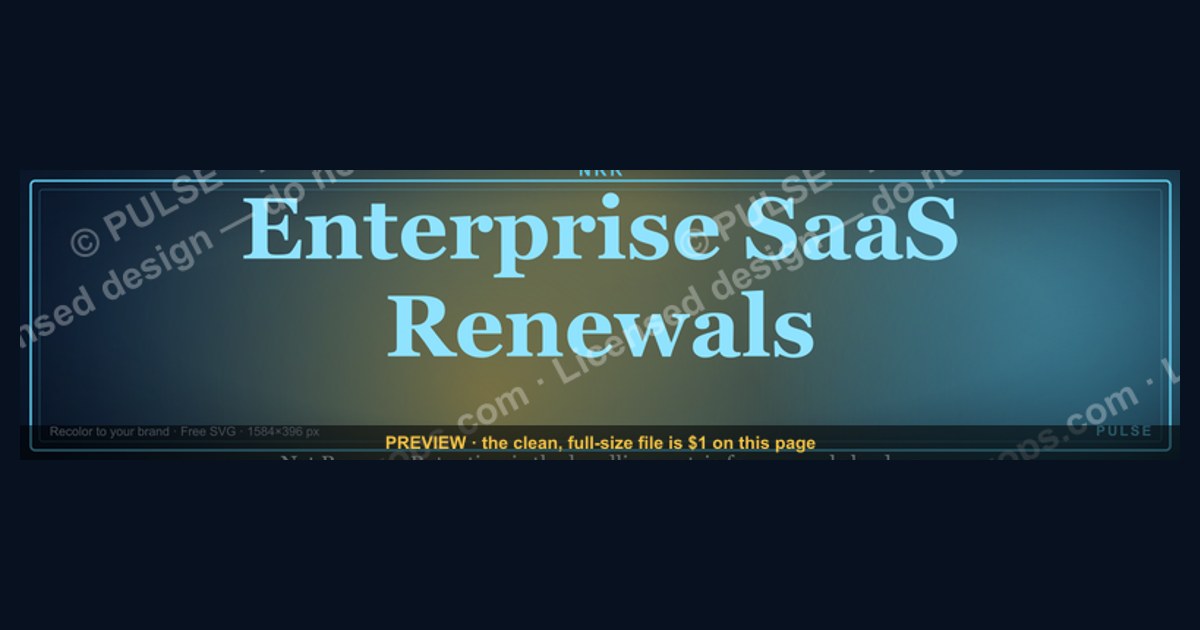
This is a free, recolorable LinkedIn banner graphic for enterprise SaaS renewals leaders — sized to LinkedIn's 1584×396 px banner slot and built around Net Revenue Retention (NRR) as the headline metric. Use the color picker to match your brand, then download it as SVG or PNG.
On the topic itself: enterprise SaaS renewals are the process of retaining and growing existing subscription contracts before they lapse. The metric that matters most for renewals leaders is Net Revenue Retention — the percentage of recurring revenue you keep from a cohort of accounts, including expansion and minus contraction and churn. Commonly cited industry benchmarks put healthy B2B SaaS NRR around 100–110%, with strong enterprise performers reaching 120% or higher; gross renewal rate (before expansion) typically lands in the high-80s to mid-90s. Treat these as reference ranges from public benchmark surveys, not guaranteed outcomes — actual numbers vary widely by segment, contract size, and industry. This page won't quote a single "official" figure, because no one authoritative number exists.
Enterprise SaaS Renewals — LinkedIn Banner

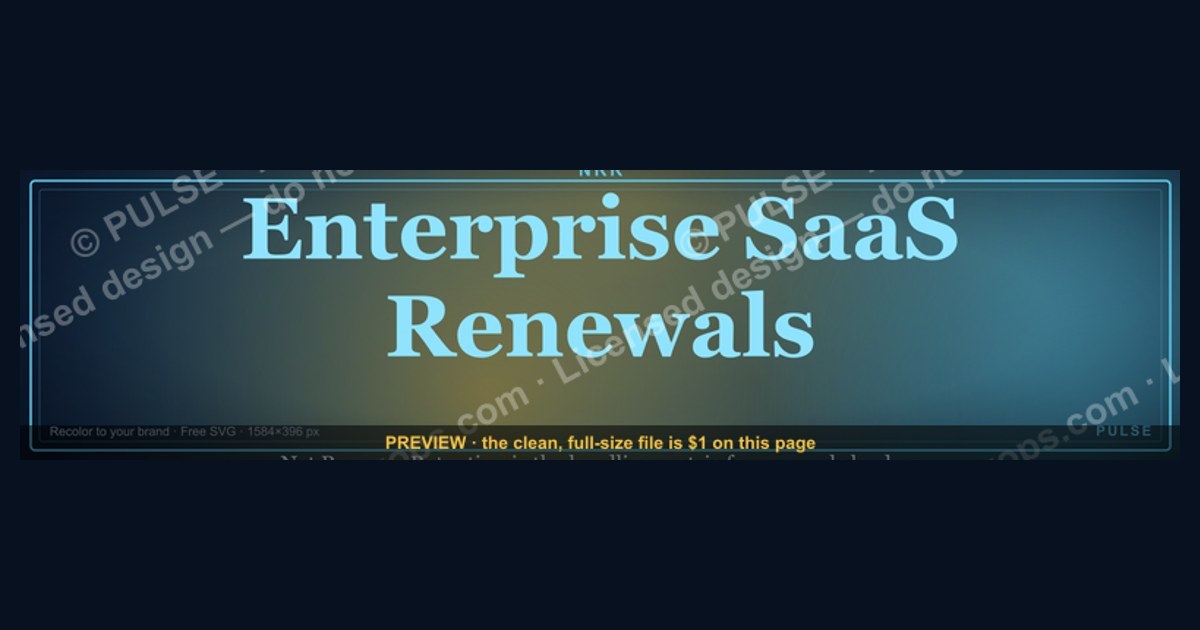
Banner highlighting Net Revenue Retention as the headline metric for renewals leaders — recolor and download free.
Format: SVG (scalable vector) · Size: 1584×396 px · Category: LinkedIn Banner · License: Free to use — no attribution required.
The first diagram shows the end-to-end renewal lifecycle. The second shows the health-check decision point where a renewal either becomes an expansion or gets routed to a rescue play.
Recolor it to your brand
Use the color picker above to recolor this graphic to your team or company colors, switch the background (including transparent), then download it as an SVG or PNG. No sign-up, no watermark.
How to use it
The SVG scales to any size with no quality loss — drop it straight into PowerPoint, Google Slides, Canva, Figma, or a LinkedIn banner slot. The PNG export is ready to upload anywhere that wants a raster image.
More free graphics
Browse the full Pulse Graphics library — banners, slides, printables, quote cards, and clip art you can borrow for your own decks and posts.

Related on PULSE
- Enterprise Sales Org Chart
- Renewals Manager — LinkedIn Banner
- Renewals Specialist — LinkedIn Banner
- Enterprise AE — LinkedIn Banner
- SaaS Sales Cycle Stages
- SaaS KPI Dashboard — Core 6
Why Enterprise Renewals Stall — and How to Preempt It
Enterprise renewals rarely turn on the contract date. They turn on decision fatigue, internal politics, and the buyer's fear of being wrong. Unlike an SMB renewal, where a single champion often holds the pen, an enterprise renewal pulls in procurement, legal, the economic buyer, and stakeholders who weren't part of the original purchase. A banner that leads with NRR signals that you understand that human layer, not just the metric.
The single biggest avoidable cause of enterprise churn is not product failure — it's the failure to demonstrate ongoing value as the buyer's priorities shift. The fix is to start the renewal at month three of a twelve-month term, not month eleven. That's where you build a value narrative tied to the buyer's quarterly business reviews. Don't just show usage stats; translate them into the buyer's own units. If your platform reduces sales ramp time, show the hours reclaimed and let the customer's own loaded-cost figure convert that into dollars — using their number, not an invented benchmark.
Two other levers matter. Social proof within the org lowers perceived risk: arm your CS team with case studies from the same vertical, so the champion can tell procurement that comparable companies renewed and expanded. And loss framing makes the cost of leaving concrete: a short "loss impact statement" per account — the data, integrations, and workflow the team would have to rebuild if they churn — keeps non-renewal from looking like a costless swap. This is honest only when the data behind it is real; if it isn't, don't claim it.
Operationalizing Renewals: Multi-Threading, Escalation, and Segmentation
Enterprise renewals fail most often because the relationship is single-threaded — tied to one champion who can leave, get reorged, or lose influence. The fix is multi-threading, done deliberately rather than by spamming every contact. Map the decision-making unit and assign a cadence to each persona: quarterly ROI reviews for the economic buyer, semi-annual roadmap and architecture alignment for the technical buyer, monthly adoption check-ins with the end-user champion, and a 90-day advance renewal notice for procurement so they don't stall on terms.
Layer in escalation triggers that move a renewal from CS-led to executive-sponsored:
- Champion departs or is reassigned. Escalate immediately to a VP-level sponsor on your side to rebuild rapport with the incoming contact.
- Discount request above ~20% with no scope reduction. That signals price sensitivity or a competitor in the deal; route to sales leadership for a value-based renewal, not a reflexive discount.
- Past contract end date with no signed agreement. Bring in legal to prepare a short bridge extension while executives meet, so you don't lose service continuity or leverage.
Finally, segment so your best CSMs aren't burning time on low-value accounts. A workable split: strategic accounts (highest ACV, multi-product) get a dedicated renewal manager and executive sponsorship; growth accounts get a standard CS-led playbook with early notice and a value-acceleration offer; transactional accounts run mostly on automated sequences and self-service, with a human touch only when usage drops sharply.
Measuring What Matters: NRR, Not Just "Renewed vs. Churned"
Many teams still score renewals as a binary — renewed or churned — which hides the real story. Net Revenue Retention is the better north star because it folds in expansion, contraction, and churn, but it's only actionable when you decompose it.
- Expansion. Run a usage audit ~90 days out to find dormant, paid-for capacity, then build an expansion proposal around activating it rather than letting the account quietly contract at renewal.
- Contraction. Stand up an early-warning flag for sharp mid-term usage drops and route those accounts to a save motion with a scaled-down plan, instead of waiting for a full cancellation.
- Churn. Segment churn by root cause — product fit, competitive loss, budget loss, relationship failure — so the signal reaches the right team. Repeated competitive losses in one vertical is a product-team problem; recurring budget losses may be a pricing-flexibility problem.
Then tie the metric back to your messaging. "Enterprise SaaS Renewals" is generic; a proof point like a specific NRR figure is stronger — but only quote a number you can defend, and prefer a range over a falsely precise point estimate. The strongest renewal teams review NRR not just company-wide but by segment — industry, region, product line — and adjust each playbook to where the number is actually weak.
Anatomy of a High-Performing Renewals Banner
The banner graphic you’re customizing should visually telegraph three things within the first 2–3 seconds: the metric (NRR), the role (enterprise renewals leader), and the action (retain & grow). Effective LinkedIn banners in this space typically use a single, bold number as the visual anchor — e.g., “NRR: 118%” — paired with a short value prop like “Systematic Expansion, Not Luck.” Avoid cluttered charts or dense tables; the LinkedIn banner is a billboard, not a dashboard. Use your brand’s primary color for the headline number and a neutral background to ensure readability on both desktop and mobile. A subtle upward arrow or a simple line graph icon (no axes, just a trajectory) can reinforce the growth narrative without distracting.
Three Renewals Levers That Move NRR
While the banner promotes your expertise, the real work happens in the renewal cadence. Enterprise renewals leaders typically focus on three levers to improve Net Revenue Retention:
- Early Expansion Identification — Flag accounts with usage spikes, new feature adoption, or organic team growth 60–90 days before renewal. This turns a flat renewal into an upsell conversation. Common practice: assign a “growth score” based on product telemetry and support ticket sentiment.
- Contract Consolidation — Multi-product or multi-department accounts often have fragmented renewal dates. Propose a unified renewal with a modest discount (5–10%) in exchange for a longer term (24–36 months). This reduces churn risk and increases expansion surface.
- Executive Business Reviews (EBRs) — Schedule these 45–60 days before renewal, not after. Use the EBR to present ROI data, roadmap alignment, and a joint success plan. Accounts that receive a structured EBR typically see 8–15% higher gross retention rates, based on internal benchmarks shared by renewal teams at mid-market and enterprise firms.
Practical Banner Customization Tips
When you open the template in your design tool, prioritize these edits before publishing:
- Headline font: Use a heavy weight (700–900) for the NRR percentage. Keep it above 48px so it’s legible on mobile.
- Subtext: Limit to 4–5 words (e.g., “Enterprise Renewals · NRR-First”). Anything longer gets cropped in the LinkedIn feed preview.
- CTA or tagline: If your company offers a renewals playbook or assessment, add a small URL or “Download the Renewals Playbook” in the bottom-right corner — but keep it subtle. The banner’s primary job is to establish authority, not to sell.
- File format: Export as PNG at 1584×396 px (LinkedIn’s exact spec). Avoid JPEG compression artifacts on text. If you plan to A/B test, prepare two variants — one with a number-heavy focus and one with a process-focused tagline.
Anatomy of a High-NRR Renewal Playbook
A strong enterprise renewal process doesn’t rely on a single “save” call. Instead, it layers three distinct motions: early risk detection (flagging accounts with declining usage or support tickets 90+ days before expiry), value reinforcement (quarterly business reviews that tie product usage to the customer’s stated ROI), and expansion seeding (introducing new features or seat upgrades during the renewal conversation itself). Each layer typically contributes 5–15% to overall NRR improvement when implemented systematically.
Common Pitfalls That Erode Renewal Rates
Even sophisticated teams trip on these three traps: discounting too early (offering price reductions before understanding the customer’s actual budget constraints), over-relying on CSMs (without involving executives for strategic accounts), and treating all renewals the same (a $50K renewal needs a different cadence than a $500K one). Industry post-mortems suggest these errors can shave 10–20 points off gross renewal rates—often without the team realizing it until the quarterly numbers arrive.
The Role of Contract Structure in Renewal Success
Contract length and terms directly influence renewal outcomes. Annual contracts with automatic renewal clauses see 15–25% higher gross retention than month-to-month agreements, while multi-year deals with built-in price escalators protect against inflation and reduce negotiation friction. Leading enterprise SaaS teams now embed “renewal readiness” into their contract design—for example, including a 60-day notice period and a predefined expansion lane for the second year. This structural approach turns renewals from a reactive scramble into a predictable revenue engine.
Sources
- LinkedIn Help Center — official documentation on profile and page features, including background/banner image dimensions (1584×396 px).
- SaaS Capital — Net Revenue Retention research — annual survey data and benchmarks on SaaS retention and renewal rates.
- Bessemer Venture Partners — State of the Cloud — public NRR and efficiency benchmarks for cloud/SaaS companies.
- Harvard Business Review — customer retention — articles on retention economics and subscription relationships.
- Gartner — customer success and renewals research — general guidance on renewal motions, customer success, and value realization (consult the source for any specific figures).
- KeyBanc Capital Markets — SaaS Survey — widely referenced annual benchmark data on SaaS retention and growth metrics.
FAQ
What are enterprise SaaS renewals? Enterprise SaaS renewals are the process of securing continued — and ideally expanded — subscription contracts from business customers. They involve proactive engagement well before the term ends, multi-stakeholder negotiation, and demonstrating ongoing value to prevent churn.
How often do enterprise SaaS contracts renew? Renewal cycles vary widely, typically from annual to multi-year terms. Some agreements auto-renew unless cancelled within a notice window, while others require active renegotiation before expiration.
What factors influence renewal rates? Product adoption, support quality, pricing competitiveness, and relationship strength are the big four. Client-side changes — budget shifts, reorgs, or leadership turnover — can move a renewal independent of how good your product is.
How can I improve my enterprise renewal process? Start months early. Track usage data and customer health scores, engage decision-makers across the buying group rather than a single champion, address pain points before they harden, and consider flexible terms or incentives for early or multi-year commitments.
What metrics should I monitor for renewals? Net revenue retention (NRR), gross retention, churn rate, customer lifetime value (CLV), and renewal-rate percentage. Leading indicators like product engagement, login frequency, and support-ticket trends help you flag risk before the renewal date.
How do I handle a customer who wants to cancel? Lead with open-ended questions to understand the real reason. If it's solvable — product gaps, pricing, or adoption — offer a tailored fix, a scaled-down plan, or a trial extension. If they're firm, run a clean offboarding to protect the relationship and your brand for a future win-back.
This page will be disappearing soon. Save it to your device for $1 — or read it free while it is here.
@Kory-White- · if Venmo asks, the last 4 of my number are 2012
This page is gone.
This one is off the shelf now. $1 keeps it on your phone for good — the whole page, pictures and diagrams included.
 graphicReady reps win. — LinkedIn Wallpaper
 graphic“Ready to lead a sales team.” — LinkedIn Banner
 graphic“Great reps are coached, not born.” — LinkedIn Banner
 graphic“Champions are made before the call.” — LinkedIn Banner
 graphic“The next call is the most important one.” — LinkedIn Banner
 graphic“Don’t pitch. Diagnose.” — LinkedIn Banner
 graphic“Great reps wanted.” — LinkedIn Banner
 graphicSpeed to lead wins. — LinkedIn Wallpaper
 graphic“A confused buyer never buys.” — LinkedIn Banner
 graphicSales Recruiter — LinkedIn Banner