
“Plans are nothing. Reps are everything.” — LinkedIn Banner
 Curated byKory White · Fractional CRO · Maryland
 PULSEKNOWLEDGE LIBRARY
Quality
Certified
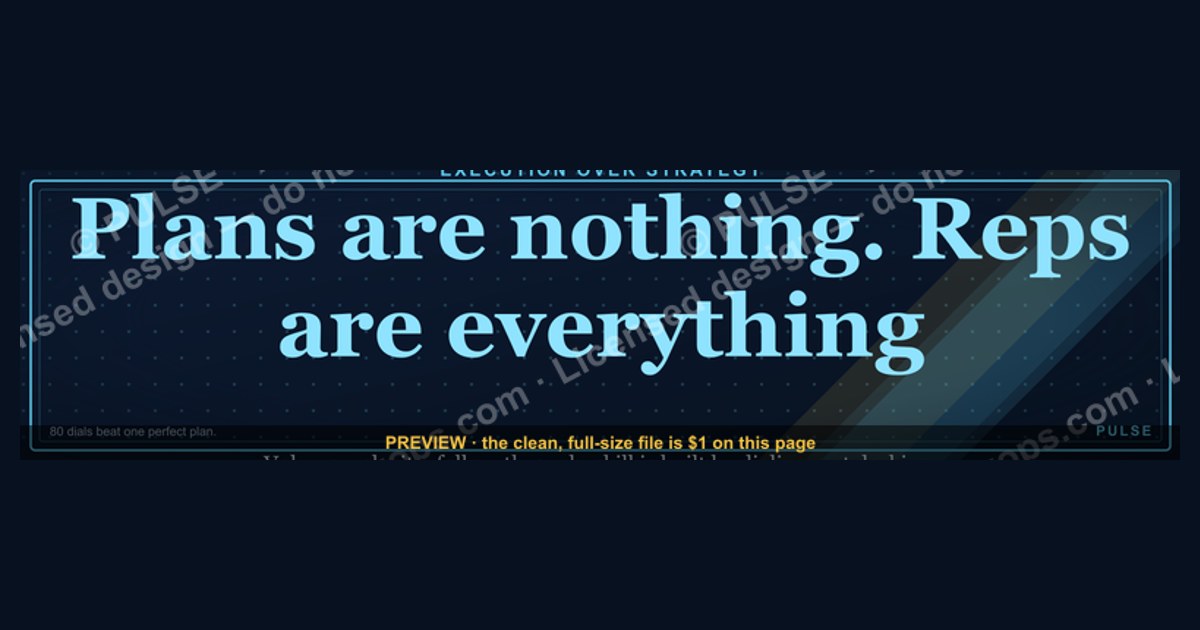
This LinkedIn Banner signals that the profile owner prioritizes execution over strategy, believing repeated action builds skill and results more effectively than planning alone. It remixes Eisenhower's "plans are worthless, but planning is indispensable" into a modern execution-culture mantra, positioning the user as a practitioner who values volume, follow-through, and learning through doing rather than abstract strategizing.
The two mindsets compared
The Banner represents a deliberate choice between two competing professional philosophies. The first is the execution-first mindset: prioritize volume, velocity, and action above all else. A sales development representative following this path might make 80 to 100 outbound calls daily, track every outcome in a spreadsheet, and measure success purely by activity metrics — dials, emails sent, meetings booked. This approach works best in high-velocity environments where the law of large numbers applies: more attempts mean more opportunities, and statistical probability eventually favors the persistent. The second is the planning-first mindset: invest heavily in strategy, research, and preparation before taking action. A strategic account executive might spend two weeks building a territory plan, researching each prospect's company, mapping decision-makers, and crafting personalized outreach sequences before making a single call. This approach excels in complex B2B sales where deal sizes exceed $50,000 and the cost of a misstep is high — one wrong message to a C-suite executive can burn a relationship that took months to build. The Banner explicitly champions the first mindset, but the most effective professionals in practice operate somewhere in the middle. A pure executionist burns out or builds bad habits; a pure planner never generates revenue. The sweet spot is a lightweight plan — no more than 20% of your time — followed by rapid, feedback-rich execution cycles.
The execution-first mindset thrives on the principle that everything compounds through repetition. Each call, each email, each LinkedIn message is a data point that refines your approach. Over 90 days, a rep making 80 calls daily accumulates 7,200 data points — enough to identify which opening lines work, which objections recur, and which prospect personas convert. A planner making 20 carefully researched calls daily accumulates only 1,800 data points in the same period. The planner's data is higher quality per interaction, but the volume differential means the executionist learns patterns faster. This is why the Banner resonates most strongly in roles where learning speed directly correlates with revenue generation.

How to decide between them
The decision framework above helps you determine which side of the Banner's message applies to your situation. The critical question is whether volume is your primary lever for driving results. In sales development roles where the average conversion rate from call to meeting is 1-3%, making 100 calls instead of 50 directly doubles your expected meetings booked. In enterprise sales where deal cycles run 6-12 months and each interaction carries significant weight, a single poorly prepared call can set you back weeks — planning becomes essential. The Banner works best when your compensation model rewards volume. If your pay plan rewards meetings booked or demos completed, "reps are everything" is literally true for your paycheck. If your compensation depends on closing six-figure contracts with long sales cycles, the Banner may signal the wrong priorities to your network.
Consider the revenue implications of each path. A SaaS company with a $10,000 average deal size and a 2% call-to-meeting conversion rate needs 50 calls to generate one meeting. At a 25% meeting-to-opportunity rate, 200 calls generate one opportunity. If the win rate is 30%, approximately 667 calls generate one closed deal. An SDR making 80 calls daily generates one deal roughly every 8.3 working days. An SDR making 40 calls daily generates one deal every 16.7 working days. The math is straightforward: in high-volume environments, execution directly multiplies revenue. The Banner captures this arithmetic in a single, memorable phrase.

Concrete numbers behind each option
The execution-first approach generates measurable activity benchmarks. Top-performing SDRs in SaaS companies typically produce:
- 80-120 outbound calls per day
- 40-60 personalized emails per day
- 15-20 LinkedIn outreach messages per day
- 8-12 qualified meetings booked per month
- 3-5 opportunities created per month
At a 1-3% call-to-meeting conversion rate, those 80-120 daily calls yield roughly 1-3 meetings per week. Over a quarter, that's 12-36 meetings, which at a 20-30% meeting-to-opportunity conversion rate produces 3-10 opportunities. If the average deal size is $10,000, that's $30,000-$100,000 in potential pipeline per quarter from outbound alone. The planning-first approach measures different metrics. Enterprise account executives might spend:
- 10-20 hours per week on account research and strategy
- 2-3 hours preparing for each executive presentation
- 4-6 weeks mapping decision-makers before first outreach
- 15-20 touches across multiple channels per deal
- 3-6 months average sales cycle
At a 25-40% win rate on qualified opportunities with an average deal size of $100,000, a planning-heavy approach can generate $250,000-$400,000 in closed revenue per quarter from a smaller number of high-quality opportunities. The trade-off is clear: execution maximizes volume and speed; planning maximizes value per deal and win rate.

The numbers reveal a deeper truth about the Banner's philosophy. In the execution-first path, the cost of a bad rep is low — a wasted 2-minute phone call. In the planning-first path, the cost of a bad rep is high — a burned relationship that took months to cultivate. This asymmetry explains why the Banner is polarizing. Professionals who work in high-cost-of-failure environments see it as reckless. Professionals who work in high-volume environments see it as the only path to meaningful revenue. Both are correct within their context. The Banner is not a universal truth; it is a context-specific heuristic that works brilliantly in some settings and dangerously in others.
Implementation details and sequencing
The implementation loop above is the practical engine behind the Banner's philosophy. Each cycle takes 5-10 minutes for a sales call or 15-30 minutes for a more complex activity. The key is sequencing: never do two reps without a debrief between them. For a sales development representative, a practical daily sequence looks like:
- Morning block (8:00-10:00 AM): 20 calls, each with a specific goal (e.g., "identify budget owner" or "discover current solution")
- Debrief (10:00-10:15 AM): Review the 20 calls — note which scripts worked, which objections appeared, which prospects require follow-up
- Mid-morning block (10:15-12:00 PM): 20 more calls incorporating adjustments from the debrief
- Lunch debrief (12:00-12:30 PM): Same review process, identify patterns across 40 calls
- Afternoon block (1:00-3:00 PM): 20 calls with refined approach
- Final debrief (3:00-3:30 PM): Record all learnings, update scripts, prepare for tomorrow

This sequence generates 60 calls daily with three feedback loops — dramatically more effective than 100 calls with no review. The total time invested: roughly 6 hours of execution and 1 hour of reflection. Over a month, that's 1,200 quality reps with 20 feedback cycles versus 2,000 junk reps with none. For a content creator using the same framework, a weekly sequence might be:
- Monday: Draft three headlines, test against framework, pick one
- Tuesday: Write first draft (500-800 words)
- Wednesday: Edit for clarity, add examples, publish
- Thursday: Review analytics — reads, shares, comments, conversions
- Friday: Identify what resonated, plan next week's topic based on data
The same principle applies: do the rep, measure the outcome, adjust, repeat. The LinkedIn Banner itself is a rep — put it up, see if it generates profile views or connection requests, and iterate if it doesn't. The implementation details matter more than the philosophy. A rep who follows the loop above for 90 days will have completed approximately 5,400 calls with 180 feedback cycles. That volume of deliberate practice, guided by continuous adjustment, is what the Banner promises. It is not about mindless repetition; it is about structured, feedback-rich execution at scale.

The sequencing also applies to team management. A sales manager adopting the Banner philosophy might structure the team's week as follows:
- Monday morning: Team reviews last week's conversion data, identifies top-performing scripts, and selects one adjustment for the week
- Monday through Thursday: Each rep executes their daily blocks with individual debriefs
- Friday morning: Team aggregates results, compares individual performance, and identifies patterns
- Friday afternoon: Individual coaching sessions focused on one specific skill each
This weekly cadence generates 20 feedback cycles per rep per month. Over a quarter, that's 60 cycles of improvement. The compounding effect is significant: a rep who improves call quality by 1% per cycle improves by approximately 82% over 60 cycles. That improvement translates directly into more meetings, more opportunities, and more revenue.
Related questions
What does "Plans are nothing. Reps are everything" mean in practice?
It means consistent, repeated action builds skill and results more effectively than strategy documents alone. In execution-heavy work like sales, the number and quality of attempts — calls, demos, follow-ups — often shapes outcomes more than the polish of the original plan.
Is this quote from a specific person?
It's a modern remix of Dwight D. Eisenhower's line, "plans are worthless, but planning is indispensable," from a 1957 speech. The "reps are everything" version is an execution-culture rephrasing common in sales and athletics — Eisenhower never said it directly.
Does this mean I shouldn't plan at all?
No. Planning sets direction and sequences your reps; the warning is against over-planning as a substitute for action. The workable approach is a lightweight plan, then rapid iteration based on what your reps actually return.
How many reps before I see results?
There's no universal number — it depends on the skill and feedback loop. Sales cycles need dozens of touches per deal; mastering a pitch can take hundreds of reviewed attempts. Consistency plus feedback matters more than hitting any specific count.
Can this approach backfire if reps are low-quality?
Yes, and this is the main failure mode. Repeating an ineffective action without reviewing it just entrenches the bad version. The principle assumes deliberate reps — a goal, a measured outcome, and an adjustment each time — not mindless volume.
FAQ
What does the LinkedIn Banner signal to recruiters and peers? It signals you value execution over positioning, volume over perfection, and learning through doing over abstract strategy. Recruiters in sales, startups, and operations-heavy fields interpret it as a bias toward action. Executives in regulated industries may read it as anti-strategic.
How do I make the Banner credible on my profile? Back it with specific numbers in your experience section. Instead of "managed outbound sales," write "made 80+ calls daily, booked 12 meetings per month, generated $50k in pipeline." The Banner sets an expectation; your profile must deliver evidence of the reps.
What's the Eisenhower connection? Dwight D. Eisenhower said "plans are worthless, but planning is indispensable" in 1957. The Banner remixes this into a modern execution mantra. Eisenhower emphasized that planning builds readiness for change, while the Banner emphasizes that execution builds actual skill and results.
When should I avoid using this Banner? Avoid it if your role requires high precision with low tolerance for error — surgery, engineering design, legal strategy, financial compliance. Also avoid it if your profile highlights strategic planning, cross-functional leadership, or long-cycle enterprise sales as your primary value.
How do quality reps differ from junk reps? A quality rep has a specific goal before execution, a recorded outcome, and a debrief that produces one adjustment for next time. A junk rep lacks any of these elements — it's going through the motions without intention, measurement, or reflection.
Can this mindset apply outside sales? Yes — any skill-building field benefits from deliberate repetition: coding (write a function, test it, refactor), public speaking (record, watch, adjust one thing), writing (draft, measure engagement, rewrite), athletics (drill with feedback, not just volume).
Sources
- https://www.eisenhowerlibrary.gov/eisenhower-resources/quotes
- https://hbr.org/2018/01/the-leaders-calendar
- https://www.saleshacker.com/sdr-metrics-benchmarks/
- https://blog.hubspot.com/sales/outbound-sales-metrics
- https://www.forbes.com/sites/forbescoachescouncil/2021/03/22/the-power-of-execution-in-business/
- https://www.jamesclear.com/atomic-habits
- https://www.amazon.com/Peak-Secrets-New-Science-Expertise/dp/0544456238
- https://www.amazon.com/Talent-Code-Greatness-Born-Grown/dp/055380684X
- https://www.gong.io/resources/sales-benchmarks/
Related on PULSE
This page will be disappearing soon. Save it to your device for $1 — or read it free while it is here.
@Kory-White- · if Venmo asks, the last 4 of my number are 2012
This page is gone.
This one is off the shelf now. $1 keeps it on your phone for good — the whole page, pictures and diagrams included.
 graphicStartup Founder — LinkedIn Banner
 graphicRevOps Manager — LinkedIn Banner
 graphic“Process over pressure.” — LinkedIn Banner
 graphic“Bring the energy every call.” — LinkedIn Banner
 graphicReady reps win. — LinkedIn Wallpaper
 graphic“Champions are made before the call.” — LinkedIn Banner
 graphicAI Observability Operator — LinkedIn Banner
 graphicPipeline cures all. — LinkedIn Wallpaper
 graphicTrust compounds. — LinkedIn Wallpaper
 graphicOffensive Security Pentest CRO — LinkedIn Banner