
“Do the reps.” — LinkedIn Banner
 Curated byKory White · Fractional CRO · Maryland
 PULSEKNOWLEDGE LIBRARY
Quality
Certified
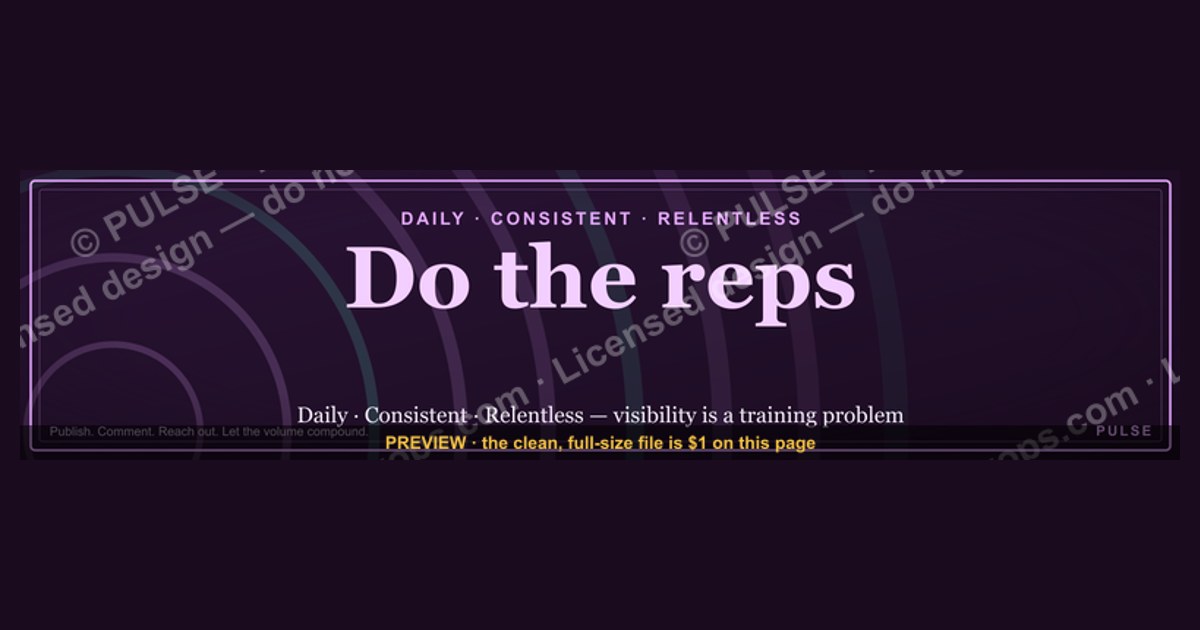
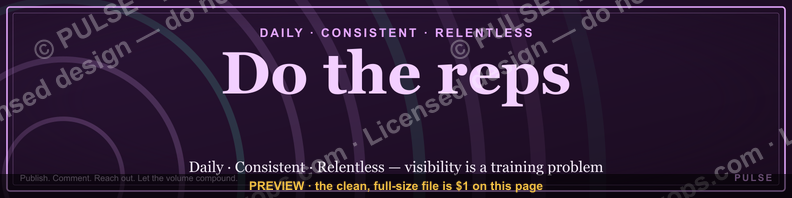
"Do the reps." on a LinkedIn banner is a four-word discipline statement: results on the platform come from repeated, deliberate actions, not from one viral post or a polished headline. Borrowed from athletic and gym culture, "reps" reframes professional visibility as a training problem — show up daily, run the fundamentals (publish, comment, reach out), and let the volume compound. As a profile graphic it does two jobs at once: it tells visitors what kind of operator you are (consistent, process-driven), and it reminds *you* of the same thing every time you log in. The phrase is intentionally open-ended, so a recruiter, a founder, and a creator each read it as a nudge to keep going at their own craft.
“Do the reps.” — LinkedIn Banner

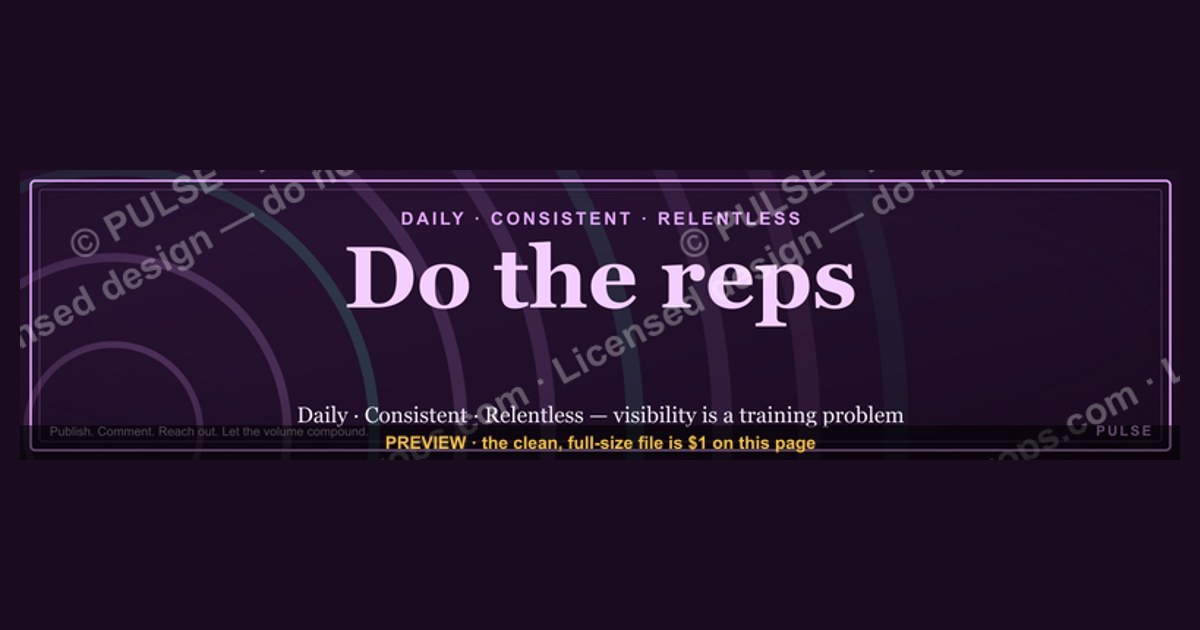
A dark, on-brand LinkedIn banner — "Do the reps." over a "Daily · Consistent · Relentless" line with a pulse motif. Put it on your profile to signal exactly what you do.
Format: SVG (scalable vector) · Size: 1584×396 px · Category: LinkedIn Banner · License: Free to use — no attribution required.
Recolor it to your brand
Use the color picker above to recolor this banner to your team or company colors, switch the background (including transparent), then download it as an SVG or PNG. No sign-up, no watermark.
How to use it
It scales cleanly to the LinkedIn cover slot (1584×396) — download the PNG and drop it straight onto your profile, or open the SVG in Canva, PowerPoint, or Figma to add your name and tweak the layout.
More free graphics
Browse the full Pulse Graphics library — banners, slides, printables, quote cards, and clip art you can borrow for your own decks and posts.
Related on PULSE
- “DO THE REPS” — Sales Floor Print
- Small reps, big results. — LinkedIn Wallpaper
- Better reps, every week. — LinkedIn Wallpaper
- Ready reps win. — LinkedIn Wallpaper
- Do the reps. — LinkedIn Wallpaper
- “Great reps wanted.” — LinkedIn Banner
Why “Do the reps.” works for personal branding
The phrase sounds like gym slang or a sales coach's mantra, but its pull comes from one idea: consistency compounds. On LinkedIn — where almost everyone is selling expertise, a service, or a personal brand — a banner like this signals a mindset shift away from "hacks" and toward habits. Sporadic viral posts rarely build lasting authority; smaller, regular actions do. Commenting on a few industry posts, sending a handful of personalized connection requests, publishing one genuine insight a week — those stack up over months into a track record people remember.
Part of what makes the banner effective is that it doesn't over-explain itself, which leaves room for interpretation. A recruiter reads "keep applying, keep networking." A founder reads "keep pitching, keep iterating." A creator reads "keep making, keep posting." That openness invites people in rather than pitching at them. And in high-rejection fields — sales, consulting, early-stage startups — the phrase quietly normalizes the grind: *I've been where you are, and I'm still showing up.* That relatability tends to build trust faster than a long list of credentials.
There's a useful psychological anchor at work, too. "Reps" borrows from fitness, where progress comes from volume and consistency rather than occasional intensity spikes. That framing helps you reframe your own work: instead of chasing one big deal or a single viral moment, you focus on the daily, repeatable actions that add up. Because the banner sits at the top of your own profile, it doubles as a private reminder every time you log in — a nudge to keep going even when the feed feels quiet.
How to design your own “Do the reps.” banner
If you want to build a similar banner, the design choices matter as much as the words. The original leans on a dark background with high-contrast, bold typography — a deliberate choice, because most LinkedIn banners are light or gradient, so a dark one tends to stand out in the feed and stays readable on mobile, where a large share of LinkedIn browsing happens. A few practical guidelines:
- Keep the palette tight. Two or three colors at most. The original is dark grey/black with white text. If you add a brand color, use it as a small accent — an underline or a single shape — not a busy pattern.
- Pick a bold, clean font. Sans-serif faces like Montserrat, Inter, or Helvetica Neue read well at small sizes. Skip script and decorative fonts; they get hard to read and can look unprofessional.
- Keep the text short. Roughly three to five words is the sweet spot before the layout feels crowded. "Do the reps." is already ideal. If you add a subtitle, keep it brief — something like "Consistency > intensity."
- Use negative space. You don't need to fill every pixel. The power of the original is its simplicity: centered text with plenty of breathing room reads as intentional, not cluttered.
- Test on a phone. Upload it, then view your profile on mobile. LinkedIn banners are 1584 × 396 pixels, but your profile photo and the edges get cropped on smaller screens — keep the important text toward the center so nothing critical gets cut off.
A clean banner doesn't just look good; it signals clarity. It tells a visitor, "I know what I stand for, and I don't need to over-explain it." On a platform crowded with noise, that confidence is rare enough to be memorable.
The quiet ROI of a minimalist banner
Most people treat their banner as an afterthought — a generic cityscape, a company logo, a stock handshake. A statement banner does a little more work than that:
It pre-qualifies your audience. Visitors scan the top of your profile in a second or two. If the message lands, they're likelier to read your headline and summary; if it doesn't, they scroll on. You *want* the people who value consistency and discipline to stay. A generic banner attracts everyone and resonates with no one.
It reduces friction in outreach. If your profile says "Do the reps." and your connection note says "I've been putting in the reps on outbound — would love to compare notes," the message feels congruent rather than random. Visual and verbal cues that point the same direction read as a peer-to-peer conversation, not a cold pitch.
It creates a memorable hook. People recall a strong visual paired with a strong phrase far better than either alone. That matters later, when someone is deciding who to refer, hire, or partner with — you want to be the profile that stays top of mind.
Your LinkedIn profile is often the first digital impression someone forms of you. Thirty minutes spent on a deliberate banner can be the difference between "who is this?" and "I should talk to this person."
How to apply the mindset beyond the banner
A banner is only a promise until your activity backs it up. Turn "do the reps" into a simple weekly cadence: Monday, share a lesson learned; Wednesday, engage genuinely with your network's content; Friday, reach out to one new person in your field. Track it somewhere lightweight — a spreadsheet or a habit app — and aim for consistency over perfection. Over a quarter, that repetition becomes a visible record of engagement, and the banner stops being a slogan and starts being an accurate description of how you actually work.
Why It Works on LinkedIn Specifically
LinkedIn’s algorithm rewards frequency over perfection — a single well-written post might reach 500 people, but 20 posts over a month can reach 5,000+. “Do the reps.” signals you understand this mechanic and are playing the long game. The banner acts as a subtle filter: it attracts peers who value consistency and repels those looking for shortcuts. For recruiters, it suggests a candidate who will show up daily rather than burn out after a sprint.
How to Pair the Banner With Your Activity
To make the phrase credible, back it with visible reps. Post 3–4 times weekly, comment thoughtfully on 5–10 posts per day, and send 5–10 connection messages weekly. The banner becomes a promise your profile keeps. Without the activity, it reads as empty branding. With it, every visitor sees proof of the principle in your recent posts and engagement history — the banner and your feed become a single argument.
Variations for Different Contexts
The phrase adapts well to specific niches. A sales professional might use “Do the calls.” A writer could use “Do the drafts.” A founder might prefer “Do the outreach.” Each variation keeps the core discipline message while narrowing the focus to the highest-leverage action in that role. The original “Do the reps.” remains the most versatile — it works across industries because every role has its own set of fundamental actions worth repeating.
Why "Do the reps." Works Better Than a Tagline
Most LinkedIn banners waste space with generic career buzzwords ("Innovative Leader," "Results-Driven"). "Do the reps." sidesteps that entirely — it's a call to action, not a self-description. This matters because LinkedIn's algorithm rewards activity patterns, not credentials. A banner that reads like a command (to yourself and your audience) signals you understand the platform's mechanics: visibility is earned through frequency, not brilliance. It also creates curiosity — people who pause to decode the phrase are more likely to click your profile.
Pairing the Banner With Your Actual Reps
A banner alone won't build authority. To make "Do the reps." credible, align your profile activity with the message:
- Post 3–4 times per week on a consistent topic (industry insight, lesson learned, client win).
- Comment on 5–10 posts daily in your niche — add value, not just emojis.
- Send 2–3 thoughtful DMs per day to new connections or existing ones you haven't talked to recently.
The banner acts as a visual anchor for this habit loop. When you see it, it's a trigger: *time to do the work.*
When It Might Not Fit
This banner works best for individual contributors, founders, and operators who want to be seen as gritty and hands-on. It may feel out of place if your brand is polished corporate consulting, luxury services, or highly regulated industries (finance, law, healthcare) where "reps" sounds too informal. In those cases, a softer variation — "Consistency compounds" or "Show up daily" — preserves the discipline message without the gym slang.
Sources
- LinkedIn Help Center — official guidance on profile optimization, background/banner image dimensions, and account settings.
- LinkedIn Official Blog — product updates and platform best practices direct from LinkedIn.
- Harvard Business Review — articles on professional branding, networking, and career development.
- Forbes — coverage of LinkedIn strategy, personal branding, and social media practices.
- The Muse — career advice, including LinkedIn profile and job-search tactics.
- Social Media Examiner — guidance on LinkedIn marketing, content strategy, and engagement.
FAQ
What does "do the reps" mean in a sales context? It's a reminder that consistent, repeated effort — prospecting calls, demos, follow-ups — is the most reliable path to hitting a number. Just as an athlete drills the same movement until it's automatic, salespeople execute the fundamentals daily. No clever shortcut replaces volume and discipline over time.
Is this banner only for sales professionals? No. It applies to anyone building a skill or a business — founders, marketers, recruiters, even engineers. The underlying principle is universal: mastery comes from repetition, not one heroic effort. It resonates most strongly with revenue teams, but the message travels across roles.
How often should I change my LinkedIn banner? There's no fixed rule. Many people update it when their focus shifts — a new role, a new campaign — which can be every few months. A timeless mantra like "do the reps" can stay in place longer. Avoid swapping it weekly; constant changes dilute recognition rather than building it.
Will this banner help me get more leads or job offers? On its own, no. A banner can start conversations and help the right person remember you, but it won't replace a strong headline, a clear summary, and real outreach. Treat it as one congruent piece of a profile — a hook, not a lead engine. Set expectations for modest impact, not a flood of inbound.
Can I customize the "do the reps" design for my own brand? Yes — adapt the colors and add your name, but keep the core message and the minimal style intact. The original works because it's dark, high-contrast, and uncluttered. If you swap in a busy background, a decorative font, or too much text, you lose the visual punch that makes it land.
Does this banner work on platforms besides LinkedIn? It can, but LinkedIn is its natural home because of the professional audience and the wide banner slot. On more casual feeds like X or Instagram, the same phrase can get lost. If you repurpose it, redesign for that platform's dimensions and tone, and see whether it still reads as intentional rather than out of place.
This page will be disappearing soon. Save it to your device for $1 — or read it free while it is here.
@Kory-White- · if Venmo asks, the last 4 of my number are 2012
This page is gone.
This one is off the shelf now. $1 keeps it on your phone for good — the whole page, pictures and diagrams included.
 graphicSpeed to lead wins. — LinkedIn Wallpaper
 graphicHow do you build a Champions sell motion from scratch in 2027?
 graphic“A confused buyer never buys.” — LinkedIn Banner
 graphicSales Recruiter — LinkedIn Banner
 graphic“Revenue that delights.” — LinkedIn Banner
 graphicVector Database CTO — LinkedIn Banner
 graphicCommercial Director — LinkedIn Banner
 graphicStay in the deal. — LinkedIn Wallpaper
 graphic“Looking for my next quota.” — LinkedIn Banner
 graphic“Hire slow. Ramp fast.” — LinkedIn Banner