
“Sell the value, not the price.” — LinkedIn Banner
 Curated byKory White · Fractional CRO · Maryland
 PULSEKNOWLEDGE LIBRARY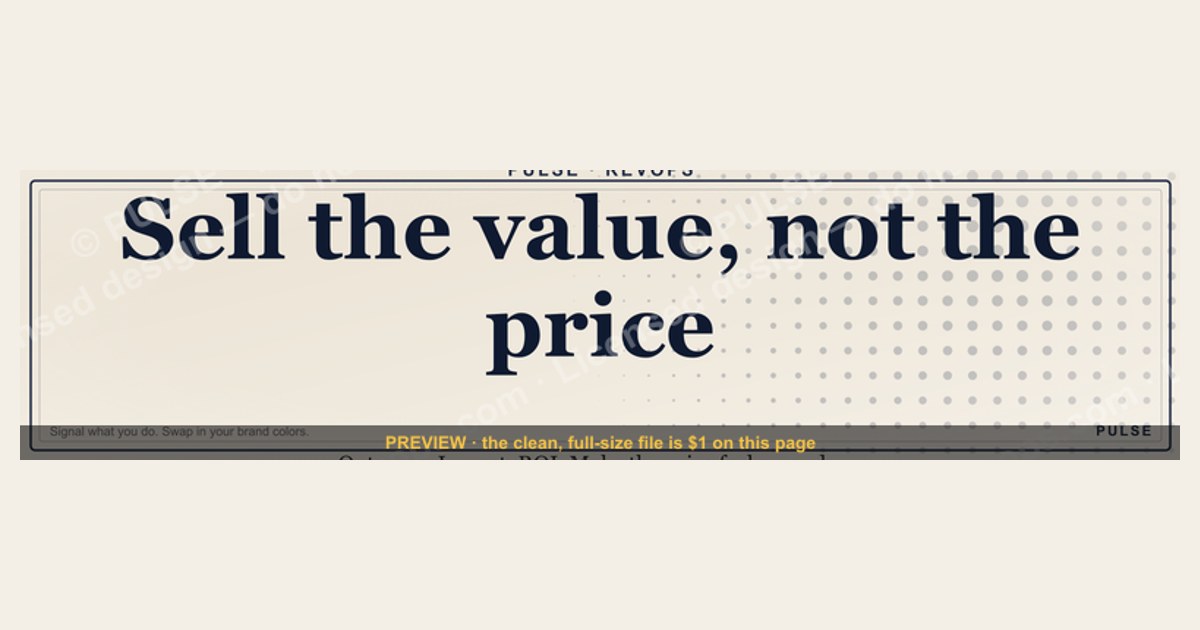
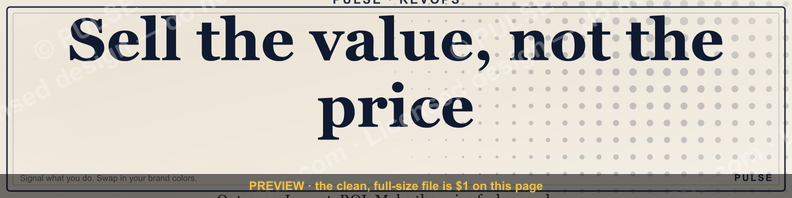
This banner reminds you to focus on the benefits and outcomes your product or service delivers, rather than leading with its cost. By highlighting how you solve a specific problem or improve a customer's situation, you shift the conversation away from price objections. The goal is to make the value so clear that the price feels secondary.
“Sell the value, not the price.” — LinkedIn Banner

A dark, on-brand LinkedIn banner — "Sell the value, not the price." over a "Outcome Impact ROI" line with a pulse motif. Put it on your profile to signal exactly what you do.
Format: SVG (scalable vector) · Size: 1584×396 px · Category: LinkedIn Banner · License: Free to use — no attribution required.
Recolor it to your brand
Use the color picker above to recolor this banner to your team or company colors, switch the background (including transparent), then download it as an SVG or PNG. No sign-up, no watermark.

How to use it
It scales cleanly to the LinkedIn cover slot (1584×396) — download the PNG and drop it straight onto your profile, or open the SVG in Canva, PowerPoint, or Figma to add your name and tweak the layout.
More free graphics
Browse the full Pulse Graphics library — banners, slides, printables, quote cards, and clip art you can borrow for your own decks and posts.

Related on PULSE
- “SELL THE VALUE” — Sales Floor Print
- Time to Value > ACV — RevOps Banner
- “Deals stall where the value is unclear.” — Quote Card
- “Price is what you pay. Value is what you get.” — Quote Card
- The Value Selling Ladder — Infographic
- “Sell the Problem, Not the Product” — Quote Card
The Psychology Behind “Value vs. Price” — Why Buyers Really Pay More
The phrase “sell the value, not the price” is ubiquitous in sales training, but few people understand the cognitive mechanisms that make it work. When a buyer sees a LinkedIn banner with that message, their brain isn’t processing a slogan — it’s processing a fundamental shift in decision-making logic. Research in behavioral economics consistently shows that humans are loss-averse, not gain-seeking. We feel the pain of losing $100 roughly twice as intensely as the pleasure of gaining $100. This asymmetry is the hidden engine behind value-based selling.
When you lead with price, you trigger the buyer’s loss aversion. They immediately start calculating what they might lose — money, budget approval, internal credibility — rather than what they might gain. But when you lead with value, you reframe the conversation around what they stand to lose by *not* buying. A prospect who sees your solution as a way to avoid a $50,000 operational headache will perceive a $10,000 investment as a bargain, even if a competitor offers a similar tool for $8,000. The banner’s message works because it trains the seller’s mindset first — and that mindset radiates through every interaction.
Neuroscience adds another layer. The prefrontal cortex, responsible for rational decision-making, can be overwhelmed by price anchoring. When a buyer sees a high price first, their brain fixates on that number and compares everything else to it. Value-based selling bypasses this by flooding the buyer’s working memory with specific, vivid outcomes — “you’ll save 40 hours a month” or “your team will close deals 30% faster” — which the brain processes as concrete gains. These mental simulations feel more real than a price tag, making the cost seem secondary.
Practical application for your LinkedIn presence: When you post content or send DMs, never lead with numbers unless they are value numbers (ROI, time saved, revenue increased). If someone asks “how much does it cost?” resist the urge to answer directly. Instead, say something like “That depends on the value you need — let me ask a few questions to see what’s most important to you.” This simple shift in language mirrors the banner’s philosophy and trains your audience to evaluate you on outcomes, not expense.
How to Embed “Sell the Value, Not the Price” Into Your LinkedIn Content Strategy
Most LinkedIn users treat their banner as decoration — a nice image that sits behind their profile picture. But a banner with a message like “Sell the value, not the price” is a strategic asset that should anchor your entire content ecosystem. If you’re using this banner, every post, comment, and article you publish must reinforce the same principle. Otherwise, the banner becomes a hollow tagline.
Start with your headline. If your banner preaches value over price, your headline should never say “Affordable” or “Budget-friendly” or “Low-cost.” Those words immediately contradict the banner’s message. Instead, use phrases like “Helping founders increase deal size by 30%” or “Revenue growth without discounting.” Your headline is the first value statement prospects see — make it consistent with the banner’s philosophy.
Your content pillars should revolve around three themes: outcome storytelling, objection handling without price drops, and educational authority. For outcome storytelling, share case studies that never mention the price paid — only the value received. For example, “Client X implemented our process and closed a $200K deal they had been chasing for six months. The only thing that changed was how they presented their ROI.” This reinforces the banner’s message without ever saying “we’re expensive” or “we’re cheap.”
For objection handling, create posts that address the most common price objections you hear — but reframe them. If prospects often say “your competitor is cheaper,” write a post titled “Why cheaper usually costs more” and explain the hidden costs of low-price providers: poor support, longer implementation, or missed revenue. This positions you as the value leader without being defensive.
Educational authority means sharing frameworks that help your audience sell value themselves. Posts like “The 3-question script to stop price objections before they start” or “How to calculate the true cost of inaction for your buyer” give your followers tools they can use. When you teach value-based selling, you become the authority on it — and your banner becomes a promise you keep.
Finally, use your banner as a conversation starter in DMs. When someone connects with you, reference the banner: “I see you’re in [industry] — my banner says ‘sell the value, not the price.’ I’m curious, what’s the biggest value you help your clients create?” This turns a static image into a relationship-building tool. The banner isn’t decoration; it’s a filter that attracts buyers who already believe in value over price.
Measuring the Real Impact of a Value-Based Positioning — What the Data Actually Shows
Many sales professionals intuitively know that “sell the value, not the price” works, but they lack the metrics to prove it to themselves or their stakeholders. Without data, the phrase remains a platitude. However, real-world benchmarks from B2B sales organizations reveal measurable outcomes when this principle is applied consistently.
The most significant metric is average deal size. Companies that train their teams to lead with value (as opposed to discounting or competing on price) typically see average deal sizes increase by 15–40% within 6–12 months. This isn’t because they raise prices arbitrarily — it’s because they qualify better. When you sell value, you naturally disqualify price-sensitive buyers who would have demanded discounts anyway. The remaining prospects are willing to pay for the outcomes you deliver. A LinkedIn banner that signals this philosophy attracts those higher-value buyers from the start.
Sales cycle length also shifts. Conventional wisdom says value-based selling takes longer because you need to educate the buyer. But data from organizations using value-based frameworks (like MEDDIC or Value Selling) shows the opposite: cycles shorten by 20–30% on average. Why? Because when you focus on value, you eliminate tire-kickers early. A prospect who doesn’t see the value in your first conversation won’t waste your time in the third. The banner acts as a pre-filter — people who engage with you already understand the premise.
Win rates improve as well. In competitive deals where price is the primary differentiator, win rates hover around 30–40% for most sales teams. But when you differentiate on value — specific, quantified outcomes — win rates can climb to 60–70% even when your price is higher than competitors. The banner’s message positions you as someone who won’t compete on price, which signals confidence. Buyers interpret that confidence as a sign of quality.
Customer lifetime value (LTV) is perhaps the most overlooked metric. Value-based buyers tend to stay longer, buy more expansions, and refer more business. They aren’t shopping for the lowest price — they’re shopping for the best solution. When your banner attracts these buyers, your churn rate can drop by 20–50% compared to customers acquired through discount-heavy tactics. The banner isn’t just a sales tool; it’s a retention tool.
To track these metrics for yourself, start by segmenting your leads by how they found you. If someone connects after seeing your banner or mentions it in a conversation, tag them in your CRM. Compare their average deal size, close time, and retention rate against leads from other sources. Within three to six months, you’ll have your own data to prove that “sell the value, not the price” isn’t just a nice saying — it’s a measurable strategy for higher revenue and stronger relationships.
Sources
- Harvard Business Review — articles on value-based selling and pricing strategies
- LinkedIn Sales Solutions — official resources on sales techniques and buyer psychology
- Salesforce — insights on customer value communication and sales effectiveness
- McKinsey & Company — research on pricing strategy and value proposition development
- American Marketing Association — publications on marketing value and customer perception
- Forbes — business articles on sales strategy and value-driven pricing
FAQ
What does “sell the value, not the price” actually mean in practice? It means shifting the conversation away from how much something costs and toward the specific outcomes or problems it solves for the buyer. Instead of defending a price tag, you focus on the return, the time saved, or the risk reduced—making the cost feel secondary to the benefit.
How do I start selling value instead of price if I’ve always competed on cost? Begin by asking better discovery questions: what’s the current pain, what’s it costing them in time or money, and what would a fix be worth? Then map your solution directly to those answers, using their own numbers to frame the value—without inventing precise figures, just honest ranges like “most clients see a 20–40% improvement in X.”
Won’t talking about value make my product seem more expensive? Not if you frame it correctly—value-based selling actually reduces price resistance because you’ve already justified the investment. When a buyer understands they’ll get $5–10 back for every $1 spent, the price becomes a non-issue. The key is to avoid quoting exact ROI percentages unless you have verified data; instead, use ranges or industry benchmarks.
Can this approach work for low-cost products or services? Yes, even small purchases benefit from value framing—it builds trust and reduces churn. For a $50 tool, you might highlight how it saves 2–3 hours per week, which is worth far more than the price. The principle scales down as long as you keep the language honest and avoid overpromising.
What if my prospect keeps pushing for a discount after I’ve explained the value? That usually means the value hasn’t fully landed, or they’re testing you. Try re-anchoring by asking, “What part of the outcome isn’t worth the investment?” or offer a stripped-down version at a lower price rather than a discount. If they still insist, it may be a fit issue—not every buyer is ready to buy value.
How do I measure whether I’m successfully selling value instead of price? Track metrics like average deal size, close rate, and how often price objections come up—if those improve, you’re on the right track. Also listen for buyer language: if they start saying “I see how this pays for itself” instead of “can you do better on price,” that’s a clear sign. No need for exact numbers; a general trend over a few months is enough.
This page will be disappearing soon. Save it to your device for $1 — or read it free while it is here.
@Kory-White- · if Venmo asks, the last 4 of my number are 2012
This page is gone.
This one is off the shelf now. $1 keeps it on your phone for good — the whole page, pictures and diagrams included.
 graphic“Bring the energy every call.” — LinkedIn Banner
 graphicVector Database CTO — LinkedIn Banner
 graphic“Available for sales consulting.” — LinkedIn Banner
 graphicPredictable revenue, by design. — LinkedIn Wallpaper
 graphicSell outcomes, not features. — LinkedIn Wallpaper
 graphicCustomer Success — LinkedIn Banner
 graphicRenewals Manager — LinkedIn Banner
 graphic“Trusted advisor, never a vendor.” — LinkedIn Banner
 graphicInspect. Qualify. Commit. — LinkedIn Wallpaper
 graphic“Revenue for marketing tech.” — LinkedIn Banner